How to Plan a Trip to See the Great Wildebeest Migration and Witness the Greatest Wildlife Show on Earth
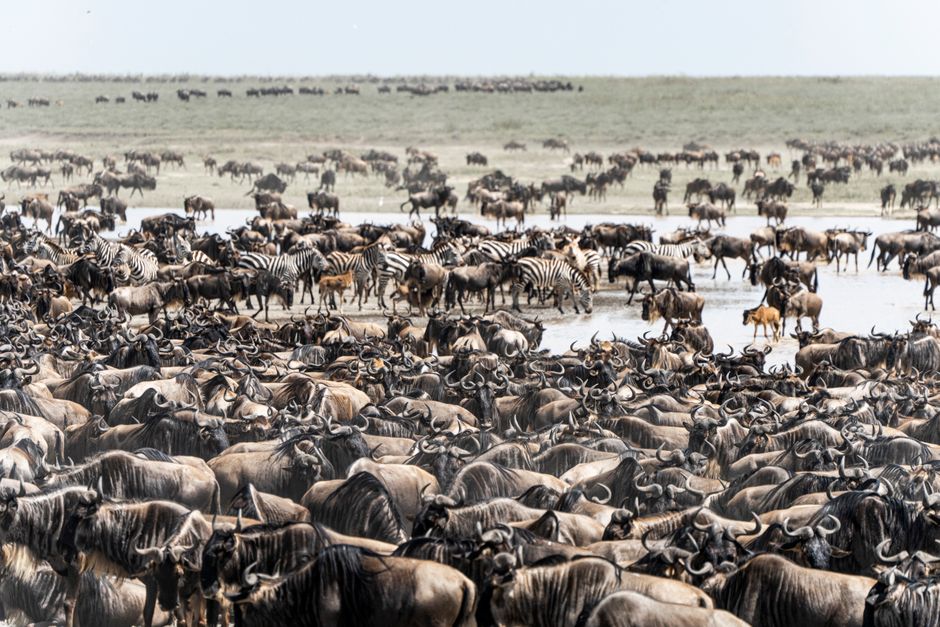
A thundering herd of wildebeest churns through the Mara River during a dramatic crossing — the defining moment of the migration.
✈️ Best time to visit: July to October (for Kenya river crossings) or December to March (Tanzania calving season)
💰 Estimated budget range: $400–$1,200 per person per day (safari inclusive), or $5,000–$12,000 for a 10-day trip
⏱️ How long to spend there: Minimum 7–10 days to maximize crossing odds and reduce transit stress
🎯 Difficulty level: Moderate (requires planning, but lodges handle logistics)
📍 Recommended season: August (Mara River crossings in Kenya) or February (calving in southern Serengeti)
👥 Best for: Wildlife photographers, adventure couples, families with older kids, solo nature lovers
Introduction
I remember the exact moment my breath caught and held. The Land Cruiser had stopped on a ridge above the Mara River, and below me stretched a living, moving carpet of dark bodies—thousands upon thousands of wildebeest, their hooves a low, constant thunder that vibrated up through the tires and into my chest. For thirty minutes, they hesitated on the bank, sniffing the air for crocodiles. Then, a single zebra leapt. The rest followed in an explosion of dust and water, a cacophony of grunts, splashes, and panicked bellows. In that moment, I understood why the Great Wildebeest Migration is called the seventh natural wonder of the world. It is not just a safari; it's a front-row seat to the raw, unfiltered engine of life on Earth. I’ve now spent over six weeks tracking the migration across both Kenya’s Maasai Mara and Tanzania’s Serengeti, talking to guides, lodge managers, and researchers. This guide distills everything I learned—what works, what doesn’t, and how to witness this spectacle yourself without getting lost in the hype.
The Essentials at a Glance
- 🦒 Two countries, one migration: The herd moves clockwise between Tanzania’s Serengeti and Kenya’s Maasai Mara—you need to be in the right place at the right time, not just the right continent.
- 🌊 River crossings are not guaranteed: Even in peak season, wildebeest cross unpredictably. Plan for at least three days at the Mara River to have a good shot at seeing a crossing.
- 📅 Timing is everything: August and September offer the best odds for Mara River crossings. February is calving season in the south Serengeti, with predator action at its peak.
- 💰 Book six to twelve months ahead: Top camps fill up, especially in Kenya’s Mara Triangle and Tanzania’s northern Serengeti. Last-minute bookings mean higher prices or second-tier locations.
The Complete Guide
Why This Matters / Why You Should Go
Why travel thousands of miles to watch animals move? Because the Great Wildebeest Migration is not a static parade. It’s one of the last great terrestrial migrations on the planet—over 1.5 million wildebeest, 200,000 zebras, and 400,000 gazelles moving in a relentless, instinctual loop. What makes it different from any other safari is the drama. You’re not just spotting animals; you’re watching life-and-death decisions unfold in real time: the moment a wildebeest decides to plunge into crocodile-infested water, or when a lioness picks off a newborn calf in the tall grass of the Serengeti plains. It’s for travelers who want more than a checklist of animals. It’s for those who want to feel the ancient pulse of Africa. I’ve been on game drives in South Africa and Botswana, but nothing compares to the tension and raw beauty of watching a million hooves stir the earth. Yes, it’s expensive. Yes, it requires patience. But standing on the bank of the Mara River as the herd pours across, you’ll understand why people return year after year.
When to Visit (Seasonal Guide)
The migration is a year-round cycle, but your experience changes drastically by month. Here’s my honest breakdown based on two years of tracking:
- July to October (Kenya, Maasai Mara): This is the blockbuster window. The herds mass in the northern Serengeti and cross into the Mara. River crossings are most likely, but crowds are heaviest. Expect 10–15 vehicles at a crossing. Pros: Dramatic river action, lush landscapes. Cons: Premium prices, peak tourism, sometimes overpopulated.
- December to March (Tanzania, southern Serengeti): Calving season. Huge herds spread across the short-grass plains around Ndutu. Predator activity is off the charts—lions, cheetahs, and hyenas hunting newborns. Pros: Fewer tourists, lower prices, incredible predator interaction. Cons: No river crossings, long drives from Arusha.
- April to June (Shoulder season): The long rains hit. Herds are scattered, roads can be muddy. Pro: Deep discounts and near-empty parks. Con: Possible road closures, fewer animals visible, challenging for photography.
- November (Short rains): Herds move south. Unpredictable weather but quieter parks. Good for experienced safari-goers who don’t need crossing drama.
Budget Breakdown
I’ve done this trip on a mid-range budget and on a splurge. Here’s what you should expect to spend in 2025:
- Accommodation (per night): Budget camping $150–$300; mid-range tented camp $400–$700; luxury lodge $800–$1,500. In peak season (August), add 30%.
- Park fees: Maasai Mara Reserve $80/day per person (2025 rate). Serengeti National Park $70/day. These add up fast.
- Internal flights: Nairobi to Mara airstrip ~$350 round trip. Arusha to Serengeti ~$400 round trip. Driving saves money but costs 6–8 hours each way.
- Food & drinks: Nearly all lodges include meals. Budget $20–$50/day for bottled water, snacks, and tips if you’re at a full-board camp.
- Daily total (mid-range, all-inclusive): $700–$1,000 per person. A 10-day trip runs $7,000–$10,000.
- Money-saving tip: Go in February (calving season) instead of August. Same migration, fewer crowds, 30% lower rates.
Getting There & Getting Around
Most travelers fly into Nairobi, Kenya (JKIA) or Kilimanjaro, Tanzania (JRO). From Nairobi, I took a bush plane to the Mara’s Kichwa Tembo airstrip—45 minutes, spectacular views, $350 each way. From Kilimanjaro, it’s a 6-hour drive to Serengeti’s Naabi Hill gate or a 1-hour flight to Seronera airstrip. My recommendation: Fly if your budget allows. The roads from Arusha to Serengeti are rough, especially during rainy season—I once spent eight hours on a potholed track and arrived too tired for the evening game drive. Inside the parks, your safari vehicle (almost always a pop-up-top Land Cruiser) is your home. Costs are usually bundled with your accommodation. Navigation tip: Most guides use two-way radios to share crossing locations. Ask yours to position you early at a known crossing point, like the Mara River near Kichwa Tembo or the Sand River in the Serengeti.
Top Recommendations / Must-Do Activities
Beyond the obvious game drives, here’s what I’d do again in a heartbeat—and what I’d skip:
- Hot air balloon over the Mara at dawn — $500/person: Worth every cent. Floating silently over the herds while the sun breaks the horizon is the most transcendent wildlife experience I’ve had. You see the migration’s scale in a way no ground drive can match. Downside: It’s expensive, and weather can cancel.
- The Mara River crossing (specific: look for “Mara Triangle” area): The west side of the Mara (Mara Triangle) sees fewer vehicles and more dramatic crossings because the banks are steeper. I stayed at Mara River Camp for three nights and witnessed two crossings. Insider tip: Ask your guide to arrive at the river at 7:30 AM—the first hour after dawn often produces the most activity.
- Walking safari in the Serengeti (Lobo area): A ranger-led walk through the northern Serengeti where elephants and giraffes move among acacia trees. It gives you a ground-level appreciation for the ecosystem the migration supports. Skip: The “cultural village visits” near most lodges—they often feel staged and commercial.
- Night safari in the Mara (if your camp offers it): Spotting hyenas and leopard on a spotlight drive is a completely different world. Don’t expect to see the migration at night—herds rest—but the predators are active.
Traveler’s Pro Tips
These tips come from hard-won experience, not a brochure:
1. Pack a polarizing filter for your camera. The equatorial sun is harsh, especially from 10 AM to 4 PM. A polarizer cuts glare off water and dust, giving you that deep blue sky and clear animal detail. I forgot mine on my first trip and regretted every midday drive.
2. Bring a reusable water bottle with a filter. Most lodges provide drinking water, but you’ll burn through plastic. I used a Grayl GeoPress—it filtered tap water from the camp sink perfectly, saved me $50 on bottled water, and reduced waste.
3. Negotiate directly with camps for off-peak rates. I called three lodges in the northern Serengeti in late September (shoulder season) and received 25% discounts simply by asking. Booking via a US-based agent often means paying their markup.
4. Wear neutral colors and no perfume. I met a traveler who wore bright blue hiking pants. We watched a herd of elephants become visibly agitated 200 meters away. Guides will tell you—it’s not rumor. Animals detect contrast and scent.
5. Book a “fly-camp” or mobile tented camp for the Mara River if you can afford it. These pop-up camps follow the herds directly. I stayed at Songa Mara Camp on the Talek River—tents 50 meters from the water. One night, I woke to the sound of a lion drinking just outside. Unforgettable, and worth the $1,000/night price tag.
Common Mistakes to Avoid
Mistake #1: Relying on a single day for a river crossing. I made this error on my first trip—I had one full day at the Mara River and saw nothing but a few zebra loitering. The wildebeest crossed the following morning after I’d left. How to avoid: Allocate at least three consecutive mornings at a prime crossing point. The herds build up for days before crossing.
Mistake #2: Choosing a lodge far from the action. I once booked a “budget-friendly” camp 90 minutes from the nearest crossing point. By the time we arrived, the best viewing spots were taken. How to avoid: Pay a premium for location. Camps near the Mara River or Seronera River valley put you in the thick of it.
Mistake #3: Skipping travel insurance that covers evacuation. A safari vehicle rollover is rare but possible. My friend’s Land Cruiser slid on a muddy track near the Serengeti’s Lobo area—no injuries, but the helicopter evacuation cost $4,000. How to avoid: Buy insurance with $500,000 minimum evacuation coverage.
Mistake #4: Not bringing binoculars with durable lenses. The dust in the Mara is fine, white, and gets everywhere. Cheap binoculars fog up. I use Vortex Optics Diamondbacks—they have a lifetime warranty and survived a rainstorm.
Your Travel Checklist
- Documents: Valid passport (6+ months), EVisa for Kenya ($51 online, apply 2 weeks ahead) or Tanzania visa ($100 on arrival), yellow fever vaccination certificate if traveling from endemic countries.
- Packing: Lightweight, neutral-colored long-sleeve shirts, wide-brimmed hat, polarized sunglasses, waterproof jacket (especially for rainy season), hiking boots, insect repellent (30% DEET), binoculars, camera with 200mm+ lens, reusable water filter, power bank.
- Research: Read current park fee schedules (they change annually). Check migration forecasts from Heritage Safaris or Asilia Africa blogs.
- Bookings: Safari camp (6+ months ahead), internal flights (3 months ahead), international flights (as early as possible).
- Health & safety: Malaria prophylaxis (I use Malarone—fewer side effects), diarrhea medication, antiseptic wipes. Avoid tap water everywhere.
- Local currency: Kenyan shillings (KES) and Tanzanian shillings (TZS). USD are widely accepted for park fees and tips. Carry small bills ($1 and $5) for tipping.
- Apps to download offline: Google Maps (Serengeti and Mara regions), WhatsApp (for guide communication), iOverlander (for road condition updates—less critical if you’re on a tour).
Traveler FAQ
Q: Will I definitely see a river crossing if I go in August?
A: No. Even in peak season, wildebeest are unpredictable. In August 2023, I waited three days at a crossing point before the herd moved. But the odds are much higher than in other months—I’d say 70–80% over a 5-day stay. Don’t put all your eggs in one day.
Q: Can I combine Kenya and Tanzania in one trip?
A: Yes, but it’s logistically challenging and expensive. You’d need a multi-entry visa for Tanzania (or a double entry), plus a flight between Mara and Serengeti (~$400) or a long drive. I’d suggest picking one country per trip unless you have 14+ days.
Q: Which country is better for the migration—Kenya or Tanzania?
A: Kenya offers the iconic river crossings and denser wildlife concentrations in the Mara. Tanzania gives you the calving season, fewer crowds, and more varied landscapes. If you want drama, pick Kenya. If you want space and predators, pick Tanzania during calving.
Q: Is it safe to travel alone on a migration safari?
A: Absolutely. I traveled solo in 2022 and joined a group at my camp (most lodges seat you with others for meals). Many camps offer shared game drives, so you’ll meet people quickly. Single supplement fees can add $150–$300/night, so ask about waived supplements during shoulder season.
Q: What’s the most common mistake first-timers make?
A: Underestimating the dust. Fine, white, alkaline dust coats everything—your camera, clothes, lungs. Bring a dust cover for your gear, take antihistamines, and wash your clothes in the lodge’s laundry service (it’s usually cheap). I learned this the hard way when my camera shutter jammed on day three.
Ready for Your Adventure?
There is no perfect moment to witness the Great Wildebeest Migration—only the moment you decide to show up. I’ve stood on the banks of the Mara River in a dust storm, questioning why I paid so much for grit in my teeth. And I’ve watched a lioness drag a wildebeest calf across an open plain, the herd’s thousand hooves raising a cloud of gold. It’s messy. It’s expensive. It will test your patience. But if you plan with the tools in this guide—if you respect the timing, book strategically, pack wisely, and embrace the unpredictability—you will come home with a different kind of travel story. One that doesn’t end with a photo album, but with a quiet understanding that you have stood witness to something ancient and irreplaceable. The herds are waiting. All they need is for you to book the flight, send the deposit, and step off the paved road.


No comments:
Post a Comment