Front Brake Dominance: Why the Front Brake Is the Most Powerful on a Motorcycle
Introduction
Every rider, from a cautious beginner to a seasoned track veteran, eventually faces a fundamental question that can mean the difference between a controlled stop and a dangerous situation: which brake on a motorcycle is the most powerful? Understanding this is not just a mechanical curiosity; it is a cornerstone of safe, effective riding. The answer might surprise you, especially if you come from a cycling or automotive background where braking dynamics are different. In this comprehensive article, you will discover exactly which brake provides the greatest stopping force, the physics that make it so, and why mastering this knowledge transforms your control over the machine. We will dive deep into weight transfer, brake balance, and real-world riding scenarios to give you a complete picture. Whether you are looking to improve your emergency stopping technique or simply want to understand your bike better, this article will give you a clear, authoritative answer. By the end, you will not only know which brake is the most powerful, but you will also understand why and how to use that knowledge to ride more confidently and safely. Let’s settle this question once and for all.
The Short Answer
The front brake is the most powerful brake on a motorcycle, providing approximately 70% to 90% of the total stopping power depending on the bike and conditions. This is due to physics: under braking, weight transfer forces the front tire into the pavement, dramatically increasing its grip and traction. The rear brake, while useful for stability and low-speed maneuvers, simply cannot match the front brake's stopping force, especially in a straight-line emergency stop.
The Full Explanation
To truly grasp why the front brake reigns supreme, you must understand the interplay of physics, motorcycle design, and rider input. It all begins with a phenomenon called weight transfer.
The Physics of Weight Transfer
When you apply any brake on a motorcycle, the bike’s momentum wants to continue forward. However, the braking force acts at the contact patches of the tires. This creates a rotational force (torque) that pitches the motorcycle forward. The result is that a significant portion of the bike’s weight—and the rider’s weight—transfers from the rear wheel to the front wheel. In a hard braking scenario, the rear wheel can become so light that it has minimal traction, while the front wheel is pushed down with immense force, sometimes exceeding the static weight of the motorcycle. This increased load directly increases the friction available at the front tire’s contact patch. Friction equals stopping power. The harder you brake, the more weight transfers forward, and the more grip the front tire has. The rear tire, conversely, loses load and grip, which is why locking the rear brake or lifting the rear wheel (a stoppie) becomes possible with extreme front brake application.
Moment of Inertia and Stopping Force
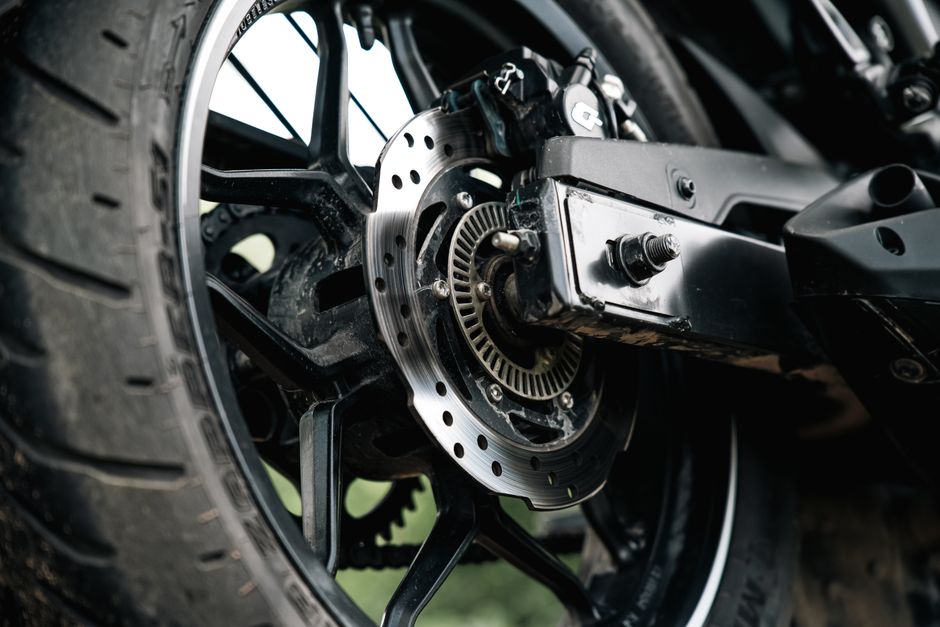
Another factor is the moment of inertia. A motorcycle’s center of mass is located relatively high and between the wheels. Under braking, the front suspension compresses, further lowering the front end and increasing the effective leverage of the front brake. The front brake rotors are also typically larger in diameter than the rear, and they are often equipped with multiple pistons and larger brake pads. This is no coincidence—manufacturers design the front braking system to handle the majority of the workload. A typical sportbike might have twin 320mm front discs with four-piston calipers, while the rear is a single 220mm disc with a two-piston caliper. This design asymmetry alone tells you where the stopping power is meant to come from. In fact, many motorcycles produce enough front brake force to flip the bike end over end if the front brake is applied too aggressively, a testament to its raw power.
Real-World Application: Emergency Stops
In a straight-line emergency stop from highway speeds, the most effective technique is to apply the front brake firmly and progressively while simultaneously using the rear brake lightly to stabilize the chassis. Expert riders and professional racers consistently report that in such scenarios, the front brake provides the overwhelming majority of deceleration. Studies by motorcycle safety organizations, such as the Motorcycle Safety Foundation (MSF), emphasize that riders who underutilize the front brake in emergencies dramatically increase their stopping distance. The average rider can achieve a deceleration rate of around 0.6g to 0.7g using both brakes, while a skilled rider using maximal front brake can exceed 1.0g—that is, decelerating at a rate greater than gravity. This is only possible because the front brake is so powerful.
Key Factors & What You Need to Know
While the front brake is undeniably the most powerful, several factors can influence its effectiveness and how you should approach braking on a motorcycle.
Road Surface and Conditions
The power of the front brake is only as good as the grip available. On dry asphalt, the front tire can generate incredible friction. But on wet roads, gravel, or oil-slicked pavement, the traction limit is much lower. In such conditions, the front brake’s dominance can become a liability if applied too abruptly—it can lock the front wheel, causing a high-side or low-side crash. Riders must modulate front brake pressure based on surface grip. The rear brake becomes relatively more important on low-grip surfaces because it provides a margin of safety and helps stabilize the bike, but even then, the front brake remains the primary stopper if used judiciously.
Motorcycle Type and Geometry
A long, heavy cruiser with a raked-out front fork behaves differently from a short, aggressive sportbike. Cruisers and touring bikes often have more weight bias toward the rear, and their suspension geometry makes weight transfer less dramatic. Even so, the front brake still provides the majority of stopping power—typically around 60-70%—compared to a sportbike where it can be 80-90%. The rear brake on a cruiser can play a more significant role in everyday riding because the front end does not dive as aggressively. However, in a maximum-effort stop, the front brake still dominates. Similarly, a motorcycle equipped with advanced cornering ABS can allow you to brake harder with the front brake while leaned over, but the physics of weight transfer and traction still apply.
Rider Skill and Technique
No matter how powerful the front brake is, it is useless without proper rider input. Many riders fear the front brake, worried they will be thrown over the handlebars. This fear leads them to rely too heavily on the rear brake, which is less effective and increases stopping distance. Progressive braking—gradually increasing pressure on the front lever as weight transfers—is the key to unlocking its full power. A rider who has practiced hard braking will be able to use the front brake near its traction limit without locking the wheel, while simultaneously using the rear brake for chassis control. The human factor is the ultimate variable.
Common Myths & Misconceptions
Myth: The front brake is dangerous and should be avoided
This is perhaps the most dangerous misconception in motorcycling. While it is true that a sudden, full grab of the front brake at low speed or in a turn can cause a crash, the front brake itself is not inherently dangerous. In fact, the majority of motorcycle crashes with a braking component involve riders who failed to use the front brake adequately. The correct solution is not to avoid the front brake, but to learn how to apply it smoothly and progressively. Mastering the front brake is the single most effective way to improve your stopping ability and safety.
Myth: The rear brake is equally as powerful as the front
Some riders, especially those coming from bicycles where both brakes can be effective, assume the same applies to motorcycles. This is false. The rear brake on a motorcycle is mechanically smaller and, more importantly, operates with less available traction due to weight transfer. Under hard braking, the rear wheel can lock easily, offering very little deceleration. The rear brake’s primary roles are for low-speed maneuvers, trail braking into corners, and stabilizing the bike during hard front braking—not for providing the majority of stopping force.
Myth: ABS makes the rear brake more powerful
ABS (Anti-lock Braking System) prevents wheel lock-up, but it does not change the fundamental physics of braking. While ABS allows you to brake harder without locking the rear wheel, the front brake still provides the majority of stopping power. ABS on the front wheel allows you to use its power more effectively without fear of locking, but the rear wheel’s contribution remains limited by weight transfer. ABS is a safety aid, not a game-changer for brake power balance.
Practical Implications / What This Means for You
Understanding that the front brake is the most powerful has immediate, actionable consequences for your riding. First, you must consciously train yourself to use the front brake as your primary stopping tool. That means keeping one or two fingers covering the front brake lever in traffic, ready to apply pressure. Second, you need to practice progressive braking in a safe, empty parking lot. Start at low speeds and gradually increase, feeling the front suspension compress as weight transfers. This builds muscle memory and confidence. Third, adjust your braking technique for different conditions. In the rain, for example, you still rely primarily on the front brake, but with a slower, more deliberate application. Fourth, ensure your front brake system is in top condition—check pad wear, brake fluid condition, and rotor health regularly. A worn front brake is a dangerous failure point. Finally, never neglect the rear brake entirely; it is essential for stability and low-speed control, but remember that it is your secondary brake, not your primary. By internalizing this hierarchy, you will dramatically reduce your stopping distances and improve your overall safety margin.
Expert Tips
Tip 1: Practice the "Two-Finger" Technique. Cover the front brake lever with your index and middle fingers at all times, even when accelerating. This reduces reaction time. The other fingers stay on the grip for control. Practice this until it becomes automatic.
Tip 2: Use the Rear Brake for Stability. During hard front braking, a light application of the rear brake helps settle the chassis and prevents the rear wheel from hopping or wobbling. Think of the rear brake as a stabilizer, not a stopper. Apply it just before the front brake and release it smoothly as weight transfers.
Tip 3: Master Threshold Braking. The goal is to apply the front brake just shy of locking the wheel. This is called "threshold braking." Practice feeling the front tire's limit in a safe environment. You can feel a slight shudder or vibration from the front end when you are at the edge of traction. Back off pressure slightly if you feel it.
Tip 4: Maintain Your Front Brake Religiously. Since the front brake does 70-90% of the work, it wears faster. Replace brake pads before they hit the wear indicators. Bleed the brake fluid every 1-2 years to remove moisture that can cause fade. A spongy front brake lever is a red flag.
Tip 5: Anticipate and Brake Early. Even with a powerful front brake, the best stop is the one you plan ahead for. Scan the road for hazards, and begin your braking early with smooth, progressive pressure. The front brake's power gives you a safety buffer, but it is not a substitute for good situational awareness.
Conclusion
The front brake is unequivocally the most powerful brake on a motorcycle, responsible for the vast majority of your stopping force. This is not a matter of opinion but of physics—weight transfer, tire grip, and mechanical design all point to the same conclusion. Understanding and respecting this power is essential for every rider who wants to stop quickly and safely. By overcoming the fear of the front brake, practicing smooth application, and maintaining your braking system, you will unlock a new level of control over your motorcycle. Remember, the rear brake is your partner, but the front brake is your captain. So the next time you throw a leg over your bike, know that the answer to the question is clear: the most powerful brake is right in front of you, waiting to be mastered. Ride safe, and keep that front lever covered.
Frequently Asked Questions
What percentage of stopping power does the front brake provide?On most modern motorcycles, the front brake provides between 70% and 90% of the total stopping power, depending on the bike's geometry, weight distribution, and the rider's technique. Sportbikes tend to lean more towards the higher end, while cruisers may be closer to 60-70%.
Can you stop a motorcycle using only the front brake?Yes, you can stop a motorcycle using only the front brake, especially in a straight line. In fact, many expert riders can achieve shorter stopping distances with just the front brake than with a poorly coordinated use of both brakes. However, using both brakes is generally recommended for stability and to reduce wear on the front components.
Is the rear brake useless on a motorcycle?No, the rear brake is far from useless. While it contributes less to overall stopping power, it plays critical roles in stability during hard braking, low-speed maneuvers (like parking lot turns), and trail braking into corners. It also helps prevent the rear from lifting during aggressive front brake use. Use it as a support brake, not a primary brake.
Why do some riders avoid using the front brake?Many riders avoid the front brake out of fear of being thrown over the handlebars (an "endo" or stoppie). This fear often stems from improper technique—grabbing a handful of brake abruptly without progressive application. With proper training and smooth input, the risk is minimal, and the benefits of the front brake are enormous.
Does the most powerful brake change when cornering?When leaned over in a corner, the dynamics change. Using the front brake aggressively can straighten the bike up or cause a loss of front-end traction. In corners, the rear brake is often used for trail braking and line adjustment because it is less likely to upset the chassis. However, for maximum stopping power in a straight line before a corner, the front brake still reigns supreme.


No comments:
Post a Comment