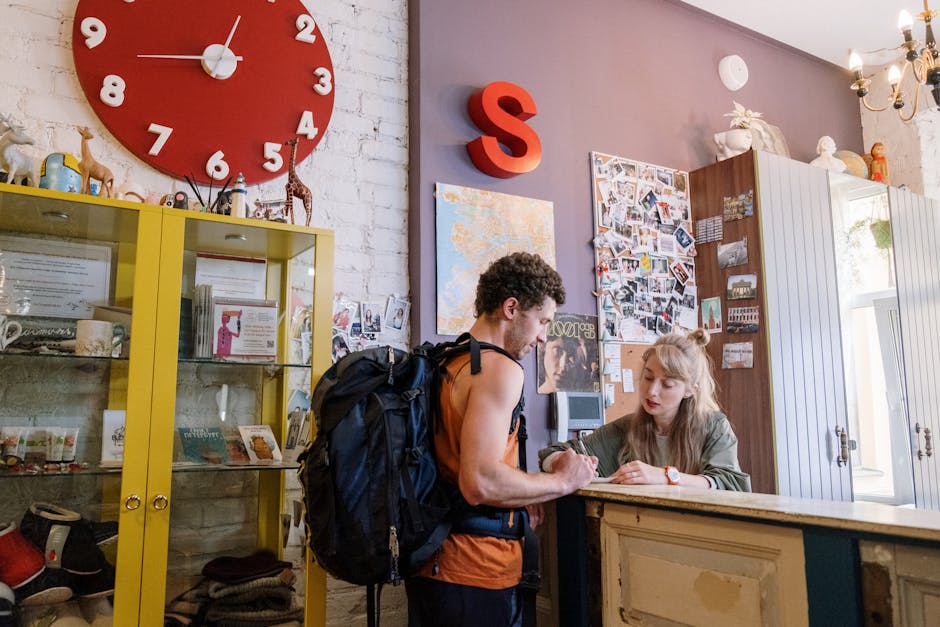
A backpacker weighing two options — a $6 dorm bed with free earplugs or a $10 private room where the fan actually works. The math gets personal fast.
💰 Daily target: $22–28 (all-in, three meals, transit, bed)
🛏️ Average dorm price: $4–8 (Thailand, Vietnam, Cambodia)
🚌 Local transit rate: $0.35–1.50 per ride (songthaew, jeepney, tuk-tuk short hop)
⏱️ Suggested duration: 5–7 nights per city before the guesthouse premium eats your buffer
🎒 Target travel style: Gritty, no-reservation, cash-only, sweat-equity backpacker
Hostel vs Guesthouse: Which Is Cheaper in Southeast Asia?
I woke up face-down on a dorm mattress in Chiang Mai at 3:14 AM. The guy above me had rolled off his bunk — landed hard, groaned, crawled back up without a word. Nobody else stirred. That’s a $6 night right there, earplugs included, no questions asked. Two weeks later I was in Hoi An, paying $10 for a guesthouse room with a mosquito coil, a rocking chair, and a ceiling fan that clicked like a metronome. I slept worse because I kept thinking about the $4 difference. This is the debate nobody talks about straight: hostel vs guesthouse in Southeast Asia isn’t just about money — it’s about what you’re willing to trade for a quiet night versus a cheap one.
I’ve spent nine months across Thailand, Vietnam, Cambodia, Laos, and the Philippines bouncing between both. I’ve done the $3 dorm in a Cambodian fishing town where the bathroom was a bucket. I’ve also done the $12 guesthouse in Pai where the owner’s mom made me breakfast and the Wi-Fi actually loaded a YouTube video. The price gap is real. But the value gap? That’s a snake that changes colors depending on the street you’re on.
Let me be clear: I’m not a travel blogger who stays in “boutique hostels” with co-working spaces and cold brew on tap. I’m the guy who haggles for a fan room, eats street-side for less than a dollar, and counts every single baht, dong, kip, and peso. This article is for you if your daily budget has a hard ceiling and you need to know exactly when a guesthouse is worth the extra cash — and when it’s a trap.
The Essentials at a Glance
- Dorm beds run $4–8 in most SE Asian cities. Guesthouse privates start around $8–12 for a fan room, $12–18 for AC. That $4–6 nightly difference adds up to $28–42 per week — a full extra day of travel money.
- Guesthouses nearly always include free drinking water and coffee. Hostels often charge $0.50–1 for a bottle or instant coffee sachet. Over a week that’s $3.50–7 you won’t see on a booking site.
- Laos and Cambodia favor guesthouses. Guesthouse culture is stronger there — cheaper privates, more family-run places, fewer party-hostel giants. Vietnam and Thailand have more hostel density, which drives dorm prices down but guesthouse prices up in tourist pockets.
- Security trade-off: Dorms mean lockers (sometimes). Guesthouses mean your door locks from the inside. I’ve had stuff go missing from a dorm locker in Bangkok. Never had a guesthouse theft. Pay attention.
- Social cost is real. A $6 dorm gives you instant drinking buddies. A $10 guesthouse gives you silence and a place to cry about your budget in private. Choose your poison.
The Real Cost Breakdown: Dorm vs Private Room, Street by Street
Bangkok, Thailand — Khao San Road vs Banglamphu Backstreets
Khao San Road dorms start at $5 a night. You get a mattress, a pillow, a fan that sounds like a dying lawnmower, and a bar downstairs blasting reggaeton until 2 AM. I stayed at NapPark Hostel — $7 for a 6-bed dorm, clean enough, but the noise was relentless. Earplugs didn’t cut it. I could feel the bass in my molars.
Two blocks off Khao San, guesthouses like Lamphu Tree House charge $14 for a private double with AC, hot water, and a balcony. That’s double the dorm price. But here’s the catch: you don’t need earplugs, you can sleep naked because the AC works, and the mosquito net isn’t full of holes. I spent two nights in the dorm, then three at the guesthouse. My wallet hurt. My spine thanked me.
The math: 7 nights dorm = $35. 7 nights guesthouse = $84. That $49 difference is a full day in Ayutthaya plus two pad thais on the street. But if you sleep like crap for a week, you’ll spend $10 on coffee just to function.
Hanoi, Vietnam — Old Quarter Shove vs Quiet Alley
Hanoi dorm beds in the Old Quarter go for $4–6. I stayed at Vietnam Backpacker Hostels — $5 a night, free beer for 30 minutes at happy hour, locker included. The crowd was loud, Australian, and determined to drink the entire bia hoi supply. I lasted three nights. Then I found a guesthouse called Little Charm Hanoi on a side alley — $8 for a private room with a window, a fan, and a kettle. No AC. Shared bathroom. But the street noise was a murmur instead of a roar.
The guesthouse saved me about $2 a night over the dorm? No — wait. The dorm was $5. The guesthouse was $8. That’s $3 more per night. But the guesthouse gave me a desk, a door I could close, and a place to leave my laptop without locking it in a rented locker. I stayed 10 nights. The $30 extra was worth it because I actually got work done and didn’t lose my mind.
“The $3 dorm in Kampot came with a bucket shower and a free sunrise view over the river. The $8 guesthouse in Hoi An came with a shared bathroom that smelled like bleach and a TV that got exactly one English channel. I still think about that bucket shower more than I think about my high school graduation.”
— Actual thought I had while washing out a sock in a sink in Kampot, Cambodia.
Kampot, Cambodia — The Bucket-Shower Economy
Campot is where the hostel vs guesthouse debate collapses into absurdity. I paid $3 a night at a guesthouse called Orchid Garden. Private room. Fan. Shared bathroom with a bucket for showering. No hot water. No Wi-Fi in the room. The bed was a mattress on a concrete platform. I loved it. The price was so low that hostels couldn’t compete — the cheapest dorm in Kampot was $4 and you got a locker and a bar. The guesthouse gave me a porch, a hammock, and a view of a rice paddy. I stayed a week. Total cost: $21 in accommodation.
This is the exception. In smaller Cambodian and Lao towns, guesthouses sometimes undercut hostels because they’re family-run, have zero marketing budget, and charge whatever covers the electricity bill. Always check both on booking sites and then walk the street. In Kampot, walking in and asking for the “cheapest room” got me a lower price than any app.
Luang Prabang, Laos — The $6 Private Room That Changed My Mind
Luang Prabang is expensive by Lao standards. Dorms run $6–9. Guesthouses charge $12–20 for a private. I found a place called Manoluck Guesthouse — $6 for a private room with a fan, a sink, and a shared toilet down the hall. The bed was a real bed. The window opened onto a courtyard with frangipani trees. I paid the same as a dorm and got silence, privacy, and a view. The catch: no AC, no breakfast, and the Wi-Fi only worked at 6 AM. But for $6? I didn’t care.
The lesson: In places where guesthouse competition is high (Luang Prabang, Hoi An, Kampot, Chiang Mai outside the old city), you can find privates at dorm prices if you’re willing to share a bathroom and skip AC. In hyper-tourist zones (Khao San, Bui Vien in Saigon, Pub Street in Siem Reap), dorm beds dominate because the real estate is too expensive for cheap privates.
Money-Saving Hacks
- Walk-in bookings beat apps 60% of the time. In Luang Prabang, the guesthouse listed at $10 on Booking.com offered me $7 cash when I showed up at 9 AM with a backpack and a tired face. The owner said “no commission” and shrugged. I took it.
- Guesthouses in alleyways are cheaper than street-front ones. In Hoi An, the guesthouse directly on the main drag charged $14 for a fan room. One turn into a side alley, the same room was $8. Walk into every alley you see. Knock. Ask. Haggle in Vietnamese if you can.
- Book Sunday night. I don’t know why this works, but I’ve consistently found lower rates in Chiang Mai, Siem Reap, and Bangkok on Sundays. Maybe it’s the booking algorithm. Maybe it’s coincidence. I’ve saved about $2–3 per night four times doing this.
- Bring a universal sink plug. Guesthouses often don’t have a usable sink plug. You end up wasting water or washing clothes in the shower. A $1 rubber plug from a hardware store saves you laundry costs — I hand-wash in the sink, hang on the balcony, skip the $3 laundry fee.
- Negotiate week-long stays. In Kampot, I asked for a weekly rate at Orchid Garden. They said $18 for the whole week instead of $21. That’s $3 saved. Not huge, but that’s two bowls of noodle soup on the street.
Common Budget Mistakes to Avoid
- Booking a guesthouse on a Friday or Saturday night sight unseen. I did this in Chiang Mai — walked into a guesthouse off Thapae Road at 9 PM, exhausted, and paid $12 for a room that smelled like a wet dog. The same room was $7 on a Tuesday. Weekend walk-in rates are a scam. Book ahead or swallow the premium.
- Assuming a hostel dinner is cheaper than street food. Hostels in Siem Reap offered a “family dinner” for $3.50. Sounded cheap. But the night market across the street had a full plate of lok lak for $1.50 and a beer for $0.50. I ate better, cheaper, and not with 14 Swedes discussing their gap year. Street food wins every time.
- Paying for breakfast as an add-on. Guesthouses often offer breakfast for $2–4. In Hoi An, I paid $3 for a guesthouse breakfast — one fried egg, a baguette, and instant coffee. The bakery two doors down had a fresh banh mi with egg for $0.80 and a real coffee for $0.60. The math is brutal. Skip the add-on breakfast. Walk 30 seconds.
- Trusting the “free” water. Some hostels advertise free water but the dispenser is empty by 10 PM or it’s a tiny glass in the lobby. I started carrying a 1.5L bottle and refilling at 7-Elevens — $0.15 per liter, always cold, always available. Guesthouses usually give you a full 1L bottle in the room. Check before you buy.
Quick Pack & Prep Checklist
- 📄 Documents: Passport with two photocopies (guesthouses often hold it for check-in — I’ve had one try to keep it for 24 hours. I refused. Handing over a copy instead is a pro move.)
- 📱 Offline apps: Maps.me with offline maps, XE Currency for real exchange rates (guesthouses sometimes quote in USD then round up in local currency), Grab for fixed-rate taxi fares (no haggling)
- 🛏️ Niche gear: A silk sleeping bag liner ($18 on Amazon) — I’ve used it in dorms with questionable sheets and guesthouse beds where the blanket was visibly not washed. Also a headlamp with a red light — dorms after lights-out are a dark maze, and a white light wakes people up.
- 🔌 Travel adapter with USB ports: Guesthouse outlets are often ancient. A multi-USB adapter means you can charge phone, battery bank, and Kindle off one socket. Dorms are even worse.
- 🩴 Flip-flops with grip: Guesthouse bathrooms in Cambodia and Laos are often wet-floor tile. Cheap flip-flops will send you sliding. I spent $3 on a pair with a proper tread and it saved me from a concussion in a Siem Reap shower.
Backpacker FAQ
Q: Is a guesthouse always cheaper than a hostel in Southeast Asia?
A: No. In tourist-heavy districts like Khao San Road or Pub Street, dorms are the cheapest option by $3–6 per night. In smaller towns like Kampot, Luang Prabang, or Hoi An, guesthouse privates can match or undercut dorm prices if you skip AC and share a bathroom.
Q: How much do guesthouses charge in Cambodia vs Vietnam?
A: Cambodia guesthouse privates average $5–10 for a fan room (Kampot, Battambang, Kratie) and $10–18 with AC in Siem Reap. Vietnam fan rooms run $7–12 in Hanoi and Saigon, dipping to $5–8 in Hoi An and Ninh Binh. Cambodia is generally $2–3 cheaper for comparable quality.
Q: Should I book hostels or guesthouses when I arrive?
A: Book one night online for a new city, then walk around and negotiate for the rest. In Luang Prabang, I saved 30% by booking one night on Agoda, then walking two blocks to find a guesthouse offering the same room for cash at a lower rate.
Q: Do guesthouses have lockers for valuables?
A: Rarely. Guesthouse security relies on locking your room door from the inside. If you need a locker, choose a hostel or bring your own small padlock — some guesthouses have a cabinet you can lock in the room, but it’s not common.
Q: Which is safer for a solo female traveler — hostel or guesthouse?
A: Both have risks. Hostels have more eyes around and often have staff at a 24-hour front desk. Guesthouses can be quieter and more private, which may feel safer or more isolating depending on the owner. Check recent reviews for both — I’ve seen solo female travelers report feeling safer in female-only dorms than in isolated guesthouse rooms with poor locks.
Final Thoughts
The hostel-vs-guesthouse decision in Southeast Asia comes down to one thing: what kind of tired are you at the end of the day? If you want noise, social pressure, and the possibility of a free beer at happy hour, a $5 dorm will drain your social battery but refill your phone battery. If you want silence, a door that locks, and a place to lay out all your receipts and cry about your budget, a $10 guesthouse is the better investment.
I’ve done both. I’ve loved both. I’ve regretted both. The real cheat code is moving between them — three days in a dorm to meet people and save cash, then three days in a guesthouse to decompress, shower twice, and eat a proper meal without 16 people asking where you’re going next. That hybrid rhythm saved me about $40 over two weeks in Cambodia and kept my head straight.
📌 Save this guide
Share it with the friend who still thinks “budget travel” means a hostel dorm everywhere. They’ll thank you when they’re sleeping in a $7 private room with a view of a rice paddy in Kampot.
Comment below: Where’s the cheapest bed you’ve ever booked in SE Asia — and was it worth it? I want the real number, not the one you tell your mom.