How to Eat Healthy on a Vacation
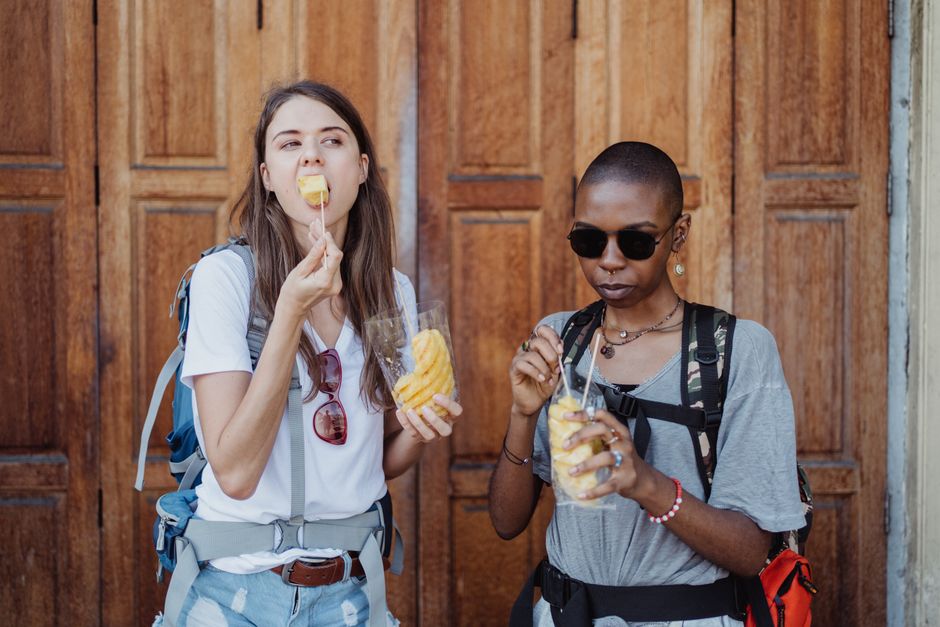
A market stall in Chiang Mai — where the most "healthy" thing I ordered turned out to be a sugar bomb in disguise. I learned the hard way that looking healthy and being healthy are two different things.
Who this solves for: Travelers who refuse to choose between a killer pasta alla gricia and feeling good in their own skin.
When to use this advice: Any trip longer than 3 days, especially if you're jumping between cities, food markets, and all-inclusive breakfast buffets.
Estimated effort: 3/5 — you'll need to think ahead, but the payoff is worth it.
Cost range: Free (planning) to $15/day extra (smart grocery runs).
Risk level: Low — worst case, you eat one too many croissants and enjoy it.
Time saved: About 2 hours of "what should I eat" paralysis per week.
I nearly wept into a bowl of "superfood smoothie" in Chiang Mai. Not because it tasted bad — it was fine — but because I'd just watched the vendor ladle in four heaping tablespoons of sweetened condensed milk. I'd walked 20 minutes in 34°C heat to find something clean. I'd passed three gorgeous street stalls selling som tam and grilled fish because I was scared of the oil, the sugar, the mystery marinades. And there I stood, drinking 65 grams of sugar disguised as wellness, while a woman next to me happily ate a plate of pad see ew and looked perfectly at peace.
That's the lie we tell ourselves on vacation: that health is a menu item. That you can order it. That it comes in a coconut bowl with a bamboo straw. Meanwhile, your body just wants vegetables, protein, water, and maybe a damned croissant without the guilt complex.
I've spent the last 12 years reporting from 40+ countries, and I've wrecked my digestion in Marrakech, starved myself in Rome (tragic, I know), and binge-ate my way through a press trip in Mexico City until my jeans stopped speaking to me. But I've also figured out the rhythm. The actual, street-level, real-world system for eating well on vacation without turning into a person who brings a spiralizer to the airport. This is that system.
Why This Problem Ruins Trips (And Why Most Advice Fails)
The standard advice is useless. "Just order the grilled fish!" Great. Now what about the breakfast buffet, the 4 p.m. churro situation, the late-night room service, the airport layover, the well-meaning local who insists you try their aunt's tres leches cake? You can't "just order grilled fish" your way through Barcelona, Bangkok, or Brooklyn. You'll either become the annoying friend who asks for no oil, or you'll give up entirely by day two and eat nachos for 72 hours straight.
The real problem isn't willpower. It's that vacation disrupts every single structure you rely on at home: your kitchen, your schedule, your portion control, your ability to say "I'll eat this tomorrow." When everything is novel, your brain screams eat it all now because who knows if you'll ever see this specific mango sticky rice again? (Spoiler: you probably won't. And that's okay.)
Most advice fails because it treats vacation like an extension of your meal-prep lifestyle. It's not. Vacation is a different metabolic and psychological reality. You need a framework that acknowledges the indulgence while protecting your energy, your digestion, and your basic desire to not feel like a bloated Tire Man by day four.
The Step-by-Step Solution
Step 1: The Pre-Trip Pivot (Do This Before You Pack)
Thirty minutes before you leave, do not research "healthy restaurants in Lisbon." Do not make a spreadsheet. Instead, open Google Maps, drop a pin at your hotel, and search for two things: "supermarket" and "produce market." That's it. You're looking for a place to buy yogurt, nuts, fruit, eggs, and flatbread within a 10-minute walk. This single act will save you more times than any restaurant recommendation.
In Reykjavik, I found a Bonus supermarket two blocks from my guesthouse. In Marrakech, a fruit stall outside the medina walls. In Tokyo, a 7-Eleven that sold onigiri, hard-boiled eggs, and edamame that became my emergency breakfast for a week. You don't need a kitchen. You need a backup plan for the moment when you're hungry, hangry, and trapped between a tourist-trap pasta place and a McDonald's.
Also: bring a quart-sized Ziploc bag of raw almonds and dark chocolate chips. Sounds ridiculous. Do it anyway. That bag has saved me from buying overpriced airport granola bars, from snapping at my travel partner, from spending $9 on a "health" muffin that was basically cake. It's not about the calories. It's about having a decision you don't have to make when your blood sugar is tanking.
Step 2: The Breakfast Rule (Earn Your Indulgence)
I have one rule that has never failed me: make breakfast the healthiest meal of your day. Not the smallest — the healthiest. Protein, fat, fiber, something green if you can find it. You want to walk out of breakfast feeling stable, not like you just mainlined a pain au chocolat and now need a nap.
In Mexico City, that meant walking to a mercado for huevos divorciados with black beans and a side of nopales (cactus salad). In Paris, it meant a bowl of fromage blanc with berries from the outdoor market instead of a second croissant. (I still had the first croissant. I'm not a monster.) In Bangkok, it was khao tom — rice soup with pork and an egg — from a street stall at 7 a.m.
The breakfast rule works because it sets your blood sugar for the day. If you start with a sugar spike, you'll chase it all day. If you start with protein and fiber, you can have the gelato at 3 p.m. without your body staging a revolt. You earn the indulgence by building a foundation first.
One caveat: if you're in a place with an incredible pastry culture — hello, Portugal, Japan, and literally all of Italy — have the pastry. But have it with the protein, not instead of it. Eat your egg first. Then the pastel de nata. Your blood sugar will thank you.
Step 3: The "Three-Bite" Rule for Destinations You'll Never Return To
Here's the hard truth I learned in a trattoria in Trastevere: you don't need to finish the plate to experience the dish. When you're in a place you may never visit again, your brain tricks you into thinking that leaving food behind is a waste of the experience. But the experience is in the first three bites. The fourth, fifth, and sixth are just diminishing returns and expanding waistlines.
The three-bite rule is simple: order what you want. Taste it properly — eyes closed, no phone, full attention. Savor the first three bites. Then decide: is this transcendent? Would I genuinely regret not finishing it? If yes, eat more. If it's good but not life-changing, push the plate away. You don't have to finish. You're not a member of the Clean Plate Club. You're a traveler, and your job is to taste, not to clean.
I used this rule in a tiny osteria in Bologna. I ordered tortellini in brodo — maybe the best pasta of my life. Three bites in, I was in heaven. By bite seven, I was full and the magic had faded. I left half. The waiter looked confused. I felt free.
Step 4: The Grocery Store Hack (Your Secret Weapon)
Every single trip I take, I visit a local grocery store within the first 24 hours. Not for a full shopping haul — for three specific items: plain yogurt, a bag of apples or oranges, and a sleeve of crackers or flatbread. If there's a hot counter, I'll grab a hard-boiled egg or two. Total cost: usually under $10.
This is your emergency kit. The yogurt saves you from the breakfast buffet. The fruit saves you from the 4 p.m. candy bar. The crackers save you from the "I'm starving and this airport sandwich costs $18" meltdown. In Lisbon, a bag of oranges from a fruit stall cost me €1.50 and lasted three days. In Istanbul, a tub of kaymak (clotted cream) with honey and simit bread became my afternoon ritual — indulgent, local, and actually balanced.
Pro tip: bring a reusable bag. Not for the environment (though sure, that too) — for the moment you stumble on a market and need to carry six plums, a hunk of cheese, and a bottle of water without buying a plastic bag that will rip in five minutes.
Step 5: The "One Indulgence Per Day" Framework
You can have anything. Just not everything. The framework is simple: pick one indulgence per day — one thing that you eat purely for pleasure, no nutritional justification required. A slice of cheesecake in New York. A second glass of Barolo in Piedmont. A churro in Madrid. One. Not three. Not "I'll just have a bite of each." One intentional, guilt-free, fully-enjoyed indulgence.
The rest of your meals should be balanced. Not perfect — balanced. That means protein, vegetables, starch, and some fat. It means eating until you're 80% full, not until the plate is clean. It means drinking water between glasses of wine. It means not punishing yourself for the indulgence by eating nothing but salad for the next two meals — that's just a binge-restrict cycle with a passport.
I tested this in Naples. Day one: one sfogliatella pastry at 11 a.m., then a lunch of grilled octopus and salad, then pizza for dinner. Day two: no pastry, just a morning espresso and a walk. The framework worked because it didn't ask me to be a saint. It just asked me to choose.
Pro Tips From Someone Who's Been There
1. Carry a small packet of electrolyte powder. Not a protein shake or a green powder — just electrolytes. Travel dehydrates you in ways you don't notice until you're lethargic, headachey, and craving sugar because your body is actually craving water and salt. One packet in a glass of water at 3 p.m. has saved more of my afternoons than any "health" food ever did.
2. Learn how to say "no oil" in the local language — but use it sparingly. In Thailand, it's mai ao nam man. In Italy, senza olio. In Mexico, sin aceite. You don't need to say it at every meal. But when you're on day six and your skin is breaking out and everything feels heavy, it's a lifesaver. Use it as a reset button, not a rule.
3. Walk to find your food. The best healthy meal is the one you have to walk 25 minutes to reach. You burn calories, you see the city, and you arrive at the table genuinely hungry — which means you'll eat more slowly and enjoy it more. I walked 40 minutes across Hong Kong Island for a bowl of congee at a hole-in-the-wall, and I swear it tasted better because of the walk.
4. Use the "plate method" at buffets. Look at the buffet. Now pick a plate. Fill half with vegetables or salad. One quarter with protein. One quarter with starch. Then you can have a small dessert. This sounds boring. It works. I used it at a safari lodge in Kenya where the buffet was 40 feet long, and I still fit in my jeans at the end of the trip.
5. Never trust a menu description that says "light" or "healthy." In most places, those words are meaningless. "Light" usually means "small." "Healthy" usually means "has a leaf on it." Instead, look for words that describe cooking methods: grilled, steamed, roasted, poached. Those are actual techniques. "Healthy" is a marketing term.
Common Mistakes Travelers Make With This Issue
Mistake 1: Skipping meals to "save calories." You skip breakfast because you want to "earn" the big lunch. Then you're so hungry by 1 p.m. that you eat double what you normally would, plus the bread basket, plus the dessert. Eating regularly — even small meals — keeps your blood sugar stable and your decisions sane.
Mistake 2: Drinking your calories. A fancy coffee drink with syrup and whipped cream, a soda at lunch, a cocktail before dinner, a glass of wine with dinner, a digestif after — that's 800+ calories you didn't chew and didn't register. Choose one or two drinks per day. Drink water in between. Your body will thank you.
Mistake 3: Eating everything because "it's local." Not every local specialty is worth your digestive system. You don't have to try the deep-fried butter just because it's a "thing." You're allowed to skip the thing that doesn't appeal to you. Being a good traveler doesn't mean being a human garbage disposal.
Mistake 4: Forgetting that vegetables exist in other countries. I once spent three days in Budapest eating only meat and bread before I realized I could buy a bag of carrots at a market. Vegetables are everywhere. You just have to look past the schnitzel and goulash. Markets, grocery stores, and even street stalls often have fresh produce. Look for it.
Your Quick-Action Checklist
- ✅ Before you go: Drop a pin at your hotel and find the nearest supermarket or produce market.
- ✅ Pack: A quart bag of almonds + dark chocolate chips, and a few electrolyte packets.
- ✅ First 24 hours: Buy plain yogurt, fruit, and crackers. Store in your room.
- ✅ Every morning: Make breakfast your healthiest meal — protein + fat + fiber.
- ✅ Every day: Choose ONE indulgence. Enjoy it fully. No guilt.
- ✅ At every meal: Use the three-bite rule for dishes that aren't life-changing.
- ✅ Stay hydrated: Water between every alcoholic drink, and one electrolyte drink per day.
- ✅ Walk: Seek out meals that require a 20+ minute walk to reach.
Frequently Asked Questions
Q: How do I eat healthy on a vacation when I'm staying in a hotel with only a minibar?
A: Use the hotel breakfast as your anchor meal and supplement with grocery store finds. Load up on protein and fruit at breakfast, then grab yogurt and nuts from a nearby store for later. Most hotels will let you store a few items in their fridge if you ask nicely at the front desk.
Q: What are the healthiest options at airports and rest stops?
A: Look for pre-made salads with protein (chicken or egg), plain yogurt cups, hard-boiled eggs, nuts, fruit cups without syrup, and sandwiches on whole-grain bread with visible vegetables. Avoid anything labeled "healthy" with a high sugar count — check the label.
Q: How can I avoid gaining weight on a food-focused trip like Italy or France?
A: Walk everywhere, make breakfast your protein anchor, share every main course, and use the three-bite rule for pasta and pastries. You don't need to finish every plate. The memory of the first bite lasts longer than the regret of the last one.
Q: What should I eat when I'm sick of restaurant food and just want something simple?
A: Hit a grocery store for a bag of salad, a rotisserie chicken leg, a piece of fruit, and a yogurt. It costs under $10, takes five minutes to assemble, and will reset your system faster than any "detox" juice ever will.
Q: Is it worth bringing supplements or protein powder on vacation?
A: Only if you genuinely use them at home. A small pack of single-serving protein powder can save you in a pinch — add it to yogurt or milk — but don't start a new supplement routine on the road. Stick with real food. It works better.
Final Word: You've Got This
Look, I've eaten my weight in gelato in Florence and then walked up a hill to burn it off. I've ordered room service Greek yogurt at 11 p.m. in a Seoul hotel because I needed something that didn't taste like soy sauce and MSG. I've stood in a Parisian supermarket staring at a shelf of yogurt for five minutes, overwhelmed by choice and jet lag, and just bought the one with the cow on it. You don't need to be perfect. You just need a system that bends instead of breaks.
The goal isn't to return home lighter than you left. The goal is to return home feeling like yourself — energized, satisfied, and full of memories that aren't weighed down by regret. You can have the croissant. You can have the pasta. You can have the street food. Just build a foundation first, choose your indulgences on purpose, and for the love of all that is holy, drink more water.
📌 Save this guide — bookmark it, screenshot it, or forward it to your travel buddy. The next time you're staring at a menu in a foreign language, hungry and overwhelmed, you'll have a plan. You've got this.
— Got your own healthy travel hack? I'd love to hear it. Drop it in the comments below, or tag me on Instagram with your market haul. Safe travels, and eat well.


No comments:
Post a Comment