How to Use Trains in Europe and Beyond
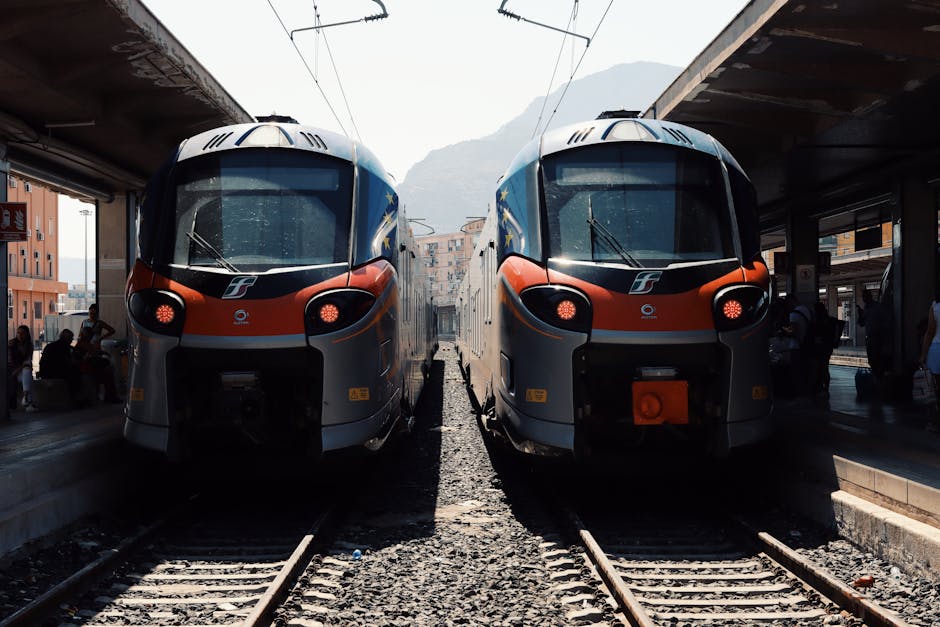
Milan Centrale at dusk — a cathedral of transit, but one wrong move and the price of a mistake hits like a freight train.
🚂 The Problem-Solver Card
Let me set the scene. It’s July 13th, a sweltering afternoon, and the air in Milano Centrale is thick—like a wool blanket soaked in diesel and impatience. I’m clutching a Eurail Global Pass I’m starting to hate. My eight-year-old daughter tugs my sleeve. “Daddy, why can’t we just get on the train?” The man at the information desk has the dead-eyed look of someone who has answered the same question ten thousand times. He points to a tiny red “R” next to my train number. “You need a reservation. No reservation, no boarding. Buy now, €240.”
That ticket shouldn’t have cost more than €50. I had a pass. I had the schedule. I had no idea what I was doing.
This is the nightmare waiting for anyone who thinks a rail pass is a golden ticket to Hogwarts. The romance of European rail—the vineyards blurring past, the creak of the carriage, the conductor calling out “Bologna Centrale”—is real. But the logistics are a minefield of hidden fees, split trains, and overlapping apps. Most advice fails because it’s written by enthusiasts who think a timetable is a page-turner. They skip the street-level details: the yellow validation machines, the cultural differences in connection times, the fact that a train can literally split in two.
I’ve made these mistakes so you don’t have to. This is the guide I needed that day on Platform 7.
Why This Problem Ruins Trips (And Why Most Advice Fails)
The root cause is information fragmentation. You learn about passes on one site, schedules on another, and platform numbers on a dusty PDF that hasn’t been updated since 2019. The official Eurail website is technically correct, but it hides the bloody details. They don’t tell you that the “Global Pass” is really a “Hardly-Covers-Anything-Without-Fees Pass” when you hit France or Spain.
Then there’s the enthusiast echo chamber. “Just use the DB Navigator,” they say. Great advice—except no one tells you that DB Navigator is a battery vampire, or that it sometimes shows connections that require a 5-minute sprint across München Hbf (a station the size of a small airport).
The result? You either overpay for flexi-tickets out of fear, or you get slapped with a €100 fine for not validating a paper ticket. Either way, the romance dies. You stop looking at the Alps and start staring at your phone, sweating, wondering if you’re on the right half of a train that’s about to split.
Let’s fix that.
The Step-by-Step Solution
The Pass vs. Point-to-Point Decision Matrix
Let’s get mathematical. Don’t ask “Which pass is best?” Ask “How many long-distance trains am I taking?”
Scenario 1: The One-Country Trip. You’re doing Paris to Marseille, Avignon, Nice. Forget the pass. Buy point-to-point advance tickets on the SNCF Connect app. If you book 2–3 months out, a TGV ticket from Paris to Nice can cost as little as €25. With a Eurail pass, you’d pay the base fare (covered) plus a €20–€30 reservation fee. Same price, less flexibility with the pass.
Scenario 2: The Multi-Country Jaunt. Munich to Salzburg to Vienna to Budapest. Now the pass shines. Those regional trains (REX, EuroCity) have no reservation fees. You pay the pass activation fee once, hop on and off at will. My rule of thumb: if you’re taking 4+ long-distance trains across 3+ countries, the pass wins.
Scenario 3: The Night Train. Night trains almost always require reservations. A pass covers the base fare, but you’ll pay €25–€50 for a couchette. Point-to-point night train tickets start around €35. The price is a wash. Use whichever system is less bureaucratic.
The Verdict: Pass for flexibility and regional trains. Point-to-point for budget precision on high-speed routes. Don’t fall for the “Global Pass is always cheaper” marketing.
The Timetable Tango
Stop using Google Maps for train times. It’s often outdated, especially for regional routes in the Balkans or rural Italy. Download DB Navigator. It doesn’t matter if you’re not in Germany. It has the most accurate real-time data for the entire European network—platforms, delays, cancellations.
Here’s the trick: search for your connection, then hit the “Save” icon. DB Navigator saves the exact schedule to your phone’s memory. When you’re underground in the Gotthard Base Tunnel and lose signal, that saved schedule is your lifeline. Screenshot it. Networks fail. Roaming dies. That screenshot is your proof for the conductor when the system ghosts you.
Oh, and check the platform number. European stations often post the platform only 10 minutes before departure. Stand under the big board and be ready to move.
The Reservation Maze
This is where beginners bleed money. You have a pass? Great. To board a TGV, Frecciarossa, Eurostar, or AVE, you must have a seat reservation. It’s an extra fee. It’s non-negotiable.
How to book: Use the app of the national railway (SNCF Connect for France, ÖBB for Austria, DB Navigator for Germany) or use the Trainline app. Trainline’s interface handles rail passes better than most national apps. When you search for a train, look for the filter: “I have a rail pass” or “Seat reservation only.” The app will try to sell you a full ticket—don’t let it.
The workaround: Avoid high-speed trains entirely. From Rome to Florence, instead of the Frecciarossa (€45 + €12 reservation fee, 1h30m), take the Regionale Veloce (€20, no reservation, 2h30m). It stops at small towns. It’s slower. It costs less than half. I do this every time. Bring a book.
Real check: Night trains. Paris to Nice on the slow Intercités de Nuit requires a couchette reservation (~€25 with a pass). The high-speed TGV requires a seat reservation (~€30 with a pass). The night train saves you a hotel night. The TGV gets you there in 4 hours. Your choice.
💡 Pro Tip: The Buffer Rule
Never plan a connection with less than 15 minutes in Germany or Switzerland, 20 minutes in France, or 30 minutes in Italy. The margin for error is cultural. In Italy, a 12-minute delay is considered “on time.” In Germany, a 5-minute delay is a crisis. Respect the culture, or you’ll watch your connection leave from across the platform.
Building Your Digital Safety Net
You need three things on your phone before you leave home. Not at the station, before you leave.
1. DB Navigator. For live schedules across all of Europe.
2. Trainline app. For buying seat reservations on the go. Their interface handles rail passes better than the national carriers.
3. Google Maps Offline. Download the maps for every city you’re passing through. This saved me when I had to navigate from Roma Termini to Roma Tiburtina with zero service.
I once lost a €150 reservation because my phone died in the middle of the Simplon Tunnel. No power, no ticket, no mercy from the conductor. He made me buy a new one on the spot. Now I carry a 10,000mAh power bank in my jacket. It’s not a luxury. It’s a survival tool.
⚠️ Real Traveler Mistake: The Split Train
Some trains, especially in the Netherlands and Germany, split en route. Car 1–5 goes to Berlin. Car 6–10 goes to Prague. If you fall asleep in the wrong car, you wake up in a different country. Confirm your coach number matches your final destination. Look at the electronic sign on the platform. It will list the “Zugteile” (train parts).
No comments:
Post a Comment