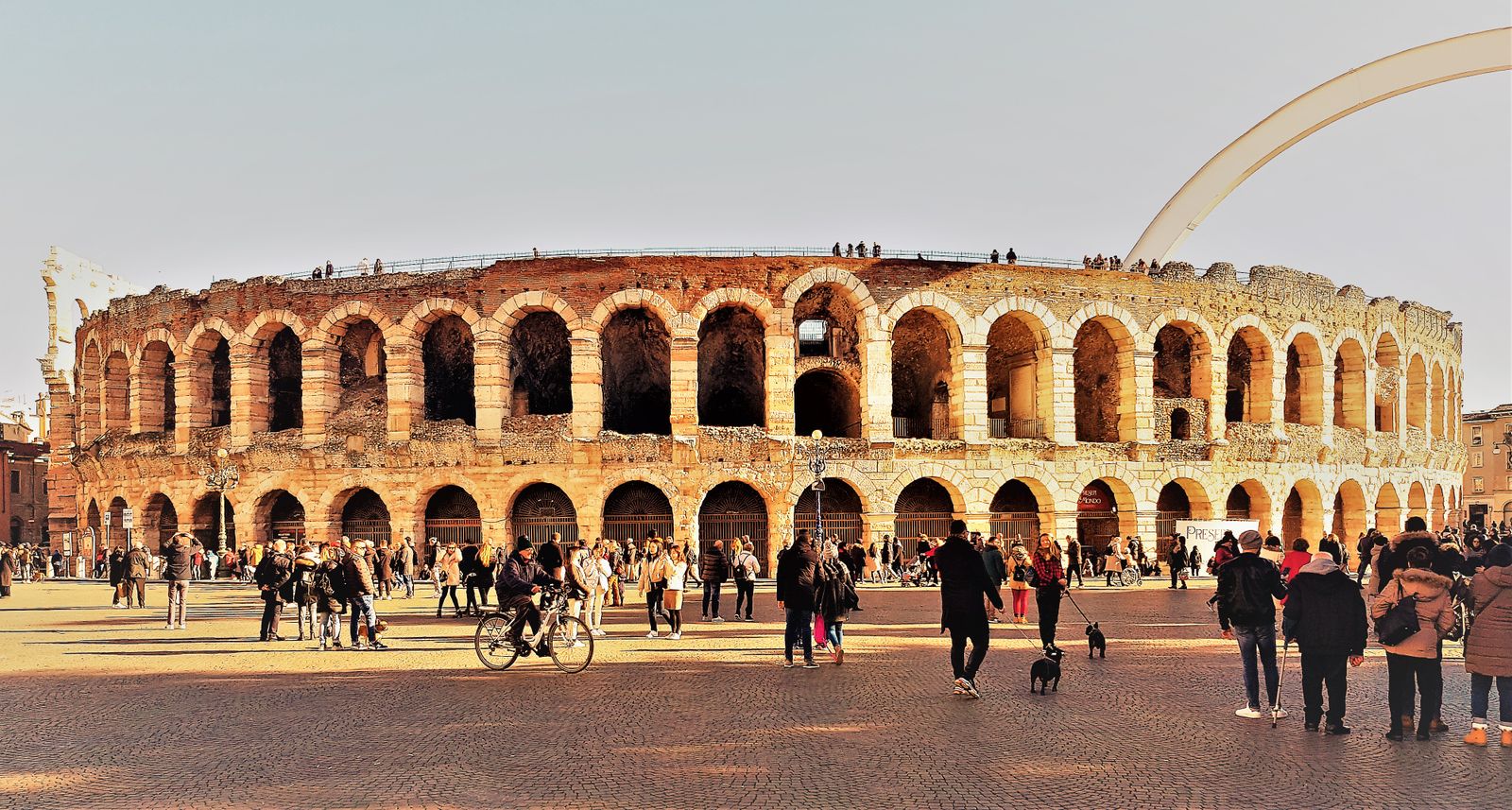
Photo by Ivan Dražić via Pexels
Verona has spent centuries being mistaken for a stage set. Shakespeare, who almost certainly never set foot here, chose it as the backdrop for star-crossed love, and the city has leaned into that association ever since, complete with a balcony visitors queue to photograph and a bronze statue worn shiny at the shoulder from a thousand superstitious touches. But reduce Verona to Romeo and Juliet and you miss almost everything that actually makes it one of northern Italy's most rewarding cities to visit. This is a place with a genuinely ancient Roman core, an amphitheater still hosting opera under the stars nearly two thousand years after gladiators fought within its walls, a medieval river-bend layout that has barely changed in centuries, and a wine region on its doorstep that produces some of Italy's most recognizable reds.
Verona sits in the Veneto region, roughly equidistant from Venice and Lake Garda, a position that has made it a crossroads for two thousand years, first as a strategic Roman garrison town at a bend in the Adige river, later as a prized possession fought over by the della Scala (Scaliger) dynasty, the Republic of Venice, the Austrian Habsburgs, and briefly Napoleon. Each period left its mark, from the Roman Arena and Teatro Romano to the Gothic battlements of the Scaliger family's castle and tombs, to the elegant Venetian-influenced palazzi lining Piazza delle Erbe. Unlike some Italian cities that feel like they exist purely for tourism, Verona remains a genuinely prosperous, functioning regional capital with its own university, thriving wine and food trade, and a UNESCO World Heritage-listed historic center that locals actually live and work in rather than one preserved purely behind glass.
What makes Verona especially appealing for travelers is its scale. The entire historic center, encircled by a dramatic loop of the Adige, is compact enough to cover comfortably on foot in two or three days, yet dense enough with genuine sights, excellent food, and atmosphere to reward a longer stay without ever feeling like padding. It works equally well as a standalone city break, a stopover between Venice and Milan, or a base for exploring the Valpolicella wine hills and Lake Garda. Add in a famous summer opera festival in the Roman Arena, some of the best gelato and risotto in Italy, and a manageable size that never feels overwhelming the way Venice or Florence can in peak season, and Verona earns its reputation as one of Italy's most livable, lovable cities. This guide covers everything needed to plan a trip: the essential sights, where to eat, which neighborhoods to explore, realistic day trips, and a full three-day itinerary to tie it all together.
Quick Facts & Best Time to Visit
Verona has a fairly typical northern Italian continental climate, meaning warmer, more humid summers and colder, sometimes foggy winters than the coastal cities further south. Late spring (April to June) and early autumn (September and October) are the most pleasant times to visit, with mild temperatures, generally reliable weather, and the added bonus that the outdoor Arena opera season, running roughly from mid-June through early September, overlaps with the tail end of spring and the start of autumn. Summer temperatures regularly climb into the low-to-mid 30s Celsius and can be humid, though evenings cool down enough to make outdoor dining and the opera comfortable. Winters are cold, often around freezing at night, with occasional fog rolling off the Adige, but the city takes on a quieter, atmospheric charm, and the Christmas markets in Piazza dei Signori and around the Arena are genuinely worth experiencing if timing allows.
The currency is the euro and Italian is the official language; English is widely spoken in hotels, restaurants, and shops throughout the historic center, reflecting Verona's long experience as an international tourist destination, though a little Italian is always appreciated. Standard Schengen visa rules apply, allowing visa-free stays of up to 90 days for citizens of the EU, UK, US, Canada, Australia, and many other countries, though requirements should always be checked before travel since they can change.
Verona Villafranca Airport (VRN) is a smaller regional airport about 12 kilometers southwest of the city, connected to the center by a shuttle bus in around 20 minutes; many travelers instead fly into Venice Marco Polo or Milan Bergamo and Malpensa and continue to Verona by train, since the city sits directly on the main Milan-Venice rail line with frequent, fast connections from both directions. Verona Porta Nuova, the main station, is about a 20-minute walk or short bus ride from the historic center. Once inside the old town, walking is by far the best way to get around; the center is compact, largely pedestrianized, and easy to navigate on foot, with city buses useful mainly for reaching the train station or outlying attractions like Castel San Pietro's funicular base.
Top Things to Do in Verona
Verona Arena
The Verona Arena is the city's defining monument: a Roman amphitheater completed around 30 AD, making it older than Rome's Colosseum, and remarkably one of the best-preserved structures of its kind anywhere in the world, having survived a major earthquake in the twelfth century with most of its outer ring still standing. Originally built to host gladiatorial combat for crowds of up to 30,000 spectators, it has been repurposed for centuries as a venue for public spectacle, and today it is world-famous for its summer opera festival, launched in 1913 with a production of Aida and still running every year from roughly mid-June through early September, drawing opera lovers from around the globe to watch performances staged on a monumental scale beneath the open sky. Even outside festival season, the Arena is open for daytime visits, and walking its ancient stone terraces, descending into the restored underground passages, and standing on the same travertine floor where Roman spectacles once played out is genuinely moving. Tickets are inexpensive for a daytime visit and can be bought on-site or online, though opera tickets, especially for popular productions, should be booked well in advance through the official Arena di Verona box office. The Arena anchors Piazza Bra, the city's largest and liveliest square, ringed with cafés whose outdoor tables offer one of the best people-watching spots in Verona.
Casa di Giulietta
Juliet's House, on Via Cappello just off Piazza delle Erbe, is Verona's most visited and most debated attraction: a medieval house, once owned by the Dal Cappello family whose name bears a passing resemblance to Shakespeare's fictional Capulets, that has been reimagined since the early twentieth century as the supposed home of Shakespeare's tragic heroine. There is no historical evidence that Romeo and Juliet were real people or that this specific house has any genuine connection to the play, and the famous balcony in the courtyard was in fact added in the 1930s using fragments from elsewhere, purely to give visitors the scene they were hoping to find. None of this stops millions of visitors each year from queuing to touch the polished right breast of the bronze Juliet statue in the courtyard for supposed romantic luck, or to add a padlock or scribble a note on the increasingly graffiti-covered courtyard walls. Whether you find it charming or overly commercial, it is worth a quick stop simply as a piece of cultural phenomenon, best visited early in the morning or in the evening to avoid the worst of the daytime crowds; the courtyard itself is free to enter, while a separate paid ticket covers the interior museum and the balcony itself, which is furnished with mostly unrelated period pieces rather than anything tied to the legend.
Piazza delle Erbe
Built directly on the site of the Roman forum, Piazza delle Erbe has functioned as Verona's central marketplace and social hub for over two thousand years, and it remains the liveliest, most photogenic square in the city. A cluster of market stalls, some selling fresh produce and others leaning more toward souvenirs, occupies the center of the piazza beneath the shadow of the Torre dei Lamberti, while the square is ringed by an extraordinary mix of buildings spanning centuries: the frescoed Case Mazzanti, the Baroque Palazzo Maffei, the medieval Torre del Gardello, and the Madonna Verona fountain, whose central statue reuses an actual Roman-era sculpture, making it one of the oldest continuously used monuments in the city. Cafés and restaurants line the perimeter with outdoor seating that makes for excellent people-watching at any time of day, though prices here run higher than a few streets away given the prime location. The piazza connects directly to Piazza dei Signori through the Arco della Costa, a narrow medieval archway famously hung with what is said to be a whale rib bone, giving first-time visitors an easy, dramatic transition between Verona's two most important historic squares within a two-minute walk.
Piazza dei Signori
Just through the Arco della Costa from Piazza delle Erbe, Piazza dei Signori has a distinctly different character: calmer, more architecturally unified, and often described as Verona's most elegant square. It was the historic seat of civic and political power, framed by the Palazzo della Ragione with its striking Romanesque brick courtyard and the Scaligeri family's former residence, and centered on a nineteenth-century statue of Dante Alighieri, who spent several years of exile in Verona under the protection of the della Scala family, a fact locals are proud to point out. The square's harmonious proportions and relative quiet, especially compared to the bustle of Piazza delle Erbe just steps away, make it a favorite spot to simply sit with a coffee or a glass of wine at one of the cafés along its edge and take in the architecture. From the piazza, the Torre dei Lamberti is directly accessible, and a short walk leads to the Arche Scaligere, the elaborate Gothic tombs of the Scaliger rulers, making this square a natural hub for exploring Verona's medieval political history in one compact, walkable area.
Torre dei Lamberti
At 84 meters, the Torre dei Lamberti is Verona's tallest tower and the best vantage point in the city for orienting yourself and taking in sweeping views over the historic center's terracotta rooftops, the curve of the Adige river, and the surrounding hills. Construction began in the twelfth century and continued in phases over the following centuries, explaining the tower's slightly mismatched upper and lower sections, and it has served historically as both a watchtower and, via its bells, a way of signaling important civic events and emergencies to the city below. Visitors can reach the top either via a spiral staircase of around 238 steps or, more practically for most people, by a lift that covers most of the ascent, arriving at an open-air viewing platform that delivers one of the best panoramic photo opportunities in Verona, particularly around golden hour in the late afternoon. The tower entrance sits directly on Piazza delle Erbe, making it easy to combine with a visit to the market square and Piazza dei Signori, and the modest ticket price is well worth it for the view alone; visiting on a clear day makes a considerable difference, so it is worth checking the forecast and prioritizing this stop on your best-weather day.
Castelvecchio and Ponte Scaligero
Built in the mid-fourteenth century by Cangrande II della Scala as both a fortress and a statement of power, Castelvecchio is Verona's most important medieval castle, its red-brick battlements and crenellated walls running along the Adige at the edge of the historic center. Today it houses the Museo di Castelvecchio, whose collection spans medieval sculpture, Renaissance painting including works by Pisanello and Veronese, and historic weaponry, all displayed within a widely celebrated 1960s renovation by architect Carlo Scarpa that thoughtfully integrated modern museum design into the historic fabric without erasing its medieval character. Directly attached to the castle, the Ponte Scaligero is a fortified brick bridge crossing the Adige, rebuilt after being destroyed by retreating German forces in the Second World War using original materials recovered from the riverbed, a restoration effort that stands as a point of local pride. Walking across the bridge, with the castle on one side and views up and down the river on the other, is one of the more atmospheric short walks in Verona, especially at sunset. The museum itself typically takes an hour to ninety minutes to see properly and is a short walk west of Piazza Bra and the Arena.
Basilica di San Zeno Maggiore
Widely regarded as one of the finest Romanesque churches in northern Italy, San Zeno Maggiore sits a little further from the main tourist core, in a quieter neighborhood west of the historic center, which keeps it comfortably free of the crowds found at Verona's more central sights despite its architectural importance. The basilica's facade, built mainly in the twelfth and thirteenth centuries, features a remarkable rose window known as the Wheel of Fortune and bronze doors covered in 48 individually cast relief panels depicting biblical scenes and local legends, among the most significant surviving examples of Romanesque bronze work in Europe. Inside, the church houses Andrea Mantegna's celebrated altarpiece triptych, the Pala di San Zeno, painted around 1459 and considered one of the masterpieces of early Renaissance painting, alongside a striking ship's-keel wooden ceiling and a peaceful, atmospheric crypt. The basilica is attached to a former Benedictine monastery with a serene cloister worth a few extra minutes. It is a slightly longer walk from Piazza Bra, around 20 minutes, or a short bus ride, but the relative effort is rewarded with one of Verona's most rewarding and least crowded major sights.
Verona Cathedral (Duomo di Verona)
Verona's Duomo, dedicated to Santa Maria Matricolare, combines Romanesque origins with later Gothic and Renaissance additions, resulting in a facade whose pink-and-white marble carving and sculpted portal, guarded by griffins and depicting scenes from the lives of the Paladins, reward a slow look before stepping inside. The interior holds Titian's "Assumption of the Virgin," painted in the 1530s, in a chapel toward the front of the nave, alongside elegant Renaissance choir screens and frescoed side chapels that make the cathedral more artistically significant than its comparatively modest visitor numbers might suggest. Beneath the cathedral, excavated remains of two earlier paleo-Christian churches can be visited, offering a tangible sense of just how many layers of history sit beneath Verona's streets. The Duomo complex also includes access to the cloister and the adjacent church of Sant'Elena, where Dante is said to have lectured, included in the same combined ticket. Set in a quieter part of the historic center near a bend in the Adige, a short walk north of Piazza delle Erbe, the cathedral is easy to combine with a riverside stroll toward Ponte Pietra.
Chiesa di Sant'Anastasia
The largest church in Verona, Sant'Anastasia is a Gothic masterpiece begun in the late thirteenth century by Dominican friars, its soaring brick interior supported by tall marble columns and capped with a network of intricate cross vaulting that creates an impressively lofty, light-filled space. Its best-known feature is a fresco by Pisanello, "Saint George and the Princess," painted around 1436-38 above the Pellegrini Chapel, an early Renaissance work notable for its meticulous, almost proto-scientific detail in the depiction of the horse, armor, and landscape. Look also for the two small hunchbacked figures, known locally as the "gobbi," carved into the base of holy water stoups near the entrance, a quirky and much-loved detail that has become something of a local mascot for the church. The building's scale and relative quiet compared to the crowded piazzas nearby make it a good place to slow down, and its position just a few minutes' walk from both the cathedral and Ponte Pietra makes it easy to string together with other sights along Verona's northern loop of the historic center.
Ponte Pietra and Teatro Romano
Ponte Pietra is Verona's oldest bridge, originally built by the Romans in the first century BC, with its surviving arches a genuine mix of original Roman stonework and careful post-war reconstruction after the retreating German army destroyed it in 1945; walking across it offers one of the most classic views in Verona, looking back over the river toward the cathedral and the old town's rooftops. On the far bank, climbing up the hillside, the Teatro Romano is Verona's Roman theater, built in the first century BC and rediscovered and excavated only in the nineteenth century after centuries of buildings had grown up over it. Though less intact than the Arena, it remains an atmospheric spot, especially during its own summer performance season, and the small archaeological museum housed in a former monastery above the theater displays Roman mosaics, sculpture, and artifacts found on site, alongside terrace views that rank among the best in the city. From the theater, it is a short, steep walk or a funicular ride up to Castel San Pietro for an even higher panorama over Verona's rooftops and the river's dramatic bend, making this whole area worth a couple of unhurried hours.
Arche Scaligere
The Scaliger Tombs form one of the most visually striking monuments in Verona: a cluster of elaborate Gothic funerary monuments built between the late thirteenth and late fourteenth centuries for members of the della Scala family, who ruled Verona at the height of its medieval power. Enclosed within an ornate wrought-iron fence decorated with the ladder motif, or scala, that gave the family its name, the tombs rise in tiers of pointed arches, pinnacles, and equestrian statues, most dramatically the tomb of Cangrande I della Scala, whose original mounted statue, showing him smiling atop his horse, now stands in the Castelvecchio museum with a faithful copy in its original position above the church door. Set beside the small Romanesque church of Santa Maria Antica, the tombs sit just a couple of minutes' walk from Piazza dei Signori, making them an easy and worthwhile detour that most visitors could otherwise walk past without realizing how significant a monument they represent. The site can be appreciated fully from the street for free, and the tombs are especially atmospheric in the soft light of early morning or early evening, when the crowds around Piazza delle Erbe have not yet built up or have already thinned.
Giardino Giusti
Laid out in 1580 and remarkably little changed since, Giardino Giusti is one of the finest surviving examples of an Italian Renaissance garden, its lower section a formal composition of clipped box hedges, cypress-lined avenues, and a maze pattern, all arranged in strict geometric order typical of the period. Climbing the hillside behind the formal garden, paths wind up through a more rugged, wooded section dotted with grottoes, statues, and a small mask-faced grotto structure said to have inspired later garden designs across Europe, eventually reaching a viewpoint that delivers one of the best panoramic outlooks over Verona's rooftops and the Adige valley. The garden has drawn admirers for centuries, including Goethe and Mozart, both of whom are recorded as having visited, and it retains a slightly wild, atmospheric quality in its upper reaches that contrasts pleasantly with the manicured formality below. It receives a fraction of the visitors that the Arena or Juliet's balcony do, making it one of the best places in Verona to escape the crowds entirely for an hour, and its cypress avenue, said to be several centuries old, remains one of the most photographed corners of the garden. It sits a short walk east of the historic center, easily combined with a visit to Sant'Anastasia or the cathedral earlier in the day.
Castel San Pietro Viewpoint
Perched on the hillside across the Adige from the historic center, the site of Castel San Pietro has been fortified since Roman and Lombard times, though the current Austrian-built barracks structure dates only to the nineteenth century and is not generally open to the public inside. What draws visitors instead is the terrace and approach path, which together offer the single best panoramic view over Verona, taking in the Arena, the cathedral, the river's dramatic bend, and the terracotta rooftops of the old town spread out below in a way that no ground-level viewpoint can match. Visitors can reach the top either via a funicular that departs from near the Teatro Romano, a quick and effortless two-minute ride, or by a somewhat steep uphill walk through switchback paths for those who prefer to earn the view on foot, which also passes some pleasant green space along the way. Sunset is by far the most popular and rewarding time to visit, when the historic center's rooftops turn a warm gold and the Arena and cathedral are lit against the darkening sky, though this also means the small terrace can get crowded on clear evenings, so arriving a little before peak sunset secures the best spot along the railing.
Best Neighborhoods to Explore
Centro Storico, the historic center enclosed by the Adige's dramatic loop, is where the vast majority of Verona's essential sights sit within easy walking distance of one another, from the Arena and Piazza Bra at its southern edge through Piazza delle Erbe and Piazza dei Signori at its heart. It is dense, lively, and unquestionably the best base for a first visit, though its central streets, particularly around Via Mazzini connecting the Arena to Piazza delle Erbe, can feel distinctly touristy and crowded during peak midday hours.
Veronetta, across the Ponte Pietra on the river's eastern bank, has a noticeably different character: home to the university, it has a younger, more bohemian energy, with the Teatro Romano, Giardino Giusti, and the path up to Castel San Pietro all located here alongside a growing number of casual, student-friendly bars and eateries that tend to be cheaper than their counterparts in the historic center proper. It is quieter and less polished than Centro Storico, but that makes it a rewarding area to wander for a couple of hours away from the main tourist flow.
The area around San Zeno, west of the old town, is a genuinely residential Veronese neighborhood built around its namesake basilica, offering a glimpse of everyday local life, small neighborhood shops, and a handful of good, unpretentious trattorias that see far fewer tourists than the center, making it worth the twenty-minute walk for travelers who want their visit to feel a little less scripted.
Closer to the train station, the area around Corso Porta Nuova serves as a practical, if less scenic, gateway into the historic center, useful mainly for its proximity to transport links and generally more affordable accommodation, with the walk from the station into Piazza Bra taking visitors past some of the city's surviving stretches of medieval and Renaissance city walls.
Finally, the streets immediately around Piazza delle Erbe and Piazza dei Signori, sometimes referred to loosely as the heart of the medieval quarter, pack in an extraordinary density of architecture, shops, and restaurants within just a few hundred meters, and while they are unavoidably the most crowded part of the city, ducking down the narrower side streets just off the main squares, such as Via Sottoriva with its medieval arcades, often reveals quieter, more atmospheric corners just steps from the busiest spots.
Where to Eat & Drink
Veronese cuisine draws on both its Venetian regional context and its own distinct culinary identity, and risotto all'Amarone, made with the region's famous full-bodied red wine, is arguably the dish most closely associated with the city, rich, deeply flavored, and found on menus throughout the historic center. Pastissada de caval, a slow-braised horse meat stew rooted in the city's medieval history, remains a traditional local specialty though it appears less frequently on modern menus and is worth seeking out for those curious about Verona's culinary heritage. Bigoli, a thick, hearty pasta often served with a rich duck or wild boar ragù, and pearà, a distinctive black pepper and bone marrow sauce traditionally paired with boiled meats, are two more dishes that reflect Verona's hearty, cold-weather-adapted cuisine, quite different from the seafood-forward cooking found further south in Italy.
For sit-down meals, Osteria del Bugiardo near Piazza delle Erbe is well loved for classic Veronese dishes served in a warm, unpretentious atmosphere, while Trattoria Al Pompiere in the historic center pairs traditional cured meats and regional plates with an extensive selection of local cheeses. Locanda 4 Cuochi, tucked down a side street near the Arena, has built a strong reputation for a more contemporary take on Veronese ingredients at reasonable prices, making it a good choice for travelers wanting something a little more refined without leaving the historic center. For a quicker, more casual bite, the bacari-style wine bars scattered around Piazza delle Erbe and the narrower streets nearby serve cicchetti, small savory bites similar to Venetian tapas, alongside a glass of local wine, a fitting and affordable way to sample several flavors without committing to a full sit-down meal.
Verona's location at the edge of the Valpolicella wine region means that wine culture runs deep here, and no visit is complete without trying Amarone della Valpolicella, a rich, powerful red made from partially dried grapes, alongside its lighter, everyday counterpart, Valpolicella Classico, and the sweet dessert wine Recioto, made using the same drying technique. Enoteca della Valpolicella and several wine bars around Piazza dei Signori offer well-curated by-the-glass selections for those who want to explore the region's wines without traveling out to the vineyards themselves. For dessert, Verona takes gelato seriously, with several excellent artisanal gelaterias around Piazza Bra and Via Mazzini worth a stop, and pandoro, the buttery star-shaped Christmas cake that actually originates from Verona rather than elsewhere in Italy, is worth trying if you visit during the winter holiday season, or in smaller versions available year-round in some bakeries.
Best Day Trips from Verona
The Valpolicella wine region, just north of Verona and easily reached by car, organized tour, or even local bus for the more accessible villages, rolls through gentle hills covered in vineyards producing Amarone, Ripasso, and Valpolicella Classico wines. Many wineries, particularly around the towns of Fumane, Negrar, and Sant'Ambrogio, offer tastings and cellar tours by advance reservation, and a half-day or full-day trip combining two or three wineries with a countryside lunch is one of the most rewarding excursions available from Verona, especially for wine enthusiasts.
Lake Garda, Italy's largest lake, sits less than 30 minutes from Verona by car or a similarly short train and bus combination to towns like Peschiera del Garda or Desenzano del Garda, both directly on the rail line. The lake's southern shore offers pastel-colored lakeside towns, the dramatic Scaligero Castle at Sirmione built out on its own peninsula, and the chance to combine sightseeing with swimming in summer, making it an easy, highly rewarding full-day trip that pairs a completely different landscape with Verona's urban, historic character.
Mantua (Mantova), about 45 minutes southwest of Verona by direct train, is a UNESCO World Heritage-listed Renaissance city built around three lakes formed by the Mincio river, home to the extraordinary Palazzo Ducale, once the seat of the powerful Gonzaga family, and the striking Palazzo Te with its illusionistic frescoes by Giulio Romano. Less visited than Verona itself, Mantua rewards a full day with a quieter, almost undiscovered feel despite its considerable art historical importance, and the direct train connection makes it an easy addition for travelers with more than three or four days in the region.
Where to Stay
Budget-conscious travelers will find the best value around Corso Porta Nuova and the area near the train station, with straightforward, well-connected hotels and guesthouses a comfortable walk or short bus ride from the historic center, generally at lower prices than accommodation right in the old town. Mid-range travelers are well served by the many boutique hotels and B&Bs scattered through Centro Storico itself, particularly in the quieter streets around Piazza dei Signori and toward the cathedral, offering the convenience of stepping directly out into the sights each morning.
For a slightly more upscale stay, the area immediately around Piazza Bra and the Arena has several well-regarded hotels within a two-minute walk of Verona's single most famous monument, ideal for travelers attending an opera performance who want to avoid any risk of a late arrival. Travelers looking for a quieter, more local atmosphere without sacrificing walkability might consider Veronetta, across the river, where a smaller but growing number of guesthouses put visitors close to the Teatro Romano and Giardino Giusti while remaining just a short bridge crossing from the main historic center.
Whatever the budget, it is worth booking well ahead for stays that coincide with the summer opera season at the Arena, from mid-June through early September, when accommodation across the entire city fills up quickly and prices rise accordingly, particularly on evenings with especially popular productions.
Suggested 3-Day Itinerary
Day 1: Roman Verona and the Historic Core
Begin at the Verona Arena, ideally at opening to explore the ancient terraces and underground passages before the crowds and heat build, then cross Piazza Bra for a coffee at one of its café terraces. Walk up Via Mazzini toward Piazza delle Erbe, pausing at the market stalls and the Madonna Verona fountain, then climb the Torre dei Lamberti for a panoramic overview of the city before passing through the Arco della Costa into the quieter Piazza dei Signori. From there, visit the Arche Scaligere just around the corner, then break for lunch at a bacaro-style wine bar near the square. Spend the early afternoon at Casa di Giulietta, timed for a less crowded window, before finishing the day at Castelvecchio and a sunset walk across the Ponte Scaligero, closing with dinner at a traditional Veronese trattoria in the historic center.
Day 2: The River Loop and Higher Ground
Start the morning at Verona Cathedral and its excavated underlying churches, then walk to nearby Sant'Anastasia to see Pisanello's fresco before crossing the river via the atmospheric Ponte Pietra. Explore the Teatro Romano and its archaeological museum, then either walk the switchback path or take the funicular up to Castel San Pietro for the city's best panoramic view, timing the visit, if possible, for the late afternoon so the same trip can extend into sunset. Descend back into Veronetta for lunch or an early dinner among its student-neighborhood cafés, then walk to Giardino Giusti for a quieter hour among the Renaissance garden's cypress avenues before heading back across the river for the evening.
Day 3: San Zeno and a Taste of the Region
Devote the morning to the Basilica di San Zeno Maggiore, taking time with Mantegna's altarpiece and the bronze doors, then wander the surrounding residential neighborhood for a more local feel and an unhurried, off-the-main-path lunch at a neighborhood trattoria. In the afternoon, head out into the Valpolicella hills for a winery visit and tasting, or, if wine touring is not of interest, take the short train ride to Lake Garda's southern shore for a swim and a walk around Sirmione's castle. Return to Verona in the early evening for a final stroll through Piazza delle Erbe as the market stalls close and the evening crowd gathers, capping the trip with a proper risotto all'Amarone dinner and, if visiting in summer, an evening at the opera in the Arena as a fitting finale.
Practical Travel Tips
Verona's historic center is compact and almost entirely walkable, and comfortable shoes matter more than any transit pass, since much of the old town's charm lies in wandering its narrower side streets rather than moving efficiently between sights. City buses are useful mainly for reaching the train station, San Zeno, or destinations slightly outside the historic core, and tickets can be bought at tobacco shops, newsstands, or via the local transit app before boarding, since they are not always available directly from the driver.
Verona is a genuinely safe city by any reasonable standard, with petty theft and pickpocketing, particularly around crowded spots like Casa di Giulietta and the train station, representing the main risk most travelers will ever encounter. Standard precautions, keeping bags zipped in crowds and staying aware in busy tourist areas, are sufficient, and the city feels comfortable to explore on foot well into the evening.
Budget-wise, Verona sits in the middle range for Italian cities, generally cheaper than Venice or Milan but pricier than cities further south; a casual lunch typically runs 12 to 18 euros, a proper sit-down dinner with wine 30 to 45 euros per person, and major sight entry fees are usually in the 6 to 15 euro range, with several combined tickets available that reduce the per-site cost for visitors planning to see multiple churches or museums. Churches generally request visitors cover shoulders and knees, so it is worth packing accordingly, particularly for the cathedral and San Zeno. Finally, book Arena opera tickets and popular wine tastings well ahead if traveling in the June through September window, as both sell out with real regularity in high season.
Frequently Asked Questions
How many days do I need in Verona?
Two full days cover the essential historic center sights comfortably, while three days allows time for at least one day trip, whether to the Valpolicella wine hills, Lake Garda, or Mantua, without feeling rushed. Verona also works well as a shorter one- or two-night stopover between Venice and Milan for travelers with more limited time.
Is Casa di Giulietta actually connected to Romeo and Juliet?
No. There is no historical evidence that Romeo and Juliet were real people, and the famous balcony was added to the courtyard in the 1930s specifically to give visitors the scene associated with Shakespeare's play. The house itself has a genuine medieval history unrelated to the story, but the Juliet connection is a twentieth-century tourism invention rather than a documented historical fact.
Is Verona expensive compared to other Italian cities?
Verona is generally more affordable than Venice or Milan, with moderate prices for meals, accommodation, and attractions, though prices rise noticeably during the summer opera season from mid-June through early September, when demand across the entire city increases significantly.
What is the best way to get to Verona from Venice or Milan?
Verona sits directly on the main Milan-Venice high-speed and regional rail line, with frequent trains taking roughly 70 to 90 minutes from Venice and about an hour to 90 minutes from Milan depending on the service, making a day trip or short stopover straightforward without needing a car.
When is the Verona Arena opera season?
The outdoor summer opera festival typically runs from mid-June through early September, with performances staged in the ancient Roman amphitheater on Piazza Bra. Tickets, especially for popular productions and better seating, should be booked well in advance through the official Arena di Verona box office, as availability tightens considerably as the season approaches.
Is Verona worth visiting if I am not interested in Romeo and Juliet?
Absolutely. Verona's Roman Arena and Teatro Romano, its Scaliger-era medieval architecture, the Romanesque Basilica di San Zeno, and its position at the edge of the Valpolicella wine country and near Lake Garda all stand entirely on their own merits, and many visitors find these aspects of the city considerably more memorable than the Juliet legend.
Final Thoughts
Verona manages a rare balance: famous enough to have a genuine tourism infrastructure and an international reputation, yet still compact, walkable, and unpretentious enough to feel like a real, lived-in Italian city rather than an open-air museum. Its Roman amphitheater, medieval towers, riverside walks, and the rolling wine country just beyond its edges offer more than enough to fill several rewarding days, entirely independent of its fictional connection to Shakespeare's star-crossed lovers. Come for whatever draws you here, the opera, the wine, the architecture, or yes, even the balcony, but stay long enough to wander its quieter streets, cross its Roman bridges at sunset, and understand why this small city on a bend in the Adige has held its place at the center of northern Italian life for two thousand years.


No comments:
Post a Comment