
Vatican City: A Cinematic Pilgrimage Through the Soul of the World
Introduction: The Whisper of Stone and Spirit
The first time you see it, it feels like a trick of the light. One moment you are in the chaotic, honking swirl of Rome, a city built on seven hills. The next, you turn a corner, and the world narrows, hushes, and rises. Before you, a colossal colonnade of travertine stone reaches out like the welcoming arms of a giant, embracing the vast, elliptical expanse of St. Peter's Square. Above it all, the dome of Michelangelo, a grey silhouette against the impossibly blue Italian sky, crowns the smallest sovereign state on Earth. This is Vatican City. It is not merely a place you visit; it is a place you feel in your bones—a profound, resonant frequency of faith, art, power, and history, all compressed into 44 hectares of sacred ground.
Crossing the invisible border from Italy is an act of cinematic transition. The air itself seems to change, growing thicker with the scent of incense, old paper, and polished marble. The soundscape shifts from the roar of Vespas to the murmur of a thousand languages in prayer, the shuffle of pilgrim feet on cobblestone, and the distant, crystalline notes of a choir rehearsing in some hidden chapel. You are stepping onto a stage where the drama of Western civilization has played out for centuries. Every stone here has a story. Every fresco whispers a secret. This is a city-state that contains multitudes: a spiritual capital for over a billion souls, a sovereign entity with its own postal service and army of Swiss Guards, and arguably the greatest art gallery ever assembled by humankind, all wrapped within the ancient walls of a fortress of faith.
To walk through Vatican City is to walk through layers of time. You tread on the same ground where the Apostle Peter is believed to have been martyred and buried. You crane your neck beneath the same ceiling where Michelangelo, lying on his back for four agonizing years, argued with God and Pope and painted a universe into being. You stand in the same halls where Renaissance popes, wielding both spiritual and temporal power, plotted, prayed, and patronized genius. The sheer density of meaning is overwhelming, a sensory and intellectual avalanche. But the magic lies in the moments between the monuments: the shaft of sunlight illuminating a forgotten mosaic; the solemn, colorful stoicism of a Swiss Guard; the quiet rustle of a nun's habit in a side chapel. This guide is your key to unlocking not just the sights, but the soul of this extraordinary enclave. Prepare for a journey that is as much an interior exploration as a physical one.
Why Visit: More Than a Postcard, A Portal
Why does Vatican City draw millions each year, far beyond the community of the faithful? Because it represents a pinnacle of human aspiration. It is a three-dimensional library of our collective striving for beauty, meaning, and the divine. For the art lover, it is the Sistine Chapel and the Raphael Rooms—masterpieces that define entire artistic epochs, seen not in a textbook but in the very rooms for which they were created. The scale is humbling; to stand beneath Michelangelo's "Creation of Adam" is to feel the electric charge of that almost-touch, a moment frozen in pigment that has shaped our imagination of genesis itself.
For the historian, it is a living archive. The Apostolic Palace, the Vatican Museums, the Secret Archives—these are not dusty relics but the ongoing nerve center of an institution nearly two millennia old. You walk corridors of power that have witnessed intrigue, reformation, and diplomacy for centuries. For the architect, it is a symphony in stone: Bernini's magnificent colonnade and baldachin, Michelangelo's dome that defies physics with its grace, Bramante's elegant Cortile del Belvedere. Each represents a battle of vision and ego, a clash of geniuses that resulted in breathtaking harmony.
And for the seeker, regardless of creed, it offers a rare space of profound contemplation. Attending a Papal Audience in St. Peter's Square, surrounded by a sea of hopeful faces from every corner of the globe, is to witness a unique phenomenon of global unity. The silence inside St. Peter's Basilica, deep and resonant as the earth's own heartbeat, has a weight you can feel on your skin. Visiting Vatican City is an affirmation that in our world of fleeting digital moments, there remain places of enduring, tangible majesty that speak directly to the human spirit. It reminds you of what we are capable of, in both our divine inspirations and our very human flaws.
When to Visit: Chasing the Golden Hour
Timing your visit to Vatican City is the difference between a serene pilgrimage and a crowded shuffle. The eternal city has seasons, and the Vatican breathes with them. The sweet spot, the cinematic golden hour for your trip, undoubtedly falls in the shoulder seasons: April to early June, and late September through October. Imagine crisp spring mornings where the fountains in the square catch the light like scattered diamonds, and the air is scented with blooming flowers from the Vatican Gardens. Or picture autumn afternoons, when the low sun paints the basilica's façade in warm honey tones, and the summer throngs have dissipated, leaving space for reflection.
Winter (November to February, excluding Christmas) offers its own stark beauty. Crowds are at their thinnest, and you might find yourself almost alone in a gallery, with the rain pattering against centuries-old windows. The line for the museums can be mercifully short. But be prepared for shorter opening hours and the possibility of chilly, damp weather—though seeing the dome of St. Peter's wreathed in morning mist is a sight worthy of a Renaissance painting. Summer (June through August) is the grand test of patience. The heat radiates off the square's cobblestones, and queues can stretch for hours under the relentless sun. It is crowded, loud, and exhausting. However, if this is your only window, strategic planning (early morning entries, booked-in-advance tours) is your shield.
Avoid major Catholic holidays like Easter and Christmas unless attending the religious ceremonies is your primary goal—the crowds are monumental. Check the Vatican website for Papal Audience schedules (typically Wednesday mornings); these days draw huge crowds but also offer a unique energy. For a truly magical experience, aim for a Friday evening between April and October when the Vatican Museums open for night visits. Wandering the galleries as dusk falls, with the art dramatically lit and the atmosphere intimate, is an unforgettable privilege.
How to Get There: The Path to the Porta
Your journey to the heart of the Catholic world begins, fittingly, in the heart of Rome. Vatican City is seamlessly embedded within the city's fabric, and reaching its gates is a straightforward pilgrimage. The most iconic approach is on foot. Walking from central Rome, perhaps from the bustling Piazza Navona or across the Tiber River via the elegant Ponte Sant'Angelo, allows for a gradual, dramatic reveal. You navigate narrow *vicoli* (alleys) that suddenly give way to the breathtaking vista of the basilica's dome, growing larger with each step until you emerge into the vastness of St. Peter's Square. It's an approach that builds anticipation beautifully.
For those staying further afield, Rome's efficient, if chaotic, metro system is your friend. Take Line A (the red line) and alight at the "Ottaviano – San Pietro" station. A five to ten-minute walk south down Via Ottaviano will lead you directly to the northern edge of Vatican City, where the walls and the entrance to the museums loom. Alternatively, the "Cipro" station, also on Line A, places you closer to the museum entrance's often shorter queue. A myriad of buses, including numbers 40, 64, and 62, stop at or near Piazza Pia, a short walk from the square. Be vigilant for pickpockets on crowded public transport—this is a universal Roman advisory.
Taxis are plentiful but will drop you at the edge of the square, as vehicle access is heavily restricted within the Vatican walls. There is no airport, no train station within its borders; you arrive as pilgrims and visitors have for centuries: on foot, through a gate, leaving the temporal world momentarily behind. Remember, while the Vatican is a state, there is no passport control or border checkpoint for visitors entering the public areas. You simply walk in, crossing from Italy into another world with a single, unceremonious step.
Accommodation: Resting Near the Sacred Walls
You will not find a hotel within the walls of Vatican City itself—the only residents are clergy, the Swiss Guard, and a handful of lay officials. But the surrounding district, known as the Borgo and Prati, offers a perfect base camp. Staying here means trading the bohemian frenzy of Trastevere or the luxury of the Spanish Steps for an atmosphere of dignified calm and incredible convenience. Imagine waking up, drawing your curtains, and seeing the dome of St. Peter's framed in your window, glowing in the dawn light. This is the quintessential Vatican-area experience.
The Prati neighborhood, just east of the square, is an elegant, residential quarter with wide, tree-lined avenues, upscale boutiques, and some of Rome's best pastry shops and cafés that are frequented by locals, not just tourists. The streets are quieter at night, offering a reprieve from the daytime crowds. Here you'll find a range of accommodations, from luxurious hotels with rooftop terraces boasting postcard-perfect views of the basilica, to charming family-run *pensioni* and modern apartments. The Borgo area, the historic neighborhood between the castle and the square, feels more medieval, with narrower streets that whisper of ancient pilgrim hostels. It was mostly reshaped in the 1930s but retains an intimate, village-like charm steps from the basilica's grand façade.
Choosing a place here means you can be first in line for the museums with a leisurely five-minute stroll, or return to your room for a midday siesta after an overwhelming morning amidst the art. In the evenings, after the tour buses have departed, you can enjoy the surreal privilege of a moonlit walk through a nearly empty St. Peter's Square, the floodlit basilica standing in silent, majestic guard. While you sacrifice the "typical" Roman holiday buzz, you gain proximity, peace, and the profound pleasure of seeing the Vatican not as a day-trip destination, but as your neighborhood's awe-inspiring centerpiece.
Things to Do: The Grand Narrative in Stone and Color
Your exploration of Vatican City is a multi-act drama. The first act belongs to the **Vatican Museums**. This is not a single museum but a labyrinthine complex of palaces, chapels, and galleries holding the accumulated treasures of the papacy. You enter through a modern ramp, but you are soon swallowed by history. The journey is a crescendo. You pass through the Gallery of Maps, where Italy's boot is rendered in stunning, painted detail across vaulted ceilings. You gasp in the Gallery of Tapestries, where lifelike figures seem to follow you with their eyes. You wander the Courtyard of the Pinecone and the Belvedere, where Laocoön and Apollo Belvedere stand in muscular, tragic perfection.
Then come the **Raphael Rooms**, the private apartments of Pope Julius II, frescoed by the young Raphael and his workshop. Entering the *Stanza della Segnatura*, you are standing in the heart of the Renaissance. Here, Raphael's "The School of Athens" unfolds—a monumental gathering of philosophers, with Plato and Aristotle at the center, their gestures debating the ideals of the physical and metaphysical worlds. The light, the color, the architectural harmony of the painting is so perfect it feels less like a wall and more like a window into a sublime intellectual realm.
And this is all prelude. You follow the current of people, a river flowing toward a single, sacred destination. You descend a final staircase, turn a corner, and enter the **Sistine Chapel**. No photograph prepares you. The room hums with a low, reverent murmur, soon shushed by guards. You look up. The ceiling is a riot of color and form, telling the story of Genesis from the Drunkenness of Noah to the iconic, central panel of God giving life to Adam. Every muscle, every gaze, every fold of drapery is charged with divine energy. At the far end, the terrifying, magnificent "Last Judgment" covers the entire wall, a swirling vortex of salvation and damnation painted by an older, more somber Michelangelo. The sheer scale of genius is paralyzing. Tears are a common, unspoken response.
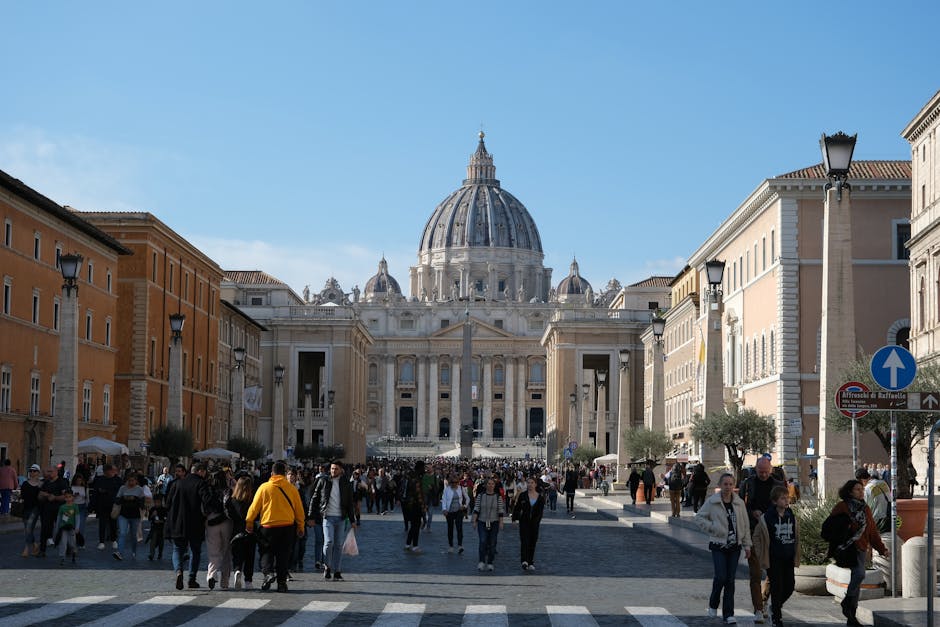
Act Two is **St. Peter's Basilica**. Exiting the museums, you walk around the Vatican walls to the square, an approach that builds the drama anew. Entering the basilica is an experience in scale. Your mind struggles to comprehend the proportions; the cherubs holding holy water fonts are the size of giants. The light slants through high windows, catching the gold of the ceiling and the swirling marbles of the floor. You are drawn first to Michelangelo's **Pietà**, protected behind glass but no less devastating. The youthful Mary cradles her crucified son with an expression of serene, heartbreaking acceptance. The marble seems to breathe, the folds of her robe to flow.
Your eyes then travel to the soaring **dome** and down to Bernini's colossal **baldachin**, a bronze canopy that spirals dynamically over the papal altar, marking the tomb of St. Peter below. Descend into the **Vatican Grottoes**, a crypt of popes and saints, before perhaps ascending to the **cupola**. The climb is strenuous—a narrow, sloping passage that seems to push you upward—but the reward is the most famous view in Rome: a 360-degree panorama of the city, with the geometric perfection of the square below and the endless sprawl of Rome beyond, all framed by the massive ribs of the dome itself.
Do not miss the **Vatican Gardens** (accessible only by guided tour), a serene oasis of manicured lawns, fountains, and hidden shrines, offering a completely different, peaceful perspective on the city-state. And if your schedule aligns, secure tickets for a **Papal Audience** to feel the global pulse of the Catholic Church in person.
Food and Drink: Sustenance for the Soul (and Body)
Dining within Vatican City's walls is a functional affair, focused on refueling the cultural pilgrim. Within the museums, you'll find cafeterias and a simple pizzeria—adequate for a quick lunch without losing precious sightseeing time. The true culinary delights, however, lie just beyond the border in the Prati district. This is where Romans eat, and the quality reflects that. After a morning of spiritual and artistic overload, the simple pleasure of a perfect pasta is its own form of grace.
For a quick, standing-room-only espresso or a delectable *maritozzo* (a sweet cream-filled bun), seek out the historic bars near the Vatican walls. At lunch, follow the locals to a *trattoria* for classic Roman fare: *Cacio e Pepe* (cheese and pepper pasta), *Saltimbocca alla Romana* (veal with sage and prosciutto), or *Carciofi alla Romana* (braised artichokes). The area is also famous for its *pizza al taglio* (pizza by the slice), sold from bakeries where you point to the rectangular trays and pay by weight. A slice of *pizza rossa* (just tomato) or *patate e rosmarino* (potato and rosemary) makes for a perfect, portable feast.
In the evening, the streets of Prati come alive with *aperitivo* culture. Find a stylish enoteca (wine bar) and join the locals for a glass of Frascati or a Prosecco, accompanied by a spread of small bites. For gelato, avoid the brightly colored tourist traps and find a *gelateria* where the pistachio is a muted green and the bins are flat, not mounded—a sign of natural ingredients and artisanal care. Remember, while you can't bring large bags into the museums, a small bottle of water and a snack are wise investments to keep energy high. The true feast in Vatican City is for the eyes and spirit, but a well-timed gelato or a plate of authentic carbonara provides the essential, earthly counterpoint to a day spent among the heavens.
Practical Tips: Navigating the Sacred Labyrinth
To transform your visit from a stressful checklist into a flowing experience, strategy is key. **Book everything in advance.** This is non-negotiable. Purchase your Vatican Museums and Sistine Chapel tickets online, weeks or even months ahead for peak season. This grants you a specific entry time and allows you to bypass the infamous queue, which can waste hours of your day. Consider a guided tour; a knowledgeable guide can navigate the crowds, provide context that brings the art to life, and often includes direct access.
**Dress for the occasion.** The dress code for St. Peter's Basilica, the Sistine Chapel, and the Vatican Gardens is strictly enforced: shoulders and knees must be covered for both men and women. Avoid low-cut tops, short skirts, and shorts. Hats should be removed inside the basilica. Comfortable walking shoes are your most important item—you will walk miles on hard marble and stone.
**Timing is everything.** Enter the museums as early as possible, right at opening, and head straight for the Sistine Chapel to enjoy a relative moment of calm before the main wave arrives. Alternatively, aim for the last entry slots of the day. Be aware that the museums are closed on Sundays (except the last Sunday of the month, when they are free and impossibly crowded) and on various Catholic holidays. St. Peter's Basilica has separate, free entry and is generally open every day, but can be closed for Papal Audiences or special ceremonies. Always check the official Vatican website for the most current information. Finally, pack patience and presence. The crowds can be intense, but if you can find a moment to step aside, lean against a cool marble wall, and simply absorb the atmosphere, you'll capture the essence of Vatican City far more than any hurried photograph could.
Suggested Itinerary: A Three-Day Pilgrimage
Day 1: The Grand Tour of Art & Faith. Start early with a pre-booked entry to the Vatican Museums. Spend 3-4 hours immersing yourself in the galleries, culminating in the Raphael Rooms and the Sistine Chapel. Exit (note: you cannot re-enter the museums from the Sistine Chapel exit into the basilica directly unless on a guided tour). Walk around to St. Peter's Square, enter the basilica, and spend the afternoon exploring its vast interior, the Pietà, the grottoes, and, if you have the energy, climbing the dome for sunset. Dine in Prati, savoring a well-earned Roman feast.
Day 2: Depth and Perspective. Return for a more focused visit. Perhaps take the **Vatican Gardens tour** in the morning, seeing the city-state from its lush, quiet heart. Afterwards, re-enter St. Peter's Basilica with fresh eyes, perhaps to attend Mass or to simply sit in a pew and absorb the silence. In the afternoon, explore the **Vatican Necropolis** (the Scavi), the ancient Roman cemetery beneath the basilica believed to contain St. Peter's tomb. This requires booking months in advance via the Scavi Office. Alternatively, visit the lesser-known but fascinating **Vatican Historical Museum** or the **Pinacoteca** (Picture Gallery) for a more intimate art experience.
Day 3: Context and Ceremony. If it's a Wednesday, attend the **Papal Audience** in the square (free tickets required, booked in advance). Feel the global energy and receive the Pope's blessing. In the afternoon, cross the Ponte Sant'Angelo to the **Castel Sant'Angelo**, the papal fortress and escape route, which offers stunning views back toward the dome. Wander the Borgo neighborhood, exploring the medieval streets and the charming **Church of Santo Spirito in Sassia**. This slower day allows the profound experiences of the first two days to settle in your memory.
Conclusion: The Echo That Remains
Leaving Vatican City, you cross back over the white line on the pavement from the State of Vatican City into the Italian Republic, and the Roman noise rushes back in. But something has shifted. You carry with you an echo—the memory of Michelangelo's cosmic vision hovering above you, the cool touch of ancient marble under your palm, the resonant silence of the basilica, the kaleidoscopic swirl of the Swiss Guard's uniform. Vatican City is more than the sum of its artistic and architectural parts. It is a testament to the enduring human need to create beauty as an act of devotion, to build monuments to belief, and to seek connection with something greater than ourselves.
It is a place that challenges scale, overwhelms the senses, and ultimately, leaves you humbled and inspired. You may come as a tourist, an art lover, or a pilgrim, but you leave as a witness to a grand, ongoing story. The images you've seen—the touch of God to Adam, the embrace of the colonnade, the silhouette of the dome against the Roman sky—will not fade. They become part of your internal landscape, a permanent postcard from a city that is not just the capital of Vatican City, but a capital of human aspiration. Your journey may end, but the pilgrimage, in a sense, has just begun.
Frequently Asked Questions
Is Vatican City actually a country?
Yes, Vatican City is the world's smallest independent sovereign state. It has its own government, led by the Pope, its own diplomatic corps, postal service, flag, anthem, and even issues its own euro coins and license plates. Its status as a state was formalized by the Lateran Treaty with Italy in 1929.
What is the dress code for visiting Vatican City?
The dress code is strictly enforced, especially for St. Peter's Basilica and the Sistine Chapel. Shoulders and knees must be covered for both men and women. This means no tank tops, short shorts, or skirts above the knee. Hats should be removed inside churches. It's wise to carry a light scarf or shawl to cover up if needed.
Do I need to buy tickets in advance for the Vatican Museums and Sistine Chapel?
Absolutely, yes. Purchasing tickets online well in advance from the official Vatican Museums website is the single most important tip. It allows you to skip the massively long general admission line, which can mean a wait of several hours, especially in peak season. You select a specific entry time for your visit.
Can you visit St. Peter's Basilica for free?
Yes, entry to St. Peter's Basilica itself is free. However, there are often very long security lines to enter the square and the church. There are fees for certain attractions within, such as climbing the dome (cupola) and visiting the Treasury Museum. The Vatican Museums and Sistine Chapel, which are a separate entity, always require a paid ticket.
How much time should I allocate for a visit to Vatican City?
To do it any justice, you need a full day as a minimum. A comprehensive visit to the Vatican Museums and Sistine Chapel alone takes 3-4 hours, and exploring St. Peter's Basilica, the square, and possibly climbing the dome can take another 2-3 hours. To avoid burnout and see more depth, spreading your visit over two days is highly recommended.
What is the best way to see the Pope?
The two main ways are the weekly Papal Audience, held most Wednesday mornings in St. Peter's Square (or in the Paul VI Audience Hall in winter), which requires free tickets requested in advance. The other is the Sunday Angelus prayer, held at noon from the window of the Apostolic Palace overlooking the square, which does not require tickets but draws large crowds.


No comments:
Post a Comment