
Introduction to Bangkok’s Food Culture
Welcome to the ultimate food guide to Bangkok. If you have ever dreamed of eating your way through a city where the air is thick with the scent of sizzling garlic, smoky charcoal, and sweet jasmine rice, you have come to the right place. Bangkok is not just a city with great food—it is a city that lives and breathes through its food. From the crack of dawn, when vendors start ladling rich broth into bowls of guay teow, to the late-night hours when woks roar to life on neon-lit corners, eating is the city’s heartbeat.
Thai cuisine is famous worldwide, but nothing prepares you for the sheer intensity and variety of flavors waiting on the streets of Bangkok. This food guide to Bangkok is designed to take you beyond the pad thai and green curry you already know, diving deep into a culinary landscape where salty, sweet, sour, and spicy collide in perfect harmony. You will discover that Bangkok’s food culture is built on contrasts—a fiery som tum salad cooled by sticky rice, a rich coconut curry balanced by a bite of fresh bird’s eye chili, and a humble street-side plastic stool paired with a dish that tastes like it came from a royal kitchen.
The magic of eating in Bangkok lies in its accessibility. You do not need a reservation at a fancy restaurant to taste the best food of your life. Often, it will be served to you by a smiling auntie who has been perfecting a single recipe for forty years, working from a cart barely larger than a suitcase. This is a city where the street food is not just a cheap alternative but the gold standard. The diversity is staggering, with influences from Chinese, Indian, Malay, and Persian cuisines woven seamlessly into the fabric of what is now unmistakably Thai. Whether you are navigating the organized chaos of Yaowarat (Chinatown) or exploring the floating markets on the city’s outskirts, every meal tells a story of migration, trade, and local ingenuity.
In 2026, Bangkok’s food scene continues to evolve while fiercely protecting its traditions. Michelin-starred street stalls sit comfortably next to modern cafes, and young chefs are reimagining classic dishes without losing their soul. This guide will help you navigate that delicious landscape with confidence, ensuring you taste the real Bangkok—one bite at a time.
Why Bangkok is a Street Food Capital
No food guide to Bangkok would be complete without acknowledging its undisputed status as the world’s street food capital. The title is not just marketing hype; it is a lived reality visible on every sidewalk and in every soi (side street). The city’s geography and climate play a huge role. The tropical heat makes cooking outdoors practical, while the dense urban layout means that real estate is at a premium—small, mobile carts are far more viable than large sit-down restaurants for many family-run businesses.
Historically, Bangkok’s street food culture exploded as the city rapidly urbanized. Migrants from across Thailand and southern China brought their regional specialties, setting up carts to feed a growing workforce that needed fast, affordable, and flavorful meals. This created a hyper-competitive environment where only the most delicious, aggressively seasoned dishes survived. Generations of knowledge are condensed into a single wok, with recipes passed down through families and guarded fiercely. When you eat at a legendary stall, you are tasting decades—sometimes over a century—of culinary refinement.
The sheer convenience and affordability are key. In Bangkok, cooking at home can be less economical than eating out, especially for single workers living in small apartments. A full meal of grilled pork skewers with sticky rice costs less than a dollar and is available within a five-minute walk of almost anywhere in the city. But it is the relentless pursuit of flavor that truly sets Bangkok apart. Vendors use fresh ingredients like lemongrass, galangal, kaffir lime leaves, and fresh chilies in quantities that home cooks in the West would find staggering. The result is a dining scene where a $2 bowl of boat noodles delivers a flavor punch that puts many high-end restaurants to shame. This democracy of deliciousness is why Bangkok rightfully wears its street food crown.
How to Use This Guide
This food guide to Bangkok is structured to take you on a logical culinary journey, but it is also built for the spontaneous eater. We have categorized the must-eat dishes into thematic groups: essential street food classics, rich curries and stir-fries, and lesser-known regional gems. Each section includes not just a description of the dish, but the specific sensory cues to look for—how it should smell, what textures to expect, and the proper way to eat it like a local.
For every dish featured, we provide a "Where to Find It" recommendation. These are not just random spots; they are legendary institutions, often run by the same family for generations, where the dish is executed perfectly. In 2026, many of these stalls have a digital presence, and we have included tips on using local apps or landmarks to locate them precisely, avoiding the frustration of hunting down a cart that has moved. We also include practical eating tips: which dishes are typically eaten for breakfast versus late-night snacks, how to customize your spice level with the crucial phrase "mai phet" (not spicy) or "phet mak" (very spicy), and the unspoken etiquette of sharing tables and using condiments.
Think of this guide as your culinary compass. You can read it straight through to understand the full landscape of Thai food, or you can jump directly to the dish you are craving. If you only have 48 hours in the city, prioritize the "Essential Street Food Dishes" section. If you are a repeat visitor looking to go deeper, the curries and regional specialties will show you a completely different side of Bangkok’s palate. Most importantly, use this guide to eat fearlessly. The best meal of your life is likely being cooked on a cart right around the corner, and this guide is here to help you find it.
Essential Bangkok Street Food Dishes
If you only have a few days in the city, these are the non-negotiable classics that form the backbone of any proper food guide to Bangkok. These dishes are the heavy hitters, the ones that appear on every local’s speed dial and dominate the plastic tables from Banglamphu to Bang Rak. They represent the perfect balance of portability, explosive flavor, and deep tradition. Eating these dishes in their natural habitat—on a bustling street, ideally on a slightly wobbly plastic stool—is a rite of passage.
What makes a street food dish "essential" is not just popularity but versatility. These plates and bowls are eaten at all hours: a quick breakfast before work, a fiery lunch, a post-midnight snack after a night out. They are also the ultimate equalizer, drawing in everyone from motorcycle taxi drivers to suited businessmen. The common thread is technical perfection executed at lightning speed. Watch a pad thai vendor juggle multiple orders over a raging flame, or a som tum master pound ingredients in a clay mortar with rhythmic precision—it is a culinary performance art. This section covers the Mount Rushmore of Bangkok street food, the dishes you simply cannot leave without trying.
Pad Thai: The Iconic Stir-Fry
Pad Thai is the global ambassador of Thai cuisine, but the version found on Bangkok’s streets is a revelation compared to its overseas counterparts. The perfect plate is a study in balance: chewy rice noodles, succulent shrimp or pork, crunchy bean sprouts, and crushed peanuts, all bound together by a sauce that harmonizes tamarind’s sourness, fish sauce’s umami, and palm sugar’s sweetness. It should never be cloying or ketchup-heavy.
Look for a stall with a fiercely hot wok and a cook who works fast. The hallmark of elite pad thai is "wok hei"—the breath of the wok—a faint smokiness that can only come from intense heat. It is typically served with lime, chili flakes, and fresh bean sprouts on the side. For a legendary experience, seek out Thipsamai in the Old Town, often cited as the originator of modern pad thai. In 2026, they still wrap portions in a delicate egg net. For a more local, no-frills version, the alleyways of Pratunam offer excellent, shrimp-fat-laced variations that cost under 60 baht.
Som Tum: Spicy Green Papaya Salad
Som Tum is the fiery soul of Isan cuisine, fully adopted and adored by Bangkok. This salad is a primal experience: watch as the vendor brutally pounds garlic, bird’s eye chilies, long beans, cherry tomatoes, and shredded green papaya in a clay mortar with a wooden pestle. The resulting dish is a high-wire act of spicy, sour, salty, and sweet flavors, with a crunch that is deeply satisfying. The standard version, Som Tum Thai, includes dried shrimp and peanuts, while Som Tum Poo Plara features fermented fish sauce and raw blue crab, offering a much funkier, more complex depth.
A true som tum expert adjusts the spice level on the fly. If you cannot handle extreme heat, a clear "mai phet" is essential before they start pounding. The dish is almost never eaten alone; it is the ultimate team player. The correct way to order is alongside a basket of warm sticky rice (khao niew) and a portion of grilled chicken (gai yang). This holy trinity neutralizes the salad’s intensity. For the best, head to Som Tam Jay So in the Silom area, a no-frills institution where the spice levels are legendary and the flavors are perfectly calibrated.
Moo Ping & Khao Niew: Grilled Pork Skewers with Sticky Rice
This is the quintessential Bangkok breakfast, though it is devoured all day long. Moo ping are skewers of marinated pork, typically fatty cuts like pork collar, grilled over charcoal until the edges caramelize and char. The marinade is a sweet-savory blend of coconut milk, garlic, coriander root, and fish sauce, which creates a lacquered, glossy exterior. The meat is tender, smoky, and slightly charred, often basted with coconut cream during grilling for extra richness.
It is always paired with a small bag of steaming sticky rice (khao niew), which acts as both utensil and palate cleanser. You pinch a bit of rice, use it to grip a piece of pork from the skewer, and pop the combination into your mouth. The interplay of the smoky, fatty meat with the clean, chewy rice is pure simplicity perfected. The best moo ping vendors set up before sunrise to catch the morning commute crowd. Look for carts with a mountain of glowing charcoal and a cloud of aromatic smoke. One standout in 2026 is the vendor near the entrance of Soi Convent in Silom, who sells out by 9 AM sharp with pork so tender it barely clings to the skewer.
Guay Teow: Noodle Soup Varieties
Guay teow is not a single dish but an entire universe of noodle soups. This food guide to Bangkok would be incomplete without emphasizing its diversity. The foundation is a deeply aromatic broth, typically pork or beef-based, simmered for hours with radish, garlic, and spices. From there, the permutations explode. You choose your noodle: sen yai (wide, flat rice noodles), sen lek (thin rice noodles), sen mee (angel hair rice vermicelli), or bamee (yellow egg noodles). Then you choose your protein: meatballs, sliced pork, braised beef, offal, or wontons.
The most famous variant is boat noodles (guay teow ruea), historically sold from boats in Bangkok’s canals. These are legendary for their intensely rich, almost gravy-like broth, darkened with pig’s blood for depth and seasoned with star anise and cinnamon. Served in tiny bowls, it is common to stack five or six empty bowls as you eat. Another must-try is yen ta fo, a pink-hued broth made with fermented red bean curd, served with fish balls and morning glory. For an iconic experience, visit the boat noodle alley near Victory Monument, where fierce competition between rival shops ensures every bowl is a masterpiece of concentration and flavor.
Must-Try Curries and Stir-Fries
While street snacks and noodle soups dominate the sidewalks, the soul of Thai gastronomy truly shines in its curries and stir-fries. These are the dishes that anchor a proper meal, typically ladled over a mound of fragrant jasmine rice. A comprehensive food guide to Bangkok must appreciate the scientific precision behind these dishes. Unlike the slow-simmered stews of other cultures, Thai curries are often built quickly, relying on the intense aromatic oils released by pounding fresh herbs into a paste. The stir-fries, meanwhile, are a masterclass in high-heat cooking, where ingredients are seared in a wok for mere seconds to achieve a smoky, crisp-tender texture.
The distinction between a good curry and a transcendent one often comes down to the paste. In Bangkok’s best kitchens, pastes are still made daily with a mortar and pestle—a laborious process that pulverizes lemongrass, galangal, chilies, and shrimp paste into a fragrant emulsion that no food processor can truly replicate. When ordering these dishes, it is standard to pair them with a plate of rice and a crisp, salty element like fried egg or salted beef. This section explores the rich, mild comfort of Massaman, the fiery punch of a proper holy basil stir-fry, and the colorful spectrum of coconut-based classics that define central Thai cooking.
Massaman Curry: A Rich, Mild Delight
Massaman curry is the gentle giant of Thai cuisine, a dish that tells a story of ancient trade routes and Persian influence. Unlike the fiery green curry, Massaman is built on warm, dry spices like cardamom, cinnamon, cloves, and nutmeg, which are blended with fresh Thai aromatics and rich coconut milk. The result is a velvety, mildly spicy, and deeply fragrant curry that often features large chunks of braised beef or chicken leg, slow-cooked until it falls apart, alongside potatoes and onions that melt into the sauce.
The perfect Massaman has a glossy sheen, the coconut oil having separated slightly from the paste, carrying the aroma of roasted peanuts and tamarind. It is comfort food of the highest order. In Bangkok, this dish is particularly beloved in the Muslim community, who have perfected the beef version. For a bowl that rivals any in the country, seek out the stall at the corner of Soi Convent and Silom, or the legendary dishes served near the Charoen Krung area. In 2026, these spots still simmer their curries for hours, allowing the connective tissue in the beef to dissolve into gelatinous richness, making every spoonful a luxurious, almost sweet, savory hug.
Pad Krapow: Holy Basil Stir-Fry
If there is one dish that defines the daily lunch of a Bangkok local, it is pad krapow. This is not just a meal; it is a craving, a quick fix of explosive flavor designed to be eaten over a plate of steaming rice. The dish is deceptively simple: minced or sliced meat (pork, chicken, or beef) is seared in a scorching wok with garlic, a torrent of bird’s eye chilies, and a generous handful of holy basil (krapow). The seasoning is a swift dash of fish sauce, a whisper of dark soy, and a touch of sugar. Holy basil is key here—it is not the sweet Italian variety; it has a peppery, clove-like, almost medicinal flavor that defines the dish’s soul.
The ultimate version is "pad krapow kai dao," served with a crispy, lacy-edged fried egg on top. The runny yolk breaking over the spicy, salty meat creates an instant sauce that cuts the heat. This is a dish that makes you sweat, the kind of heat that builds on your lips and clears your sinuses. It is ubiquitous, found in every shophouse and street corner restaurant, often called "a la carte" shops. For a benchmark experience, head to Phed Mark, a spot that has gained a huge following, or simply look for a packed local eatery at noon with a wok burner roaring like a jet engine. They will ask "phet mai?"—your answer determines your destiny.
Green, Red, and Panang Curries
The trinity of coconut-based curries represents the color-coded heart of Central Thai cooking. Green curry (gaeng keow wan) is a misnomer for the timid; it is usually the spiciest of the three. Its paste gets its vivid hue from fresh green bird’s eye chilies and fragrant sweet basil, resulting in a thin, sweet, and fire-hot broth typically simmered with chicken, bamboo shoots, and Thai eggplant. Red curry (gaeng phed) is slightly milder but deeper, using dried red chilies that give it an earthy, rich burn. It pairs beautifully with duck, pineapple, and cherry tomatoes, creating a savory-sweet balance that is luscious without being heavy.
Panang curry is thicker and creamier than its siblings, almost sauce-like in consistency. It is heavily influenced by Malay cuisine, with a paste that includes roasted peanuts and cumin. The coconut cream is cooked down until it is incredibly rich, coating tender strips of beef or pork. It is typically garnished with a vibrant chiffonade of kaffir lime leaves, which cuts through the fat with a citrusy zing. In Bangkok, these curries are often prepared in advance, the flavors melding beautifully as they sit. A proper bowl should have a clear layer of red-tinged coconut oil floating on top, a sign of a well-cracked cream. For a masterclass in these classics, the food courts of high-end malls like ICONSIAM or the shophouses along Soi Polo offer versions that perfectly balance heat, fat, and acid, proving why these curries are timeless staples of any food guide to Bangkok.
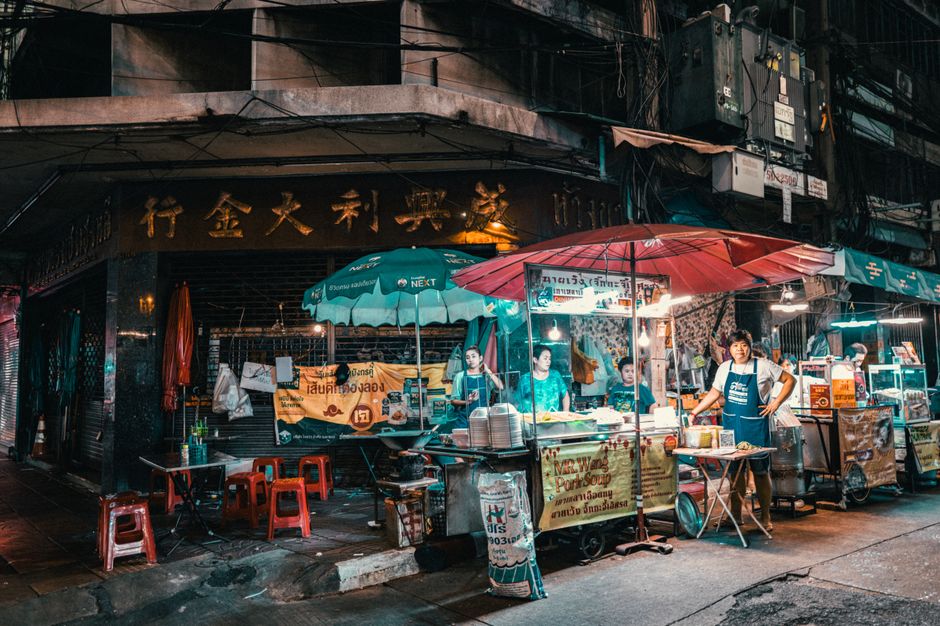
Seafood Specialties in Bangkok
Bangkok’s proximity to the Gulf of Thailand and its intricate network of rivers and canals means seafood arrives at markets astonishingly fresh. Throughout the city, you will find everything from upscale riverside restaurants to fiery street-side stalls specializing in the day’s catch. This food guide to Bangkok highlights the capital’s deep love for shellfish, crustaceans, and fish prepared with bold Thai flavors—think garlic, chili, lime, and fragrant herbs. Whether it’s a massive river prawn charred over charcoal or a whole fish encrusted in salt, seafood here is a communal experience meant to be shared. Don’t be afraid to get your hands messy; peeling shells and squeezing lime over sizzling flesh is part of the ritual.
Grilled River Prawns and Salt-Crusted Fish
Grilled river prawns (kung mae nam pao) are the crown jewels of Bangkok’s seafood scene. These freshwater giants, sourced primarily from the Chao Phraya River basin, are prized for their size—some reaching the length of a forearm—and their rich, buttery head fat. The preparation is deceptively simple: prawns are skewered and grilled over a medium charcoal fire until the shell turns a deep, smoky orange. The true connoisseur digs straight into the head, where the creamy tomalley delivers an intense, briny sweetness that rivals lobster. A sharp, spicy seafood dipping sauce made with green chili, garlic, lime, and fish sauce cuts through the richness perfectly.
Equally spectacular is pla pao, or salt-crusted fish. Typically using tilapia or red snapper, the fish is stuffed with lemongrass, kaffir lime leaves, and pandan, then packed in a thick armor of coarse sea salt. As it grills, the salt hardens into a crust, sealing in moisture and steaming the flesh to a delicate, flaking tenderness. Once cooked, the charred skin and salt layer are peeled back to reveal pristine white meat. You wrap a morsel of fish in a fresh lettuce or cabbage leaf with vermicelli noodles, a dab of chili paste, and a sprig of Thai basil. The contrast between the smoky fish, the cool herbs, and the numbing heat of the sauce is a masterclass in texture and temperature.
Finding these dishes is easy. For the quintessential riverside experience, head to the restaurants lining the Chao Phraya near the Rama III Bridge, where you sit on plastic stools on a floating dock. For a more curated setting with live music, the upscale seafood spots in the Ari neighborhood serve premium grilled prawns by weight. Always check for freshness: the eyes should be clear and the shells firm. Pro tip: order a cold Leo beer or a soda with a squeeze of fresh lime to balance the smoky char.
Hoy Tod: Crispy Oyster or Mussel Pancake
Hoy tod is the crunchiest entry in this food guide to Bangkok, a glorious contradiction of textures that originated in the city’s Chinese-Thai communities. At its base, it is a batter of rice flour, tapioca starch, and egg, fried on a scorching flat-top griddle until the edges turn lace-like and golden. The star ingredient is either plump fresh oysters (hoy tod) or briny mussels (hoy malaeng pu tod), which are added to the batter along with bean sprouts and green onions. The result is a pancake that is simultaneously gooey and crispy, served on a banana leaf or a simple plate with a side of sweet-and-sour chili sauce and a sprinkling of white pepper.
There are two distinct schools of hoy tod in Bangkok: the crispy, scattered style and the thick, gooey omelet style. The crispy version, often found at street carts in the old town, fries the batter until it shatters, resembling a bird’s nest holding the oysters together. The soft version, favored in some shophouse restaurants, cooks the batter into a chewy, substantial cake with a deeply savory egg layer. Both are unmissable. The key is eating it immediately; the pancake loses its magic as it cools. A squeeze of sriracha or the accompanying chili-vinegar dip cuts through the richness of the fried batter, making each bite dangerously addictive.
One legendary spot sits at the edge of Chinatown, where a third-generation owner cooks each order in a furious cloud of steam and pork lard. The oysters here are barely cooked, adding a fresh, metallic pop against the hot crunch. Another famous vendor near the Giant Swing offers a version with a higher egg-to-batter ratio, creating an almost custardy interior. For those wary of raw-seeming shellfish, the mussel option provides a safer, equally satisfying chew. Pair it with a glass of iced chrysanthemum tea to cool down from the grease and spice.
Desserts, Snacks, and Sweet Treats
Bangkok’s sweet landscape is a thrilling exploration of contrasts, where salt, sugar, and coconut collide in colorful, often unexpectedly refreshing ways. Unlike Western desserts, which tend to conclude a meal, Thai sweets are a round-the-clock affair—grabbed from a market stall at dawn, slurped from a plastic cup on a sweltering afternoon, or shared among friends after a late-night feast. This food guide to Bangkok would be incomplete without delving into the sticky, icy, and coconut-cream-laden treasures that define the city’s snack culture. From the world-famous mango sticky rice to the sizzle of a hot griddle cooking coconut puddings, these treats are integral to the rhythm of daily life. The best approach is to roam a fresh market and let your eyes guide you to the most colorful stall, where mung beans glisten and syrups shimmer in the afternoon heat.
Mango Sticky Rice: The Classic Favorite
Mango sticky rice (khao niew mamuang) is the undisputed ambassador of Thai desserts, a perfect harmony of ripe, golden-yellow mangoes and glutinous rice soaked in sweet, salted coconut cream. The rice is steamed until chewy and translucent, then gently folded with a rich coconut syrup that soaks into every grain. A final drizzle of thick coconut cream and a scatter of crispy yellow mung beans add texture. The magic lies in the balance: the natural tartness of the mango—ideally nam dok mai or ok rong varieties—cuts through the dense sweetness of the rice. It is available everywhere, but peak season brings the most fragrant fruit. Look for stalls where mangoes are peeled to order, ensuring the flesh remains cool and firm against the warm, slightly salty rice.
Roti Sai Mai and Kanom Krok
Roti sai mai is a visual spectacle as much as a snack. A vendor stretches a tiny lump of dough into a paper-thin, translucent sheet that blankets the griddle, cooking in seconds. It is then wrapped around strands of sai mai—cotton-candy-like spun sugar, often tinted green with pandan or purple with butterfly pea. The pancake is soft and slightly oily, while the sugar threads melt instantly on the tongue. It is a nostalgic street food, a sugar rush that feels airy and delicate. You will find the best versions in the old city, where families have spun these sugary nests for decades, and the roti is folded into a neat, portable square.
Kanom krok represents the savory-sweet soul of Thai snacks. These tiny, half-sphere coconut puddings are cooked in a heavy cast-iron pan with dimpled molds over a low flame. The batter—a mix of rice flour, coconut milk, and sugar—is poured in, and often topped with a pinch of salt, chopped green onion, or sweet corn. The result is a two-textured delight: a crispy, caramelized bottom and a molten, custardy center that bursts when you bite down. Watching a skilled cook flip them out of the pan with a tiny spoon is mesmerizing. Eat them immediately, straight from the hot griddle, preferably from a stall near a morning market where the aroma of toasted coconut and rice flour fills the air.
Tub Tim Grob and Other Iced Delights
In Bangkok’s relentless heat, iced desserts are not a luxury—they are a necessity. Tub tim grob, often called "red rubies," is a stunning bowl of crushed ice, sweetened coconut milk, and water chestnuts dyed a vivid crimson with hibiscus or food coloring. The chestnuts are coated in tapioca flour, giving them a chewy, gummy exterior that yields to a crunchy center. This textural surprise, paired with the icy, fragrant coconut milk, makes it one of the most refreshing items in this food guide to Bangkok. It is often served with a scoop of young coconut flesh or a spoonful of jackfruit, adding layers of sweetness and aroma.
Beyond the rubies, the world of Thai iced desserts is vast. Lod chong features green, worm-like pandan noodles swimming in sweet coconut milk and ice—a slightly savory, herbal counterpart to the sweeter tub tim grob. Then there is the towering chaos of Thai-style shaved ice, or nam kang sai, where a mountain of crushed ice is drenched in a rainbow of syrups—sala, palm sugar, condensed milk—and hidden beneath are treasures like lotus seeds, sweet potato, grass jelly, and boiled red beans. For a more contemporary twist, cafes in the Siam area have elevated this with artisanal syrups and imported fruits, but the soul of the dish remains in the simple, syrup-drenched bowls served from pushcarts. To find the best, look for a cart surrounded by locals clutching tall glasses of pink and green ice, a sure sign of a neighborhood favorite. One legendary stall in the Phra Nakhon district has been serving a single recipe of tub tim grob for over 40 years, and the queue forms before noon. The sweet, icy coconut milk is the perfect antidote to a day spent navigating the city’s bustling streets.
Where to Eat: Best Food Neighborhoods and Markets
Knowing what to eat is only half the battle; knowing where to find the most transcendent versions of these dishes is where a true food guide to Bangkok proves its worth. The city’s culinary geography is vast, but certain neighborhoods and markets have become legendary for their concentration of exceptional food. These are places where generations of cooks have perfected a single dish, where the smoke of grills hangs heavy in the air, and where you can taste the entire spectrum of Thai flavors within a few city blocks. From the chaotic, neon-lit lanes of Chinatown to the polished, air-conditioned aisles of a high-end farmer's market and the trendy, late-night sois of Thonglor, each area offers a distinct eating experience. Navigating them with an empty stomach and an open mind is the ultimate Bangkok adventure.
Chinatown (Yaowarat) Night Food Walk
Yaowarat Road after sunset transforms into the most exhilarating food street on the planet. The sheer density of stalls, each spilling steam and sizzling oil onto the pavement, can be overwhelming. This is the kingdom of heavy-hitters: wok-fried noodles, seafood platters, and peppery soups. The strategy here is not to sit down at one restaurant, but to graze. Start with a crispy hoy tod at the edge of Charoen Krung, move deeper for a bowl of bird’s nest soup or a plate of succulent roast duck, and finish with a bowl of ginger-infused black sesame dumplings at a bustling corner stall. The cross-cultural influence of Chinese-Thai cuisine is on full display, with dishes you will struggle to find elsewhere in the city. The best time to arrive is around 7 PM, when the crowds are building but the wait times are still manageable. Wear sturdy shoes—the sidewalks are narrow and the pace is fast.
Or Tor Kor Market and Chatuchak Area
Or Tor Kor Market, consistently ranked among the world’s best fresh markets, is the temple of Thai produce and prepared foods. It is impeccably clean, with wide aisles and vendors who arrange their fruits like jewels. This is the place for a daytime food crawl, where you can sample perfectly ripe durian, grilled river prawns, and meticulously crafted curries in a comfortable, semi-open setting. The market specializes in ready-to-eat dishes that showcase premium ingredients: think crab meat stir-fried with yellow chilies or a sour orange curry with river fish. It is a fantastic introduction for travelers who might be intimidated by street-side conditions, offering the same authentic flavors in a more approachable environment. Just across the park, the sprawling Chatuchak Weekend Market offers a more chaotic, snack-focused alternative. Here, you navigate a maze of narrow lanes to find coconut ice cream served in a real shell, grilled squid eggs, and potent iced coffees. The combination of shopping and snacking makes this a perfect Saturday or Sunday outing, though you should arrive early to beat the midday heat.
Thonglor and Ekkamai: Trendy Eats
For a taste of contemporary Bangkok, the neighboring sois of Thonglor and Ekkamai are where the city’s stylish set eats. This is not the place for 40-year-old street carts (though a few survive); instead, it is a hub for chef-driven concepts, fusion cuisine, and impeccably designed spaces where food is a lifestyle statement. Here, a food guide to Bangkok takes a turn toward the innovative. You will find a secret bar serving Thai-inspired omakase behind an unmarked door, a café plating tom yum eggs benedict for the brunch crowd, and noodle shops where the broth has been simmered for 48 hours and the decor is industrial-chic. The area comes alive late, with restaurants staying open past midnight. Soi 38, once a legendary street food strip, has moved partly into a small, organized compound, but you can still find excellent pad thai and mango sticky rice. For something unique, seek out the hidden dining rooms specializing in Isaan drinking food—fermented sausages, spicy larb, and grilled pork neck—paired with craft cocktails that use local herbs. It is the perfect contrast to the old-world chaos of Yaowarat, showing just how diverse this city’s palate truly is.

Bangkok Fine Dining and Modern Thai Cuisine
While street stalls and shophouse restaurants define Bangkok’s culinary soul, the city’s fine dining scene has skyrocketed into the global stratosphere. This isn’t stuffy, white-tablecloth dining that divorces itself from local culture. Instead, the modern Thai movement reinterprets heritage recipes with avant-garde techniques, rare local ingredients, and stunning presentations that tell a story on the plate. For travelers crafting a complete food guide to Bangkok, reserving at least one evening for an elevated tasting menu offers a profound appreciation of how dynamic and sophisticated Thai gastronomy truly is.
What sets Bangkok apart from other luxury dining capitals is the remarkable value. Multi-course tasting menus that would cost triple the price in London or New York remain accessible here, often paired with impeccable service in breathtaking settings—from candlelit colonial villas to sky-high rooftop dining rooms with panoramic Chao Phraya River views. The key shift you'll notice is the emphasis on balance, seasonality, and the rediscovery of ancient Siamese cooking methods, all plated with the precision of a gallery artwork.
Many of these restaurants work directly with smallholder farmers and artisanal producers across Thailand. You might encounter rare jungle curries from the deep south, fermented fish from Isaan, or heritage rice varieties milled to order. Booking ahead is absolutely essential, especially for the most celebrated kitchens, where counter seats overlooking the open kitchen can sell out a full month in advance.
Michelin-Starred Thai Restaurants
Bangkok’s relationship with the Michelin Guide has deepened since the city’s first edition, and the 2026 selection continues to spotlight chefs who treat Thai culinary heritage as a living, breathing art form. The starred establishments here don’t simply replicate royal recipes; they challenge diners to reconsider the very architecture of flavor embedded in a green curry or a humble nam prik chili dip.
At the two-star level, Sorn remains the single most difficult reservation in the city—and arguably the most transformative experience for anyone serious about Southern Thai food. Chefs Supaksorn “Ice” Jongsiri and Yodkwan U-pumpruk have spent years rescuing forgotten recipes from across the southern provinces. Their multi-course feasts unfold over hours, featuring peerlessly fresh seafood from the Andaman Gulf, house-fermented turmeric, and curries that vibrate with heat and complexity. The room itself, a restored mansion with lush tropical gardens, feels like dining inside a secret society dedicated to culinary preservation.
Another two-star gem, Sühring sits in a leafy compound in Yen Akat. Though helmed by German twin chefs Thomas and Mathias Sühring, the kitchen has evolved to incorporate distinctly Thai sensibilities, weaving local river prawns, fingerroot, and galangal into their Central European tasting menus. It’s a masterclass in how fine dining in Bangkok transcends borders without losing a sense of place.
For a sleek, ingredient-driven one-star experience, look to Potenong, where chef Pichaya “Pam” Soontornyanakij applies her Cordon Bleu training to the Chinese-Thai food of her family heritage. Her reinterpretations of dishes like crispy pork belly with five-spice caramel and claypot glass noodles celebrate the often-overlooked depth of Bangkok’s Chinatown cooking traditions. Equally compelling is Le Du, where chef Thitid “Ton” Tassanakajohn—who also runs the more casual Nusara next door—crafts modern plates inspired by seasonal Thai produce. His signature khao kluk kapi, a river prawn risotto made with shrimp paste and brown rice, condenses the entire spectrum of salty-sweet-umami into a single unforgettable bite.
When booking, note that many starred restaurants offer shorter lunch tasting menus that capture the kitchen’s philosophy at a gentler price point. The dress code is typically smart casual, though shorts and sandals are rarely permitted. Most importantly, communicate dietary restrictions at the time of booking—these kitchens plan menus meticulously around each evening’s ingredients.
Chef’s Tables and Fusion Experiences
Beyond the Michelin constellation, Bangkok has nurtured a thriving ecosystem of chef’s tables and fusion concepts where boundaries dissolve between Thai, global, and deeply personal culinary languages. These intimate spaces—often seating fewer than twenty guests per night—offer direct interaction with the chefs themselves, creating a narrative arc that transforms dinner into memory.
Gaggan Anand continues to electrify the dining world from his whimsical townhouse on Soi Sukhumvit 31. The tasting menu here is a rebellious love letter to India and Thailand, delivered with a rock-and-roll soundtrack and chef Gaggan’s signature irreverence. Dishes might arrive as emoji-printed edible menus, licking courses eaten directly off the plate without utensils, or a deconstructed pani puri that explodes with tom yum flavors. Booking opens in monthly batches and vanishes within minutes, so set calendar reminders and be prepared for a playful, boundary-pushing evening unlike anything else in Asia.
For a quieter but equally inventive experience, Chim by Siam Wisdom offers a serene courtyard setting where chef Thaninthorn “Noom” Chantrawan merges his grandmother’s home recipes with molecular gastronomy. His century-old egg relish reimagined as a frozen powder that melts on the tongue exemplifies how modern techniques can amplify—rather than obscure—traditional flavors. Nearby, the counter-only Samrub Samrub Thai feels like being invited into a chef-scholar’s research kitchen. Chef Prin Polsuk, a former archaeologist, resurrects dishes from centuries-old Siamese manuscripts, many requiring obscure ingredients like pla ra (fermented fish) aged in clay pots or wild herbs foraged from northern forests. Each plate arrives with a story about its historical context, making this a deeply educational feast.
Fusion in Bangkok no longer means clumsy East-meets-West mashups. At Haoma, chef Deepanker Khosla built an entire urban farm around his restaurant, raising tilapia in aquaponic tanks and harvesting microgreens steps from the dining room. His Indian-Thai tasting menus emphasize zero-waste cooking and sustainability, often featuring curry sauces made from vegetable trim and seafood sourced by local fishing communities. The garden setting in the heart of Asoke feels like a secret green refuge from the city’s concrete hum.
Dress comfortably but elegantly for these experiences, and plan to arrive at least fifteen minutes early—many chef’s tables serve a welcome cocktail or amuse-bouche in a lounge area before seating. Tipping practices vary, but a service charge of ten percent is typically included in the bill. Any extra gratuity given directly to the chef or kitchen team is warmly appreciated but never expected.
Vegetarian, Vegan, and Dietary Tips
A food guide to Bangkok would be incomplete without addressing how to navigate the city’s culinary landscape with plant-based preferences or dietary restrictions. At first glance, Thai cuisine appears deeply accommodating to vegetarians—coconut milk curries, papaya salads, and stir-fried morning glory all sound meat-free. The reality, however, is more nuanced. Fish sauce, oyster sauce, shrimp paste, and pork lard are deeply embedded in Thai cooking, often appearing in dishes that look vegetarian on the surface. Learning a few key phrases and understanding where to look transforms the experience from frustrating to incredibly rewarding.
The good news is that Bangkok has undergone a quiet plant-based revolution in recent years. An expanding network of dedicated vegan and vegetarian restaurants now exists alongside traditional jay eateries—establishments serving Thai-Chinese Buddhist cuisine that abstains from all animal products, including garlic and onion, during certain lunar cycles. The yellow and red jay flag, marked with the Thai script for "vegetarian" (เจ), signals a safe haven where you can eat confidently without worrying about hidden animal products. During the annual Nine Emperor Gods Festival, usually held in October, entire food markets across Chinatown temporarily convert to jay menus, offering an extraordinary opportunity for plant-based feasting.
Beyond dedicated spaces, high-end restaurants increasingly offer full plant-based tasting menus, and street food vendors are more accommodating than ever—especially if you approach with a smile and a few polite Thai phrases. The key is specificity: simply saying "no meat" isn't enough, as fish sauce and shrimp paste will still appear. You need to communicate clearly about all animal-derived ingredients, and this section will equip you to do exactly that.
Plant-Based Thai Dishes to Try
Certain classic Thai dishes naturally lend themselves to plant-based eating when ordered correctly. Som tam, the iconic green papaya salad, is a perfect starting point—but you must request the vegetarian version. A standard som tam contains fish sauce, dried shrimp, and sometimes fermented crab. Ask for som tam jay (ส้มตำเจ) or som tam mangsawirat (ส้มตำมังสวิรัติ), and the vendor will omit animal products, often substituting soy sauce or a salt-lime dressing for the fish sauce. The result remains crunchy, fiery, and intensely satisfying.
Pad pak boong fai daeng—stir-fried morning glory with garlic, chili, and fermented soybean paste—is already vegetarian in many iterations. The hollow, crisp stems pick up smoky wok char beautifully, and the dish appears on virtually every street food stall and restaurant menu. Confirm no oyster sauce is used by saying mai sai nam man hoi (ไม่ใส่น้ำมันหอย). Similarly, pad kana (stir-fried Chinese broccoli) and pad tua ngok (stir-fried bean sprouts with tofu) make excellent veggie-friendly sides or mains when paired with steamed rice.
Don't overlook khao man gai jay, a plant-based spin on Thailand's beloved chicken rice. The mock chicken is typically crafted from soy or mushroom protein, but the real star is the fragrant rice cooked in ginger and pandan, served with a fermented soybean dipping sauce that rivals the original. Vendors specializing in this dish often set up near office districts during lunch hours. For something heartier, seek out khao soi jay, the northern coconut curry noodle soup made without meat but retaining all the richness of pressed tofu, crispy fried noodles, and pickled mustard greens. The spice paste traditionally contains shrimp paste, so dedicated jay kitchens prepare a separate batch using fermented soybean instead.
Mango sticky rice needs no adaptation—it's naturally vegan, a glorious combination of ripe nam dok mai mangoes, coconut cream, and glutinous rice. For a lesser-known treat, try khanom krok, coconut-rice pancakes griddled in cast-iron pans until their edges turn lacy and crisp. Traditional recipes use coconut milk and rice flour only, though some vendors add scallions or corn. Ask for the plain version to be safe. Finally, fresh spring rolls (po pia sod) stuffed with lettuce, mint, tofu, and vermicelli, served with a sweet chili dipping sauce, make a refreshing snack available at most markets and food courts.
Navigating Allergies and Halal Food
Traveling with food allergies in Bangkok requires preparation, but it's entirely manageable. The most critical phrase for anyone with a peanut allergy is chan pae tua lisong (ฉันแพ้ถั่วลิสง)—"I am allergic to peanuts." Peanuts appear frequently in Thai cuisine, not just whole or crushed as garnish, but in the form of ground peanut sauce, pad thai, and massaman curry. Cross-contamination is a genuine concern at street stalls, so for severe allergies, stick to restaurants where you can communicate clearly with staff.
Shellfish and shrimp allergies require equal vigilance. Chan pae kung (ฉันแพ้กุ้ง) covers shrimp, while shrimp paste (kapi) hides in most curry pastes and chili dips. Many dedicated vegetarian and jay restaurants automatically eliminate this risk, making them the safest option for severe shellfish allergies. Gluten is less pervasive in Thai cooking than in Western cuisines—rice noodles and rice flour dominate—but soy sauce and oyster sauce contain wheat. The phrase mai sai see-ew (ไม่ใส่ซีอิ๊ว) requests no soy sauce, and carrying a small card with your allergies written in Thai script greatly reduces miscommunication. Show it to servers before ordering, and consider laminated versions that survive humidity better than paper.
Halal dining in Bangkok is robust and deeply rooted in the city's Muslim communities, particularly in neighborhoods like Bang Rak, Nong Chok, and the area around the Haroon Mosque. Look for the official Halal certification logo issued by the Central Islamic Council of Thailand—a green circle with Arabic and Thai script—displayed on restaurant windows or menus. Certified establishments guarantee not only that meat is halal but also that no alcohol or pork-derived products enter the kitchen.
Beyond certified restaurants, Muslim-owned street stalls throughout the city serve excellent halal versions of Thai classics. Khao mok gai, the Thai interpretation of biryani, features marinated chicken and fragrant rice tinted golden with turmeric, served with a sharp cucumber relish. Roti mataba shops, particularly concentrated in the Phra Athit area, fold flaky flatbreads around spiced minced chicken or beef, fried until crispy and served with a tangy curry dipping sauce. For satay lovers, halal grilled chicken or beef skewers with peanut sauce abound in Muslim neighborhoods, often accompanied by ajat, a cool cucumber and shallot pickle that cuts through the richness. The Bang Rak district, just east of the Chao Phraya River, deserves special attention—its narrow lanes house generational Muslim kitchens producing some of Bangkok's finest massaman curry, oxtail soup, and goat biryani, all fully halal and deeply satisfying.
Final Bites: Your Bangkok Food Journey Awaits
There's a moment that happens to every traveler in Bangkok, usually on the second or third day, when the city's culinary rhythm suddenly clicks into place. You stop seeing the food scene as a checklist of famous dishes and start feeling it as a living, breathing ecosystem—one where the woman stirring a vat of pork broth at 5 a.m. is as essential as the Michelin-starred chef tweezing micro-herbs onto a river prawn. This food guide to Bangkok has mapped out over sixty dishes, neighborhoods, and dining experiences, but the true magic lies in the spaces between these recommendations: the unplanned alleyway stall that stops you in your tracks with the scent of smoking charcoal, the market vendor who insists you try a knobby fruit you've never seen before, the bowl of noodles eaten on a plastic stool while monsoon rain hammers the tin roof above you.
What makes Bangkok extraordinary as a food destination isn't just the sheer diversity—it's the accessibility. You can spend three dollars on a meal that haunts your dreams for years, or three hundred dollars on a tasting menu that redefines how you understand flavor. Both experiences carry equal weight and legitimacy. The grandmother pounding som tam in a mortar she's used for four decades and the young chef deconstructing that same dish into a frozen palate cleanser are engaged in the same essential project: honoring ingredients, balancing the five fundamental tastes, and feeding people with intention and care. As you plan your own journey through this magnificent, chaotic, endlessly delicious city, carry a sense of openness alongside your map. Eat what looks good, follow the crowds, learn to say aroi (delicious) with genuine feeling, and trust that Bangkok will feed you better than you ever imagined possible. Your table is waiting.


No comments:
Post a Comment