
In This Article
- Introduction: The Battle of Romania’s Best Scenic Roads
- History and Construction: From Ancient Paths to Modern Marvels
- Route Details and Key Stops Along Each Drive
- Scenery and Landscape: Which Road Offers Better Views?
- Driving Experience: Road Conditions, Difficulty, and Safety
- Best Time to Drive: Seasonal Access and Weather Considerations
- Facilities, Accommodations, and Nearby Attractions
- Which Road Should You Choose? A Direct Comparison
- Final Verdict: Our Take on the Ultimate Romanian Road Trip
Introduction: The Battle of Romania’s Best Scenic Roads
Romania’s mountain roads have become legendary among driving enthusiasts and adventure travelers worldwide. Two highways in particular dominate conversations: Transfagarasan and Transalpina. Both carve through the Southern Carpathians, offering dizzying heights, hairpin turns, and views that make your heart race. For anyone planning a 2026 road trip, the question inevitably arises: Transfagarasan vs Transalpina which is better? The answer is not as simple as picking a favorite. Each road has a distinct personality, history, and set of experiences that appeal to different types of travelers. One feels like a dramatic rollercoaster engineered for spectacle, while the other follows an ancient high-altitude path with a quieter, more pastoral charm.
Choosing between them can shape your entire Romanian adventure. Do you crave the adrenaline of a road carved into sheer rock faces, complete with tunnels and a castle straight out of a vampire tale? Or do you prefer sweeping alpine ridges where you can see for miles, dotted with grazing sheep and traditional shepherd huts? This article breaks down every aspect of these two spectacular highways. We will compare their histories, construction stories, route details, and the must-see stops that define each drive. By the time you finish reading, you will have a clear picture of which road deserves a prime spot on your 2026 itinerary. Let’s shift into gear and start climbing into the clouds.
Why Compare Transfagarasan and Transalpina?
Comparing these two roads is not just an exercise in ranking scenery. For travelers with limited vacation time, the choice between them has real consequences. Both roads are high-altitude passes that close for much of the year due to snow, typically opening only from late June or July until October. In 2026, your travel window might be narrow, and weather conditions can change rapidly at elevations exceeding 2,000 meters. Understanding the differences helps you make an informed decision based on your driving confidence, your vehicle type, and what you want to photograph.
The comparison also matters because these roads serve different travel styles. Transfagarasan is a destination in itself, a deliberate detour that demands commitment. Transalpina often functions as a scenic transit route, connecting the regions of Oltenia and Transylvania in a way that feels more integrated with the landscape. Asking Transfagarasan vs Transalpina which is better is really about asking what kind of journey you want. Do you want engineered drama and a sense of conquering a mountain? Or do you want a high-altitude cruise through rolling ridges with a sense of freedom? Both are extraordinary, but they deliver their magic in completely different ways.
Quick Overview of Both Highways
Transfagarasan, officially designated DN7C, stretches approximately 150 kilometers between the communes of Bascov near Pitesti and Cârța in Transylvania. It crosses the Făgăraș Mountains, the highest range in Romania, reaching a maximum altitude of 2,042 meters at the Bâlea Tunnel. The road was constructed in the 1970s as a strategic military route and is famous for its abrupt switchbacks, the long tunnel piercing the main ridge, and its proximity to Poenari Castle and the Vidraru Dam. It feels monumental and intense, with northern and southern sections that offer completely different landscapes.
Transalpina, designated DN67C, runs roughly 148 kilometers from Novaci in Gorj County to Sebeș in Alba County. It crosses the Parâng Mountains and claims the title of Romania’s highest road, reaching 2,145 meters at the Urdele Pass. Its history stretches back millennia, having been used by Roman armies and shepherds long before it was paved. The modern road is characterized by long, sweeping curves across alpine meadows, offering panoramic views that seem endless. It feels more open and serene, a high ridge road where the sky dominates and the drops, while steep, are less claustrophobic than Transfagarasan’s rocky corridors. Both highways promise an unforgettable drive, but their flavors could not be more distinct.
History and Construction: From Ancient Paths to Modern Marvels
The stories behind these roads are as dramatic as the landscapes they traverse. One is a product of Cold War paranoia and authoritarian ambition, built at a staggering human cost in just a few short years. The other is a living archaeological layer, tracing its origins to Roman legions and evolving organically over centuries into a modern highway. Understanding their origins adds a profound depth to the driving experience. When you navigate the tight switchbacks of Transfagarasan, you are driving through a monument to communist-era engineering and sacrifice. When you crest a ridge on Transalpina, you are following in the wheel ruts of ancient traders, medieval armies, and generations of shepherds. History shapes every kilometer, and knowing these backstories transforms a scenic drive into a journey through time.
Construction methods, timelines, and purposes diverged wildly between the two. Transfagarasan was a brute-force project, driven by military strategy and a dictator’s desire for spectacle. Transalpina’s modernization was a much later, less deadly affair that brought a neglected ancient corridor into the 21st century. Both roads now stand as testaments to human determination, but the spirit of each is rooted in very different eras. Let’s dig into the concrete, dynamite, and ancient stones that built these mountain marvels.
The Story Behind Transfagarasan (DN7C)
Transfagarasan was born from fear. In the late 1960s, Nicolae Ceaușescu’s communist regime watched the Prague Spring unfold with alarm. Fearing a Soviet invasion through the southern Carpathians, Ceaușescu ordered a strategic military road that could move troops and tanks rapidly across the Făgăraș Mountains. Construction began in 1970 and lasted until 1974, an incredibly short timeline for such an ambitious project. The workforce consisted largely of military personnel, but also civilian laborers working under brutal conditions. Official records cite around 40 deaths, but unofficial accounts suggest the true toll was far higher, with many bodies buried in the concrete of the Vidraru Dam or lost in dynamite accidents. The human cost earned it a grim nickname: “Ceaușescu’s Folly.”
The engineering challenges were immense. Workers had to tunnel through solid rock at over 2,000 meters elevation, dealing with snow, ice, and the constant threat of rockfalls. The Bâlea Tunnel, at 884 meters long, was carved through the main ridge to connect the northern and southern slopes. The northern section required viaducts and bridges clinging to near-vertical cliffs in one of Romania’s most avalanche-prone zones. Dynamite was used liberally to blast shelves into the mountainside. The road was officially opened in September 1974, but its military purpose was never truly tested. Instead, it became a civilian marvel, though it remained a rough, poorly maintained route for decades. Major rehabilitation works finally brought it to modern standards, turning a grim Cold War relic into one of the world’s most celebrated driving roads. Today, the tunnel lights, guardrails, and smooth asphalt mask a dark and fascinating history of sacrifice and paranoia.
The Story Behind Transalpina (DN67C)
Transalpina’s history is measured not in years but in millennia. The route was first used by ancient Roman armies as a strategic passage across the Carpathians, part of a network connecting the Dacian provinces to the Danube. Locals still call it “Drumul Regelui” or “The King’s Road,” a name that references its use by King Carol II in the 1930s. Legend says the king ordered the road’s restoration so he could travel more comfortably between his residences. However, the true ancient origins are even deeper. Shepherds have driven their flocks along these high ridges since time immemorial, following the natural geography that offered a relatively gentle traverse through the Parâng Mountains. Unlike Transfagarasan’s violent birth, Transalpina evolved organically from a footpath to a cart track to a rough mountain road.
Modernization came astonishingly late. For most of the 20th century, Transalpina remained a rugged, unpaved track, traversable only by off-road vehicles, horses, or on foot. The communist regime showed little interest in it, focusing its resources on the more strategically dramatic Transfagarasan. Serious paving works only began in the early 2000s, transforming the ancient route into a modern sealed highway. The final section through the Urdele Pass was completed relatively recently, officially opening as a fully modernized road in 2012. This recent upgrade means Transalpina often has smoother, wider asphalt than its older rival, particularly on the high ridges. The construction was far less deadly, though still challenging due to altitude and weather. Today, driving Transalpina means traveling a road that carries the echoes of Roman sandals, medieval hooves, royal motorcades, and countless shepherd’s crooks, all layered beneath your tires.
Route Details and Key Stops Along Each Drive
Both roads are roughly 150 kilometers long, but the experiences they offer are radically different in rhythm and character. Transfagarasan is a concentrated burst of alpine drama, with its most spectacular section compressed into a relatively short high-altitude segment. Transalpina unfolds more gradually, a sustained high-ridge cruise that keeps you above the tree line for much longer. Planning your stops is essential on both routes, not just for photos but for safety and sheer enjoyment. You will want to know where to pause for that iconic shot, where to grab a warm meal of grilled sausages and polenta, and where to simply stand in silence absorbing the scale of the Carpathians. This section maps out the essential landmarks, viewpoints, and hidden gems that define each drive, ensuring you don’t miss a single highlight on your 2026 adventure.
Whether you drive north to south or vice versa changes the perspective dramatically. On Transfagarasan, ascending from the south builds anticipation toward the Vidraru Dam and then the main event of the switchbacks. Approaching from the north plunges you immediately into the most intense section. On Transalpina, starting from Novaci means a long, winding climb through forest before bursting onto the alpine ridge, while the Sebeș approach offers a gentler ascent. We will cover the key stops in a logical order for each road, but remember that the beauty of these drives is that they work wonderfully in either direction. Let’s hit the road and explore what awaits around every hairpin bend.
Transfagarasan: Must-See Landmarks and Viewpoints
Starting from the southern side near Curtea de Argeș, your first major encounter is the colossal Vidraru Dam. Completed in 1966, this 166-meter-high concrete arch dam held the record for Europe’s tallest for years. Stop in the parking area to walk across the top and peer into the reservoir. On the dam’s stone abutment stands a statue of Prometheus holding lightning, a striking piece of socialist-realist art. From here, the road begins its serious climb, winding through dense forests alongside the Vidraru Lake. Pull over at one of the informal viewpoints to photograph the road snaking along the water’s edge, a preview of the drama to come.
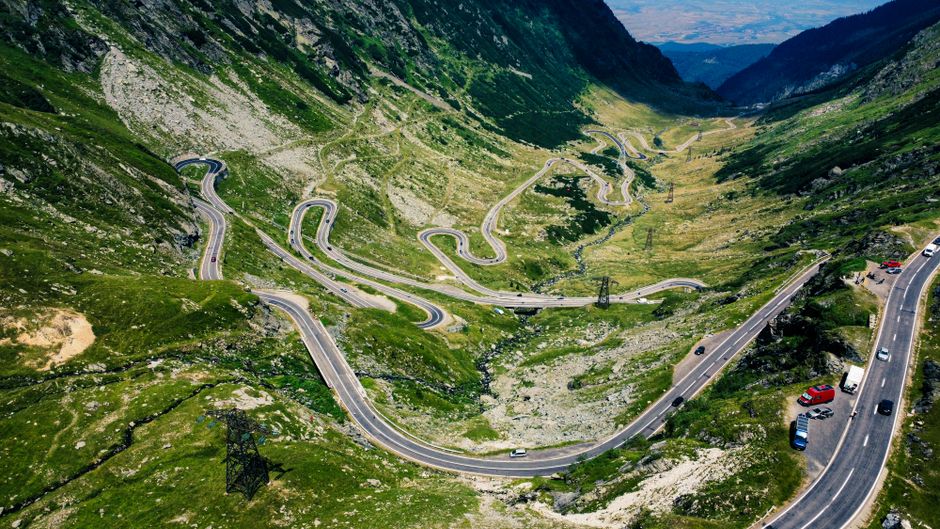
After passing the village of Căpățâneni, keep an eye out for a turnoff leading to Poenari Castle. This cliff-top fortress, perched 850 steps above the Argeș Valley, was the real stronghold of Vlad the Impaler. The climb is brutal but brief, and the ruins offer a haunting, windswept atmosphere that no Dracula-themed attraction can match. Back on the main road, the ascent intensifies. The legendary switchbacks begin in earnest as you climb toward the Bâlea Waterfall. Park at the Bâlea Cascada lot and walk to the viewing platform. The waterfall thunders down a sheer rock face, and above it you will see the road zigzagging impossibly toward the tunnel. This is the single most iconic view on the entire route. Continue through the cool darkness of the Bâlea Tunnel and emerge on the northern side, where the landscape shifts to a harsher alpine zone. Stop at Bâlea Lake, a glacial lake sitting right at the tunnel’s northern exit. Even in summer, patches of snow often linger here. Two chalets offer hot tea, hearty soups, and the chance to sleep overnight at 2,034 meters. The northern descent through the Valea Oltului is gentler but equally beautiful, with sweeping views of the Transylvanian foothills.
Transalpina: Must-See Landmarks and Viewpoints
Beginning from Novaci in the south, the drive starts through the pastoral Oltenia landscape, gradually climbing into the forests of the Parâng range. The village of Rânca, at about 1,600 meters, is the gateway to the alpine zone and a popular ski resort in winter. In summer, Rânca bursts with small guesthouses and food stalls selling grilled “mici” (skinless sausages) and telemea cheese. This is an excellent spot to fuel up before the ridge. From Rânca, the trees thin out and the road emerges onto the high alpine plateau. The transformation is breathtaking. Suddenly you are driving through a vast, open landscape of rolling green hills that stretch to the horizon in every direction.
The absolute highlight is the Urdele Pass, the highest point on any paved road in Romania at 2,145 meters. There is a small parking area and a wooden cross marking the summit. The views here are extraordinary: layers of mountain ridges fading into blue haze, with the road itself undulating ahead like a grey ribbon draped over the hills. Unlike Transfagarasan’s vertical rock walls, Transalpina offers a 360-degree panorama where you feel on top of the world. Sheep flocks frequently cross the road, and you will see shepherds with their dogs, a scene unchanged for centuries. Further north, look for the Tărtărău Saddle, a broad grassy pass that offers another stunning photo stop. The descent toward Sebeș passes through the charming town of Șugag and alongside the Oașa Reservoir. Stop at the dam for a final look back at the mountains you just conquered. The northern section feels more forested and intimate, a gentle cool-down after the exhilaration of the high ridge. Other notable stops include the Piatra Tăiată Peak viewpoint and the serene Mălaia Lake, perfect for a quiet picnic before rejoining civilization.
Scenery and Landscape: Which Road Offers Better Views?
When debating Transfagarasan vs Transalpina which is better, the visual drama each delivers is usually the deciding factor. They slice through the Southern Carpathians, yet the landscapes feel like different planets. One screams high-altitude adrenaline with jagged peaks and glacial lakes, while the other whispers serenity through endless grass-covered ridges and grazing sheep. You aren't choosing between beautiful and ugly here—you are choosing between two distinct definitions of jaw-dropping.
The scenery shifts not just by road, but by the minute. Cloud cover can swallow a summit view in seconds. Sunlight can transform a grey rock face into gold. Knowing what each pass specializes in helps you pick the right backdrop for your 2026 adventure, whether you are chasing the iconic calendar-cover shot or a quieter, soul-soothing panorama.
Transfagarasan’s Dramatic Alpine Scenery
The Transfagarasan doesn’t gently introduce itself. It grabs you by the collar. Approaching from the north, the road climbs steeply alongside a rushing river, dense spruce forests blocking the view until you burst above the treeline. Suddenly, you are in a glacial cirque dominated by Balea Lake, a sapphire-blue stretch of water sitting at 2,034 meters. Snow patches cling to the surrounding peaks well into July, creating a stark contrast of white, grey rock, and deep blue water that screams high-altitude drama.
The southern descent is where the landscape turns ferocious. You look down upon the serpentine curves that made this road famous, a seemingly impossible concrete ribbon folded onto a near-vertical wall. Here, you face Vidraru Dam’s immense scale, a curved arc of concrete holding back a fjord-like reservoir. The Fagaras Mountains, the highest in Romania, tower above you. Sharp, sculpted ridges pierce the sky, creating a classic alpine profile that feels more akin to the Swiss Alps than the typical Carpathians. Waterfalls cascade down vertical rock faces directly next to the road, spraying mist onto passing cars. The visual journey is vertical, severe, and utterly theatrical. You stop constantly—not for towns, but for sheer drops and geological power. This is scenery that demands your attention, a landscape of extremes that leaves you feeling very small against the might of the mountains.
Transalpina’s Rolling Highlands and Pastoral Vistas
If the Transfagarasan is a rock opera, Transalpina is a pastoral symphony. The road climbs onto a high plateau, the Urdele Pass, topping out at 2,145 meters—the highest paved road in Romania. But rather than feeling enclosed by towering peaks, you feel suspended in the sky. The mountains here, in the Parang and Lotru ranges, are softer and more rounded. You look out not at a single dramatic wall, but across endless waves of green-gold ridges rolling into the distance like a frozen ocean.
The defining visual motif is openness. Vast expanses of alpine grassland stretch in every direction, dotted with boulders and wildflowers. You will see shepherds tending flocks of sheep, their wooden huts and haystacks dotting the highlands, creating a bucolic scene that hasn’t changed in centuries. The road runs along the ridge line for long stretches, giving you a panoramic, 360-degree view from the comfort of your driver’s seat. You look down on deep valleys carved by ancient glaciers on one side, and a similar sweeping vista on the other. The lack of steep, enclosing rock walls changes the psychological feel of the drive. It’s airy, tranquil, and expansive. The beauty here is in the subtle details: the sound of sheep bells, the wind whipping through the short grass, the way clouds cast moving shadows across the rumpled landscape. It’s a high-altitude moorland, a sky-island that feels less about adrenaline and more about a profound, open-air peace.
Driving Experience: Road Conditions, Difficulty, and Safety
Asking about Transfagarasan vs Transalpina which is better for driving is like asking whether a scalpel or a chef’s knife is sharper—they are tools for different experiences. Both roads are modern asphalt marvels with excellent grip, but the rhythm of the drive, the concentration required, and the physical demands on your vehicle differ drastically. One is a technical, gear-shifting workout through a dark mountain belly, while the other is a high-speed, sweeping flow along the roof of the country. Your personal driving style and tolerance for exposure should dictate your choice.
Safety on both passes hinges on patience. These are not closed racetracks. You share the asphalt with tour buses, cyclists, motorcyclists, and vehicles overheating on the steep grades. In 2026, increased tourism will make early morning starts more critical than ever for a clean run. Forget speed; the reward is rhythm. Understanding the specific character of each road’s surface and danger points will ensure you focus on the view, not your anxiety.
Transfagarasan: Tight Hairpins and Tunnel Thrills
The Transfagarasan driving experience is famously intense. The northern climb is a relentless series of sharp, first-gear switchbacks that stack upon each other. You constantly saw at the steering wheel, balancing throttle and clutch. The real test comes with Balea Tunnel, a 884-meter unlit, raw-rock borehole that cuts through the mountain. It’s dark, often wet, and narrow. The uneven rock walls feel close, creating a thrilling, slightly claustrophobic experience that spits you out onto the dramatic southern descent.
On the south side, you face the iconic stretch seen on Top Gear. The road gradient is severe, and the hairpin turns are so tight that navigating them in a larger vehicle requires a three-point maneuver. You will often be looking straight down at several layers of road you are about to drive. Oncoming tour buses take up the entire lane, forcing you to reverse on a precipice. Road surface is generally smooth, but loose rocks from the cliffs above are a real hazard. Brake fade is a genuine concern on the long descent; using engine braking is mandatory, not optional. This is not a relaxing cruise. It’s a demanding, high-concentration drive that rewards technical precision. Your arms will ache, your brakes will smell, and you will feel a genuine sense of achievement pulling into a valley village. The physical and mental toll makes the stunning scenery feel earned, a prize for navigating one of Europe’s most challenging public roads.
Transalpina: High-Altitude Cruising and Wider Curves
Transalpina offers an entirely different rhythm. You climb up from either side through forested valleys on decent asphalt, but once you pop out onto the high ridge, the driving character transforms. The curves are sweeping, open, and fast. You flow from one gentle arc to the next across the undulating terrain, often with perfect visibility for hundreds of meters. It feels like driving across the top of the world, a high-altitude boulevard where the steering inputs are gentle and the stress levels are low.
The challenge here is not technical tightness but altitude exposure and distraction. The asphalt on the highest section is generally good, but it can suffer from frost heave, creating sudden dips and bumps that can unsettle a car at speed. There are no guardrails in many long stretches, just a gentle grass slope that quickly becomes a steep valley drop. The danger is deceptive; the easy, flowing nature of the road encourages higher speeds, but a moment of inattention while gawping at the endless panorama could be catastrophic. The sheer length of the pass at extreme altitude means weather changes are rapid and severe. A clear sky can turn into a hailstorm within fifteen minutes, leaving the road slick. You have fewer sheer rock walls to make you feel hemmed in, but the crosswinds are ferocious and can push a high-sided vehicle around. Transalpina is a grand touring experience, a place for a smooth, fast, and exhilarating flow state, where the driving is less about fighting the mountain and more about dancing with its contours.
Best Time to Drive: Seasonal Access and Weather Considerations
The single most critical factor in planning your 2026 road trip for either pass is timing. These are not year-round roads. They are high-altitude seasonal routes, typically buried under meters of snow for over half the year. The official opening dates are a movable feast, dictated by spring avalanches, late blizzards, and the sheer effort required to clear the packed ice. Even during the official "open" season, the weather at the summit can be a completely different season from the valley below. Sunbathing in shorts at the base means you’ll need a winter jacket at the top. You are planning a drive through the sky, and the sky doesn’t follow a predictable calendar.
Understanding the nuances of access windows, and the risks of pushing them, is what separates a successful trip from a wasted one. The best time to drive isn’t just about the road being free of snow gates; it’s about finding that sweet spot of stable weather, clear visibility, and safe asphalt temperatures before the summer tourist crush descends.
When is Transfagarasan Open in 2026?
The Transfagarasan typically has a shorter and stricter operational window. The official target for clearing the road is usually July 1st, but this is highly dependent on the previous winter’s snowpack. In heavy snow years, the road might not fully open until mid-July. Do not plan a 2026 trip for June expecting to cross the summit; the snow gates near Balea Lac will almost certainly be locked. The road is cleared from both ends, and the final section near the tunnel is a massive excavation effort through walls of ice and rock.
The best months to drive in 2026 will be August and the first half of September. August offers the most reliable weather, with daytime temperatures at the summit hovering around 10–15°C (50–59°F), though wind chill can make it feel near freezing. However, August weekends are notoriously crowded with heavy coach traffic, creating long queues at the tunnel and hairpins. The sweet spot is a weekday in early September. The tourist numbers drop, the weather often remains stable and crisp, and the autumn light turns the landscape golden. The road officially closes for winter on November 1st, but a sudden heavy snowfall in mid-October can shut it down without warning. Always check the live camera feeds from Balea Lac and have a flexible itinerary. Attempting the pass in early July 2026 means you must verify the gates are actually open, not just assume.
When is Transalpina Open in 2026?
Transalpina generally enjoys a slightly longer season than its famous sibling, though its higher altitude poses its own challenges. The road authorities usually aim to clear the pass by mid-June, making a late June crossing possible in lighter snow years. For your 2026 planning, you should not bank on a guaranteed full crossing before the last week of June. The high plateau section at Urdele Pass is exposed, and drifting snow can block the road even after the snowplows have made an initial pass.
The prime window for Transalpina in 2026 stretches from July through late September. Because the road is a long ridge, it is far more susceptible to sudden, dangerous weather closures even in peak summer. A thunderstorm can drop a layer of hail that turns the asphalt white in minutes. The best strategy is to aim for a mid-week drive in late August or early September, when the days are still long, but the extreme heat haze that can blur the distant vistas has lessened. October is a wildcard. You can experience a stunning, warm autumn day with perfect clarity, or you can find the road closed by an early blizzard. The official closure is also around November 1st, but the high section often becomes impassable earlier. For 2026, prioritize Transalpina in the stable summer core, and treat any crossing outside of July 1st to September 30th as a gamble requiring real-time local intel.

Facilities, Accommodations, and Nearby Attractions
A great mountain road isn't just about the asphalt and the views—it's also about where you can pause, refuel, sleep, and explore along the way. The facilities along Transfagarasan and Transalpina are quite different, and your experience will vary dramatically depending on which one you choose. One road feels more like a well-trodden tourist circuit with established pit stops, while the other retains a wilder, more remote character where planning ahead becomes essential.
Both roads have seen improvements in recent years, but 2026 travelers should still expect distinct differences in comfort levels. From rustic mountain huts to surprisingly elegant guesthouses, here's what you'll find when hunger strikes or fatigue sets in on each route.
Where to Stay and Eat Along Transfagarasan
Transfagarasan benefits from its status as Romania's most famous road, meaning the infrastructure is slightly more developed, though it's still far from overcrowded with commercial establishments. Your best bet for a meal is Bâlea Lac, the glacial lake perched at 2,034 meters. Here you'll find several chalets serving hearty Romanian fare—think ciorbă de burtă (tripe soup), mămăligă with cheese and sour cream, and grilled mititei sausages. The food is simple, filling, and exactly what you need after braving mountain switchbacks.
Cabana Bâlea Lac offers rustic accommodation right on the lake shore, with basic but warm rooms. Book well ahead for summer 2026 weekends. For a more comfortable stay, descend to the northern side and stop in Arefu or Căpățâneni villages, where family-run pensions provide cozy beds and home-cooked dinners. Vila Diana and Pensiunea Bella Vista are reliable choices with stunning views of the Făgăraș massif.
Near the southern end, Curtea de Argeș makes an ideal overnight base. This historic town boasts several boutique hotels and the breathtaking Curtea de Argeș Monastery, a masterpiece of Romanian architecture. Restaurants here are more refined—try Restaurantul Domnesc for traditional dishes in a royal setting. Don't leave without sampling papanăși, fried doughnuts with sour cream and berry jam.
For a truly unique experience, consider staying at Cabana Capra near the tunnel. It's spartan but positions you perfectly for sunrise photography. Food options thin out dramatically outside the summer season, so pack snacks and water if traveling between October and May.
Where to Stay and Eat Along Transalpina
Transalpina's facilities are noticeably sparser, which is precisely its charm for many travelers. This road crosses a more remote stretch of the Carpathians, and the lack of development means you'll need to plan your stops more carefully. The highest point at Pasul Urdele (2,145 meters) has a few small kiosks selling grilled meats, cheeses, and hot drinks during peak season, but don't expect a full restaurant experience up here.
Rânca, a small resort town on the southern side, is your best bet for a proper meal and a comfortable bed. This ski destination transforms into a hiking hub in summer, with numerous guesthouses and small hotels. Pensiunea Rânca and Hotel Păltiniș offer clean rooms and restaurants serving local Gorj county specialties. The lamb pastrami and bulz ciobănesc (polenta stuffed with cheese and baked) are standout dishes you shouldn't miss.
On the northern approach, the town of Novaci serves as the gateway with several supermarkets and bakeries where you can stock up. For accommodation, consider driving slightly farther to Baia de Fier, where you'll find the charming Conacul Olarilor, a restored manor house with exceptional hospitality. The nearby Peștera Muierii (Women's Cave) is worth a visit for its impressive limestone formations and fascinating prehistoric history.
Wild camping is technically discouraged along much of Transalpina, but discreet overnight parking in designated areas is tolerated by locals. If you're self-sufficient with a campervan, you'll find countless spots with jaw-dropping morning views. Just remember to leave no trace and respect the fragile alpine environment. For 2026, several new agrotourism initiatives are launching near Obârșia Lotrului, offering farm stays with authentic sheepfold experiences and cheese-making workshops.
Which Road Should You Choose? A Direct Comparison
By now you've absorbed a lot of information about both roads, and the question remains: Transfagarasan vs Transalpina which is better for your specific trip? The honest answer is that neither road is objectively superior—they excel in different areas and cater to different travel styles. Your perfect Romanian mountain road depends entirely on what you value most in a driving experience.
Let's strip away the poetry and look at the hard facts. One road demands your attention with dramatic hairpins and a tunnel through solid rock. The other seduces you with sweeping curves and endless ridge-line vistas. One feels engineered to impress, the other carved organically through ancient pastoral landscapes. Both will leave you breathless, but for different reasons.
Consider your vehicle carefully. Transfagarasan's tight switchbacks and steep gradients punish underpowered cars and test brake systems. Transalpina's gentler grade is kinder to smaller engines and less experienced drivers, though its higher altitude means weather can turn nasty without warning. If you're renting, both roads are fully paved now, but Transalpina's surface is generally smoother and newer after recent resurfacing projects.
Think about timing too. Transfagarasan's seasonal closure is rigid and enforced. Transalpina sometimes opens earlier and closes later, though conditions vary. For a June 2026 trip, Transalpina offers more certainty. For guaranteed drama in August, Transfagarasan delivers. Crowds are another factor—Transfagarasan sees significantly more traffic, especially tour buses and motorcycle groups on weekends. Transalpina remains quieter even in peak season.
Ultimately, the Transfagarasan vs Transalpina which is better debate comes down to this: choose Transfagarasan for jaw-dropping engineering and concentrated spectacle. Choose Transalpina for solitude, serenity, and a more meditative mountain journey. If you have time, drive both and decide for yourself—they're only a few hours apart, and combining them makes for an unforgettable Transylvanian loop.
Transfagarasan vs Transalpina: At a Glance Comparison Table
Sometimes you just need the facts laid out clearly. This quick-reference comparison cuts through the storytelling and gives you the essential details side by side, helping you make a confident decision for your 2026 road trip without scrolling through paragraphs of description.
Keep in mind that both roads are subject to weather conditions, and facilities can change year to year. Always check local updates before setting out, particularly in early summer or late autumn when snow can linger or return unexpectedly.
Transfagarasan stretches approximately 90 kilometers from Bascov to Cârțișoara, crossing the Făgăraș Mountains at an altitude of 2,042 meters at Bâlea Lake. Transalpina covers about 148 kilometers from Novaci to Sebeș, reaching 2,145 meters at Pasul Urdele, making it Romania's highest paved road. Transfagarasan features the famous Capra Tunnel—Romania's longest road tunnel at 884 meters—while Transalpina has no tunnels but offers longer stretches above the tree line. Both roads are fully paved as of 2026, though Transalpina's surface is generally in better condition. Transfagarasan typically opens July through October; Transalpina often opens mid-June through October. Expect heavier traffic on Transfagarasan, especially weekends. Transfagarasan suits those seeking iconic photography spots and engineering marvels; Transalpina appeals to travelers craving solitude and expansive high-altitude cruising.
Recommendations for Different Types of Travelers
Every traveler brings different expectations to a mountain road trip, and matching the right road to your personality makes all the difference. Here's how Transfagarasan and Transalpina suit various travel styles, so you can pick the route that resonates with your 2026 adventure goals.
For the avid photographer chasing those iconic shots, Transfagarasan wins hands down. The hairpin curves stacking dramatically toward Bâlea Lake, the tunnel emerging onto a glacial panorama, and the dam wall at Vidraru create instantly recognizable images. Morning light hitting the northern switchbacks is magical, and autumn transforms the valley into a golden corridor. Bring a wide-angle lens and a tripod for long exposures of the winding road.
Motorcyclists face a tougher choice. Transfagarasan offers technical riding satisfaction with tight curves and elevation changes that test your skills. The road surface can be patchy in places, demanding constant attention. Transalpina provides flowing, sweeping bends perfect for relaxed cruising with the throttle open. The smoother surface inspires confidence, and the lack of tunnels means uninterrupted riding. Many bikers prefer Transalpina for pure riding pleasure, though Transfagarasan carries bragging rights.
Families with children should lean toward Transalpina. The gentler gradients reduce car sickness risk, and the open landscapes allow kids to spot sheep, horses, and traditional shepherds' huts. Rânca offers family-friendly accommodation with playgrounds and easy hiking trails. Transfagarasan's intense switchbacks can be stressful for young passengers and drivers managing backseat complaints simultaneously.
Solo travelers seeking introspection will find Transalpina's quiet majesty deeply rewarding. Pull over anywhere along the ridge, switch off the engine, and absorb absolute silence broken only by wind and sheep bells. Transfagarasan's popularity means you'll rarely experience true solitude during daylight hours. For couples on a romantic road trip, Transfagarasan's dramatic scenery creates shared moments of awe, while cozy guesthouses in Arefu offer intimate evenings with mountain views. Adventurous pairs might prefer Transalpina's sense of discovery and the charming agrotourism stays around Novaci.
Final Verdict: Our Take on the Ultimate Romanian Road Trip
After countless kilometers threading through the Carpathians, pausing at every viewpoint, and debating the merits of each curve over warm meals in mountain cabanas, we've reached our conclusion. The Transfagarasan vs Transalpina which is better question has no single correct answer—and that's the beauty of Romania's mountain roads. Each route offers something irreplaceable, and the true winner is the traveler who makes time for both.
If you absolutely must choose just one for your 2026 journey, let your travel personality guide you. Transfagarasan is the showstopper, the road you drive to feel your heart race and your jaw drop. It's built for grand gestures and photographs that will dominate your travel album. Transalpina is the slow burn, the road that seeps into your soul gradually as you cruise above the clouds, alone with your thoughts and the endless horizon. It rewards patience and presence over quick thrills.
Our genuine recommendation is to plan a loop connecting both roads. Start in Sibiu, drive Transalpina south to north, overnight in a guesthouse near Novaci, then cross to Transfagarasan the following day. This route gives you the serene highlands first, building anticipation before the explosive finale among the Făgăraș peaks. Two days, two legendary roads, and memories that will linger long after you've descended back to the plains. Romania's mountain passes are among Europe's finest driving experiences, and in 2026 they await you in their best condition yet. Pack your sense of wonder, charge your camera, and point your wheels toward the Carpathians. The road is calling.
Gear for this trip
- Wide Angle Lens for Travel Photography
- Travel Tripod for Landscape Photography
- Car Phone Mount for Road Trip
- Portable Cooler for Road Trip
- Motorcycle Helmet Bluetooth Headset
As an Amazon Associate I earn from qualifying purchases.


No comments:
Post a Comment