Photo by Elijah Cobb via Pexels
Palermo does not ease you in. From the moment you step off the train or out of a taxi from Falcone-Borsellino Airport, the Sicilian capital comes at you in layers: the smell of frying panelle drifting from a street cart, the clatter of Vespas weaving through pedestrians on Via Maqueda, the gilded shimmer of a Byzantine mosaic glimpsed through a half-open church door, and the low hum of a city that has been fought over, ruled, and rebuilt by more civilizations than almost anywhere else in the Mediterranean. Phoenicians founded it, Romans governed it, Arabs transformed it into one of the great cities of the medieval world, Normans crowned kings here, and Spanish viceroys left their mark on its palaces. That improbable mixture is still visible on nearly every block, and it is the single biggest reason Palermo rewards travelers who are willing to look past the peeling stucco and into the detail.
This is not a city that has been sanded down for tourism the way parts of Florence or Venice have. Palermo is loud, a little chaotic, occasionally scruffy around the edges, and completely unconcerned with being anything other than itself. That is precisely its appeal. You can stand inside the Cappella Palatina and be surrounded by gold mosaics that rival anything in Istanbul or Ravenna, then walk five minutes and be elbow to elbow with grandmothers haggling over swordfish at the Ballarò market. You can eat a two-euro arancina standing up at a hole-in-the-wall counter that has been frying them the same way for three generations, then dine that same evening on some of the freshest seafood in southern Italy. Few cities pack such a wide emotional and sensory range into so compact a center.
Palermo also serves as the natural gateway to the rest of Sicily. It sits close enough to Monreale, Cefalù, and the wine country around Marsala and Trapani that it makes an excellent base for day trips, while having more than enough of its own attractions to justify a stay of three days or longer. Its beaches, most notably Mondello, are a short bus ride away, giving the city a genuine seaside-holiday dimension that many landlocked Italian art cities lack. Add in a nightlife scene built around informal aperitivo culture, a UNESCO-recognized puppet theater tradition, and some of the best and cheapest street food in the country, and it becomes clear why Palermo has quietly become one of Italy's most compelling city breaks. This guide walks through everything you need to plan a trip here: what to see, where to eat, how to get around, and how to structure your time so you leave with a real feel for the city rather than a checklist of photographs.
Quick Facts & Best Time to Visit
Palermo sits on Sicily's northwestern coast and enjoys a classic Mediterranean climate: hot, dry summers and mild, wetter winters. The sweet spots for visiting are spring (April to early June) and early autumn (September to mid-October), when daytime temperatures hover comfortably between 20 and 27 degrees Celsius, the countryside around the city is green rather than scorched, and the crowds at major sights are thinner than in peak summer. July and August can push past 35 degrees Celsius, and the combination of heat and humidity makes extensive walking through the historic center genuinely tiring in the early afternoon. Winter (November to March) is mild by northern European standards, rarely dropping below 8 degrees Celsius, and can be a pleasant, uncrowded, budget-friendly time to visit, though some beach towns and seasonal restaurants scale back their hours.
The currency is the euro, and the official language is Italian, with a distinct Sicilian dialect widely spoken at home and in markets; English is common in hotels and central restaurants but less so in neighborhood trattorias and markets, so a few basic Italian phrases go a long way. Citizens of the EU, UK, US, Canada, Australia, and many other countries can visit for up to 90 days without a visa under standard Schengen rules, though it is worth checking current requirements before booking, as they can change.
Falcone-Borsellino Airport (Palermo Airport, code PMO) sits about 35 kilometers northwest of the city center. The Trinacria Express train and regular bus shuttles both connect the airport to the central train station in roughly 45 to 50 minutes, and taxis take about the same time barring traffic, with fixed fares typically posted at the airport taxi rank. Within the city, the historic center is compact enough to explore almost entirely on foot, and comfortable walking shoes matter far more than any transit pass, since much of the old town is cobblestone and pedestrianized. For trips slightly further out, such as to Mondello or Monreale, city buses run by AMAT are cheap and frequent, though schedules can be loose, and taxis or ride-hailing apps are a reliable backup. Traffic in central Palermo is notoriously energetic, so renting a car is only worth it if you plan to explore rural Sicily beyond the city itself.
Top Things to Do in Palermo
Palermo Cathedral
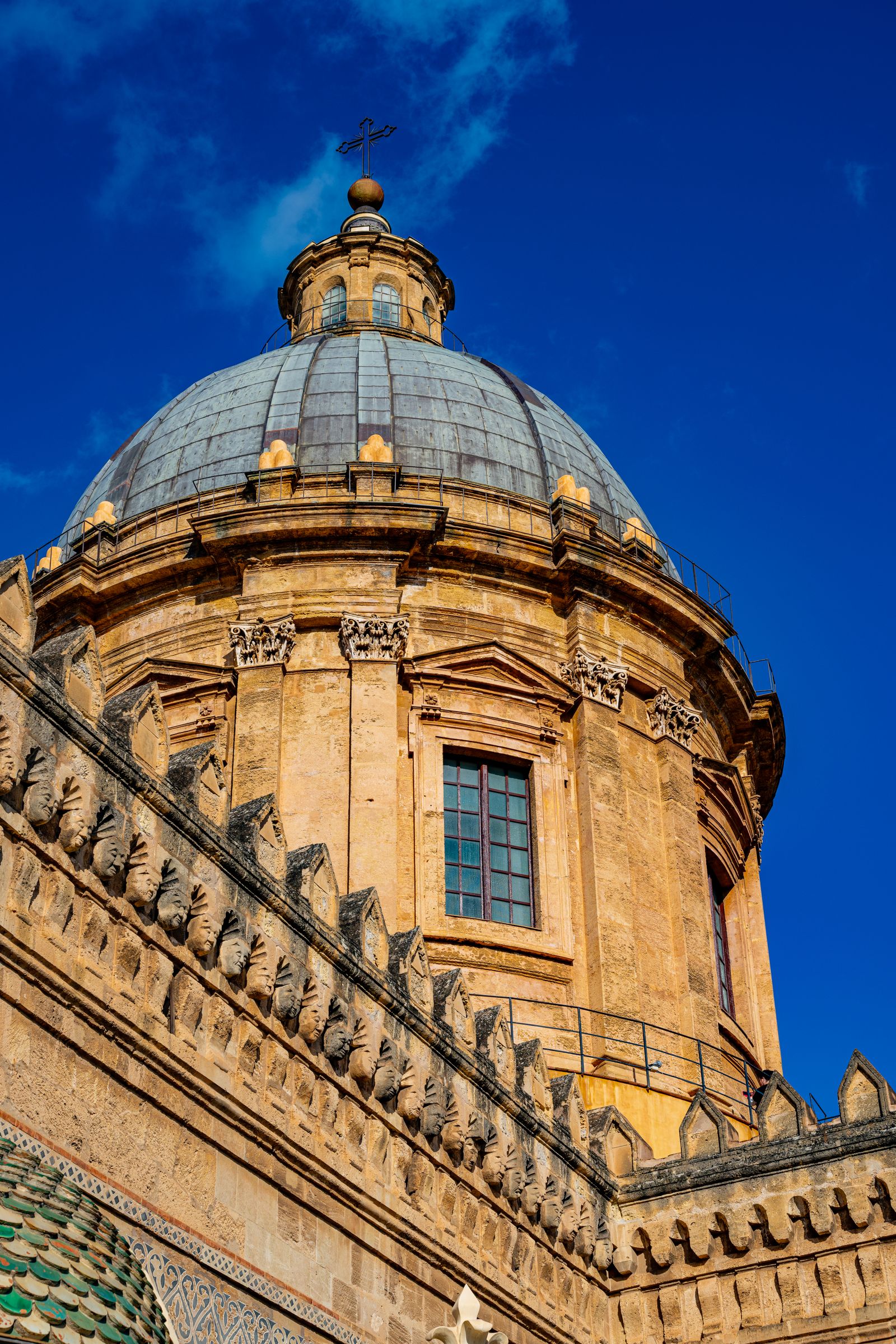
The Cattedrale di Palermo, formally dedicated to the Assumption of the Virgin Mary, is the single most photographed building in the city, and for good reason. Its exterior is a visual timeline of Palermo's layered history: Norman battlements, Gothic spires, Catalan doorways, and a neoclassical dome added in the eighteenth century, all somehow coexisting on one facade. The cathedral began life as a mosque during the Arab period before being converted into a church under Norman rule in the twelfth century, and traces of that Islamic-era structure, including inscribed columns, survive inside. Visitors can explore the main basilica for free, but it is worth paying the modest combined ticket that includes the royal tombs, where Norman king Roger II and Holy Roman Emperor Frederick II are buried in dramatic porphyry sarcophagi, as well as the treasury and the rooftop terraces. The rooftop route, accessed via a narrow staircase, delivers sweeping views over the cathedral's own domes and out across the rooftops of the historic center toward the surrounding mountains, and is genuinely one of the best photo opportunities in Palermo. Arrive early, ideally right at opening, to avoid both the heat on the roof stairs and the tour groups that build up by mid-morning. The cathedral sits directly on Corso Vittorio Emanuele, the main pedestrian spine of the old town, making it an easy stop to combine with a walk toward the Quattro Canti.
Teatro Massimo
Europe's third-largest opera house by size, after those in Paris and Vienna, Teatro Massimo is Palermo's grandest piece of nineteenth-century architecture and a genuine point of civic pride. Construction began in 1875 and dragged on for over two decades, a saga so notorious locally that it partly inspired the closing scenes of "The Godfather Part III," filmed on its steps. The neoclassical facade, fronted by a wide staircase and flanking bronze lions, opens into an interior of red velvet, gilded balconies, and a ceiling painted with allegorical scenes, all built around famously excellent acoustics. Guided tours run throughout the day in multiple languages and take about 25 to 30 minutes, covering the auditorium, the royal box, and sometimes rehearsal spaces depending on the performance schedule; tickets are inexpensive and can usually be bought at the door, though booking ahead online avoids any wait. For a deeper experience, catching an actual opera, ballet, or concert here is memorable even for visitors who are not usually opera-goers, since the setting does much of the work. The piazza in front of the theater is also simply a pleasant place to sit with a coffee or a granita and watch the city go by, especially in the early evening when the facade is lit.
Quattro Canti
The Quattro Canti, or "Four Corners," marks the exact intersection of Palermo's two historic main streets, Via Maqueda and Corso Vittorio Emanuele, and effectively divides the old town into its four traditional quarters. Officially named Piazza Vigliena after the Spanish viceroy who commissioned it in the early seventeenth century, the octagonal square is framed by four curved Baroque facades, each decorated with a fountain representing one of the four seasons, a statue of a Spanish king, and the image of a patron saint associated with that quarter of the city. It is a small space, easy to underestimate on a quick pass, but worth pausing in for several minutes to actually read the layered symbolism and watch how the light changes across the four facades as the sun moves. Traffic and foot traffic converge here constantly, so it can feel hectic, but that energy is part of its character as the symbolic heart of the city. It also functions as the most useful orientation point in Palermo: nearly every walking route through the historic center will bring you back through or near the Quattro Canti at some point, and it sits within a minute's walk of the cathedral, Piazza Pretoria, and the Ballarò market entrance.
Fontana Pretoria
Just steps from the Quattro Canti, Piazza Pretoria centers on an enormous and elaborately sculpted sixteenth-century fountain originally designed for a villa in Florence before being purchased and reassembled here in 1574. Ringed by tiers of nude mythological figures, nymphs, and river gods carved in white marble, the fountain earned the sharp-tongued nickname "Fontana della Vergogna," or Fountain of Shame, supposedly for the scandal its nudity caused among the nuns of the adjacent convent when it was installed, though historians debate how much of that story is later embellishment. Whatever the origin of the nickname, the fountain remains one of Palermo's most striking public artworks and photographs beautifully in both daylight and evening illumination. The piazza is flanked by the Palazzo delle Aquile, Palermo's city hall, and the church of Santa Caterina, whose interior is a riot of Sicilian Baroque stuccowork and marble inlay that few visitors bother to enter, making it a rewarding detour if the door happens to be open. The square is small enough to see properly in fifteen or twenty minutes but sits directly on the route between the cathedral and La Martorana, so it fits naturally into almost any walking itinerary of the center.
Palazzo dei Normanni and Cappella Palatina
The Palazzo dei Normanni, or Norman Palace, is the oldest royal residence in Europe still in use today, currently serving as the seat of Sicily's regional parliament, and its origins stretch back to Arab-era fortifications later expanded by Norman kings. The undisputed highlight inside is the Cappella Palatina, a private royal chapel commissioned by Roger II in the 1130s and widely considered one of the finest surviving examples of Arab-Norman-Byzantine artistic fusion anywhere in the world. Nearly every surface of the chapel's interior is covered in gold mosaics depicting biblical scenes, set beneath an extraordinary carved wooden muqarnas ceiling of Islamic craftsmanship, above a floor of intricate Cosmatesque marble inlay. The combined effect, three distinct artistic traditions working in total harmony, is genuinely one of the most beautiful interiors in Europe and justifies the trip on its own. Because the palace remains a working government building, access to certain rooms, including the King Roger Room with its mosaic hunting scenes, can be restricted depending on parliamentary sessions, so it is worth checking opening hours in advance and buying tickets online to skip the queue, which can be long by mid-morning in high season. Visits typically take 45 minutes to an hour, and the palace sits at the western end of Corso Vittorio Emanuele, a fifteen-minute walk from the Quattro Canti.
La Martorana and San Cataldo
Standing side by side on Piazza Bellini, these two churches offer a striking architectural contrast that neatly illustrates Palermo's layered history. La Martorana, formally the Church of Santa Maria dell'Ammiraglio, was founded in 1143 by George of Antioch, an admiral in the Norman court, and its interior preserves some of the finest Byzantine-style mosaics outside of Ravenna and Istanbul, including a famous panel depicting Roger II being crowned directly by Christ rather than by the Pope, a bold political statement in gold tesserae. The church's bell tower, one of the oldest Norman structures in the city, still shows its original arcaded Arab-Norman design beneath later Baroque additions to the main body of the church. Right beside it, San Cataldo presents an almost startling contrast: a squat, austere Norman building topped with three distinctive red domes, its plain stone interior left deliberately unadorned, offering a rare chance to see Arab-Norman architecture without later Baroque overlay. Both churches can be visited in under an hour combined, and there is a modest entry fee for La Martorana that also supports its upkeep. The piazza itself, with its palm trees and the nearby Fontana del Garraffo, is a pleasant, relatively quiet spot to linger, just a two-minute walk south of the Quattro Canti.
Ballarò Market
Ballarò is Palermo's oldest and largest open-air market, tracing its roots back over a thousand years to the Arab period, and it remains the most authentic place in the city to see daily Palermitan life in full volume. Stalls stretch through the narrow streets around Piazza Ballarò and Piazza del Carmine, piled with swordfish and tuna still glistening from the morning catch, mountains of Sicilian citrus, wild capers, sun-dried tomatoes, and enormous wheels of caciocavallo cheese, all sold by vendors who call out prices in a rapid Sicilian dialect that is half theater. By late morning the market is at its loudest and most crowded, which is exactly when it is most fun to visit, though it thins out considerably by early afternoon when many stalls begin closing. Beyond produce, Ballarò is one of the best places in the city for cheap, excellent street food: look for fried panelle and crocché sandwiches, grilled octopus, and stalls selling sfincione, Palermo's thick, spongy, tomato-and-onion topped answer to pizza. It is worth simply wandering without a fixed plan here, camera down, taking in the smells and noise rather than trying to photograph everything, since much of the appeal is sensory rather than visual. The market sits a short walk south of the cathedral, in a neighborhood that also holds some of the city's cheapest and most memorable meals after dark.
Vucciria Market
Once Palermo's principal food market and immortalized in a famous 1974 painting by Sicilian artist Renato Guttuso, Vucciria has transformed over recent decades from a purely daytime produce market into something closer to a nighttime social hub, though a smaller cluster of food stalls still operates in the mornings. By evening, especially on weekends, the narrow streets around Piazza Caracciolo fill with young locals and visitors buying cheap drinks and street food from folding tables and makeshift bars, turning the area into one of Palermo's liveliest informal nightlife scenes. It has a rougher, more improvised feel than Ballarò, and that unpolished energy is exactly why many visitors find it memorable; this is not a curated experience but a genuinely local one. During the day, it is worth a shorter visit to see the historic market architecture and grab lunch from one of the surviving food stalls, particularly for pane con la milza, Palermo's famous spleen sandwich, a strong flavor that is either loved or avoided but is undeniably a piece of local culinary identity. The market sits close to the port and the Cala, Palermo's old harbor, making it easy to combine with a stroll along the waterfront. As with any crowded nighttime area, keep valuables secure and stick to well-lit, populated streets.
Capuchin Catacombs
Not for the faint of heart, the Catacombe dei Cappuccini hold roughly 8,000 mummified and skeletal remains of Palermitans, dating from the late sixteenth century through the early twentieth century, arranged along underground corridors according to gender, profession, and social status. What began as a burial practice for Capuchin friars, whose desiccated remains are preserved through the catacombs' unusually dry air, became a status symbol among Palermo's elite, who paid for the privilege of having their bodies mummified and displayed in formal dress, some still recognizable more than a century later. The most famous resident is Rosalia Lombardo, a two-year-old girl who died in 1920 and whose body, thanks to an early embalming technique, remains so remarkably preserved that she is sometimes called "Sleeping Beauty." The catacombs are genuinely unsettling for some visitors, and photography is prohibited out of respect, but they offer an unusually direct, unfiltered window into how Palermitans across several centuries understood death, memory, and social standing. Visits typically take 30 to 45 minutes and the site is a short taxi or bus ride from the historic center, near Piazza Indipendenza. It is not recommended for young children or anyone particularly sensitive to imagery of human remains, but for most adult travelers it is one of the most memorable and thought-provoking stops in the city.
Mondello Beach
Twelve kilometers northwest of central Palermo, Mondello is the city's beloved seaside escape, a wide arc of fine white sand set against turquoise water and framed by the limestone cliffs of Monte Pellegrino and Monte Gallo. Once a swampy fishing village, it was transformed into an elegant bathing resort in the early twentieth century, and its centerpiece, the graceful Art Nouveau bathing pavilion known as the Charleston, still stands on stilts over the water and remains one of the most photographed structures on the beach. Public sections of the beach are free and can get crowded in July and August, while paid beach clubs offer sunbeds, umbrellas, and showers for a daily fee; either option works well, though arriving before mid-morning secures better space in peak season. Beyond swimming, Mondello has a lively promenade lined with gelaterias, seafood restaurants, and casual bars that fill up for aperitivo as the sun sets over the bay, making it easy to turn a beach afternoon into a full evening out. Regular AMAT city buses connect Mondello to central Palermo in about 20 to 30 minutes and run frequently in summer, making it an easy half-day or full-day trip without needing a car. Come outside peak summer weekends if possible, since Mondello is where much of Palermo itself heads to unwind, and it shows.
Palazzo Abatellis and the Galleria Regionale della Sicilia
Housed in a restored fifteenth-century Catalan-Gothic palace in the Kalsa district, the Galleria Regionale della Sicilia at Palazzo Abatellis holds one of the finest collections of Sicilian art anywhere on the island, thoughtfully installed by the celebrated architect Carlo Scarpa in a mid-twentieth-century renovation that is itself considered a landmark of modern museum design. The undisputed highlight is Antonello da Messina's "Annunciata," a small, quietly luminous portrait of the Virgin Mary that is one of the masterpieces of Sicilian Renaissance painting and worth the visit on its own. Equally striking is the enormous fresco fragment "Trionfo della Morte," or Triumph of Death, a haunting fifteenth-century depiction of a skeletal figure on horseback cutting down figures from every level of society, originally from a nearby palace courtyard and now displayed on its own dedicated wall. The museum is manageable in scale, taking most visitors about an hour to see properly, and rarely feels crowded even in high season, offering a welcome contrast to the bustle of the markets and main squares nearby. It sits in the Kalsa neighborhood, close to several of the city's best contemporary restaurants and bars, making it easy to pair a museum visit with lunch or an early dinner in the same walk.
Orto Botanico di Palermo
Founded in 1789, Palermo's botanical garden is one of the oldest and most important in Italy, and its collection reflects the city's long history as a crossroads of trade with North Africa, the Middle East, and beyond. Enormous Ficus macrophylla trees, their aerial roots forming cathedral-like canopies, are the garden's signature sight, alongside towering bamboo groves, a collection of succulents and cacti, papyrus ponds, and a neoclassical main building, the Gymnasium, built in the same era as the garden itself. It is a genuinely peaceful escape from the intensity of the historic center, shaded and quiet even in summer heat, and popular with local students and families as much as with tourists. The garden sits adjacent to Villa Giulia, one of Palermo's oldest public parks, laid out in the eighteenth century with geometric paths, fountains, and mature trees, and the two can easily be visited together for a relaxed two-hour break from sightseeing. Both are located in the Kalsa area near the waterfront, within reasonable walking distance of Palazzo Abatellis and the Foro Italico promenade, making this stretch of the city one of the most pleasant for an unhurried afternoon walk.
Oratorio del Rosario di Santa Cita
Tucked away behind an unassuming exterior near the Vucciria, this small oratory houses one of the most extraordinary interiors in Palermo: floor-to-ceiling white stucco decoration by Giacomo Serpotta, the master Sicilian sculptor whose work here, completed around 1720, is considered among the finest examples of Baroque stucco art in Europe. Cherubic figures, allegorical women representing virtues, and elaborate decorative frames wrap the entire chapel in a way that feels almost theatrical, all executed in brilliant white plaster that catches light dramatically against the darker altarpiece paintings. The oratory's altarpiece, a large depiction of the Battle of Lepanto attributed to the school of Carlo Maratta, adds a further layer of historical resonance, commemorating the 1571 naval victory that Sicily's rulers considered a defining moment for Christian Europe. Because it receives a fraction of the visitors that the cathedral or Cappella Palatina do, the oratory offers a rare chance to stand alone in a genuinely world-class interior. It typically takes only 15 to 20 minutes to visit and pairs naturally with a walk through the nearby Vucciria market, though opening hours can be limited, so checking ahead or visiting with a local guide who has arranged access is worthwhile.
Best Neighborhoods to Explore
Palermo's historic center is traditionally divided into four quarters, or mandamenti, radiating out from the Quattro Canti, and each has developed a distinct character worth exploring on foot rather than rushing through. The Albergheria quarter, home to the Ballarò market, is the most raw and unfiltered slice of daily Palermitan life, with narrow lanes, drying laundry strung between balconies, and some of the cheapest, most authentic street food in the city; it can feel a little rough around its edges after dark, but by day it is essential for understanding how Palermo actually functions.
The Kalsa, once the Arab administrative quarter and later a rough, war-damaged district, has undergone the most visible transformation of any Palermo neighborhood over the past two decades. It is now home to Palazzo Abatellis, the Orto Botanico, the waterfront Foro Italico promenade, and a growing cluster of wine bars, design shops, and contemporary restaurants, while still retaining atmospheric, half-restored corners that give it real texture rather than a scrubbed-clean feel. Piazza Marina, with its enormous Ficus macrophylla trees and the Garibaldi garden, sits at its edge and is one of the most pleasant public spaces in the city for an evening stroll.
The Vucciria quarter, centered on its namesake market, is compact and best experienced in two very different modes: a quieter daytime wander through the historic market streets, and a livelier nighttime visit for cheap drinks and street food among a young, mixed crowd of locals and travelers. It borders the port area, so it is worth continuing a Vucciria evening with a walk toward the harbor if the weather is good.
Via Maqueda and Corso Vittorio Emanuele, the two grand pedestrian axes that cross at the Quattro Canti, form the natural spine connecting all four quarters and are lined with the majority of Palermo's shops, gelaterias, and mid-range restaurants, making this corridor the easiest and most comfortable base for first-time visitors, especially those staying in the many boutique hotels and B&Bs housed in restored historic palazzi along or just off these streets.
A little further out, the modern district around Politeama and Via della Libertà offers a completely different atmosphere: wide, tree-lined nineteenth-century boulevards, upscale shopping, and grand belle epoque buildings including the Politeama theater itself, reflecting Palermo's period of prosperity after Italian unification. It is quieter and more orderly than the historic center, making it a good choice for travelers who want easy access to the sights while retreating each evening to a calmer, more residential feel, and it connects easily by foot or short taxi ride back into the old town.
Where to Eat & Drink
Palermo's food culture is inseparable from its street life, and eating well here often means eating standing up, from a paper cone, at a counter with no menu. Sfincione, a thick, spongy focaccia-like bread topped with tomato, onion, anchovy, and caciocavallo cheese, is the city's signature savory bite, sold by weight at bakeries and market stalls throughout the historic center. Arancine, Sicily's stuffed and fried rice balls, come in countless variations, but the classic Palermo version is conical in shape, typically filled with ragù, peas, and mozzarella. Panelle, thin fried chickpea flour fritters, and crocché, potato croquettes, are traditionally served together in a soft roll as a working-class lunch that remains beloved across all social classes today. For the more adventurous, pane con la milza, a sandwich of sautéed veal spleen and lung served in a sesame roll, sold from smoking stalls at Vucciria and elsewhere, is a genuine local institution, while quarume, a boiled tripe and stomach dish, appears in some of the same stalls for those wanting to go further still.
For sit-down meals, Trattoria Ai Cascinari in the Zisa neighborhood has built a loyal following for honest, well-priced Sicilian home cooking, from pasta con le sarde, the classic sardine, wild fennel, pine nut, and raisin dish, to grilled swordfish involtini. In the Kalsa, Osteria Ballarò and the string of casual seafood spots around Piazza Marina offer fresher, slightly more polished takes on the same coastal repertoire, while Antica Focacceria San Francesco, one of the city's oldest and most storied eateries near the Basilica di San Francesco d'Assisi, remains a reliable stop for sfincione and traditional Palermitan dishes in a historic setting. For dessert, Palermo takes its pastries seriously: cannoli filled to order rather than pre-piped, cassata siciliana with its marzipan and candied fruit, and granita served with a warm brioche col tuppo for breakfast, a genuinely Sicilian tradition rather than a tourist gimmick, are all worth seeking out, with Pasticceria Cappello and Bar Alba both frequently recommended by locals for the real thing.
Drinking culture in Palermo centers on aperitivo rather than late-night bars, with the Kalsa and the streets around Piazza Olivella developing into the city's most active wine bar and cocktail scene in recent years, often serving natural Sicilian wines alongside small plates. Vucciria remains the loudest, cheapest, most informal place for an evening drink, with folding tables spilling into the street and prices a fraction of what you would pay in more polished areas. Wherever you eat, it is worth remembering that Palermo's best food is rarely found in the restaurants directly facing the most famous piazzas; a short detour down a side street, following where locals are actually queuing, is almost always rewarded.
Best Day Trips from Palermo
Monreale, just eight kilometers southwest of Palermo and easily reached by regular AMAT bus or a short taxi ride, is the single most essential day trip and arguably should not be skipped even on a short visit. Its cathedral, built by the Norman king William II in the twelfth century, is covered in an astonishing 6,340 square meters of gold mosaics depicting the entire biblical narrative from Genesis to the New Testament, rivaling and by some measures surpassing the Cappella Palatina in scale. The adjoining cloister, ringed by 228 intricately carved twin columns, each pair unique, is equally worth the modest entry fee, and the hilltop town itself offers sweeping views back over the Conca d'Oro valley toward Palermo and the sea.
Cefalù, about an hour east of Palermo by regular train along a scenic coastal line, pairs a striking Norman cathedral, another mosaic-filled masterpiece from the same twelfth-century building boom, with one of Sicily's most attractive small-town beaches and a picturesque old fishing harbor beneath a dramatic rocky headland called La Rocca. It is an easy, low-effort day trip that works well as a half-day or full-day excursion, with direct trains running frequently enough that no advance planning beyond checking the timetable is really necessary.
For a longer and more ambitious day out, the Valley of the Temples at Agrigento, roughly two hours south by car or a somewhat longer train journey, holds one of the best-preserved collections of Greek temples anywhere outside Greece itself, including the remarkably intact Temple of Concordia. This trip is best done with an early start, either by renting a car for the day or joining an organized tour from Palermo, since the site is large, exposed to the sun, and most rewarding with several unhurried hours rather than a rushed visit squeezed between train connections.
Where to Stay
Budget travelers are well served by hostels and simple guesthouses clustered around Via Maqueda and the streets near the central train station, offering easy walking access to the main sights alongside some of the city's cheapest street food; this area is central and convenient but can feel a bit rough and noisy late at night, so light sleepers may prefer a room set back from the main road. Mid-range travelers will find excellent value in the many boutique B&Bs and small hotels housed in restored nineteenth-century palazzi along or just off Corso Vittorio Emanuele and Via Roma, often featuring high ceilings, tiled floors, and small balconies at prices well below equivalent properties in northern Italian cities.
For a quieter, more residential base with easy access to the sights, the streets around Piazza Marina and the Kalsa offer charming, design-conscious guesthouses close to Palazzo Abatellis, the botanical garden, and the increasingly lively restaurant scene of the neighborhood, at the cost of being a slightly longer walk from the cathedral and Quattro Canti. Travelers who prioritize calm evenings and wide boulevards over immersion in the old town's noise and energy might instead consider the Politeama and Via della Libertà area, where several established mid-range and upscale hotels sit among elegant belle epoque buildings, a short taxi or fifteen-minute walk from the historic center.
For a genuine beach holiday feel with day access to the city, staying in Mondello itself is an option worth considering, especially for families or travelers visiting in summer, with a range of seafront hotels and apartments and the added benefit of falling asleep to the sound of the sea rather than city traffic; the trade-off is a twenty- to thirty-minute bus or taxi ride each way into central Palermo for sightseeing.
Suggested 3-Day Itinerary
Day 1: The Historic Center
Start early at Palermo Cathedral, ideally at opening, to climb the rooftop terraces before the heat and crowds build, then walk the short distance to the Quattro Canti and Piazza Pretoria, pausing to take in the fountain and the facades of Santa Caterina. From there it is a two-minute walk to La Martorana and San Cataldo, where the contrast between Byzantine gold and austere Norman stone makes for one of the best short visits in the city. Spend the late morning at the Palazzo dei Normanni and Cappella Palatina, allowing a full hour to properly take in the mosaics, then break for lunch nearby, either at a sit-down trattoria or by grazing through the Ballarò market a few minutes' walk south. In the afternoon, wander Ballarò itself at a slow pace, then head toward Teatro Massimo for a guided tour or simply to admire the exterior, finishing the day with an aperitivo in the streets around Piazza Olivella or, for a livelier scene, at Vucciria as evening sets in.
Day 2: Kalsa, Culture, and the Sea
Devote the morning to the Kalsa quarter, starting with Palazzo Abatellis and its Antonello da Messina masterpiece, then walking through Piazza Marina beneath its enormous fig trees toward the Foro Italico waterfront promenade. Continue to the Orto Botanico and adjacent Villa Giulia for a shaded, unhurried break, ideally timed around midday when the historic center's heat is at its most intense. In the early afternoon, brace yourself for the Catacombe dei Cappuccini, a short taxi ride from the center, before heading out to Mondello for the rest of the day; swim, walk the promenade, and settle in for a seafood dinner watching the sun go down over the bay, then take a bus or taxi back into the city, or simply stay for the evening if your hotel is nearby.
Day 3: Monreale and Palermo's Hidden Corners
Reserve the morning for the essential day trip to Monreale, catching an early bus to beat both the heat and the tour groups, and allow at least two hours to properly take in the cathedral's mosaics and the cloister's carved columns before heading back into Palermo for lunch. In the afternoon, seek out the Oratorio del Rosario di Santa Cita near the Vucciria for Serpotta's stuccowork, then spend your remaining hours revisiting favorite corners of the city at a slower pace, whether that means a final wander through Ballarò for last-minute food shopping, a coffee on Via della Libertà, or simply retracing your steps through the old town to fix its layout in memory. Close the trip with a proper sit-down dinner featuring pasta con le sarde and a Sicilian wine, ideally somewhere in the Kalsa's growing restaurant scene, as a fitting final meal.
Practical Travel Tips
Palermo is very walkable, but the historic center's cobblestones and general unevenness make sturdy, comfortable footwear essential rather than optional; flip-flops and thin-soled sandals are a common source of twisted ankles among visitors. Public buses run by AMAT are inexpensive and cover most of the city, but timetables can be unreliable, so building in extra time and treating printed schedules as approximate rather than exact will save frustration. Taxis and ride-hailing apps are widely available and reasonably priced for short hops, particularly useful for reaching the Capuchin Catacombs or returning from Mondello late in the evening.
Safety in Palermo's tourist areas is generally good and comparable to any major European city; the mafia-related violence that shaped the city's reputation in past decades has declined dramatically, and most visitors will encounter nothing more troubling than the ordinary petty theft risks common to any busy market or crowded bus. That said, standard precautions apply: keep bags zipped and worn in front in crowded markets like Ballarò and Vucciria, be alert around the central train station after dark, and avoid displaying expensive jewelry or electronics unnecessarily.
Budget-wise, Palermo remains noticeably cheaper than northern Italian cities or major European capitals; a full street food lunch can cost under ten euros, a sit-down trattoria dinner with wine often comes in under 30 euros per person, and museum and church entry fees are typically modest, in the range of five to twelve euros each. Many churches, however, request modest dress covering shoulders and knees, so pack accordingly, particularly for the cathedral and Monreale. Tap water is safe to drink throughout the city, and Palermo's many public drinking fountains are a reliable way to refill a bottle while sightseeing in summer heat. Finally, learning a handful of basic Italian phrases, and simply greeting shopkeepers and market vendors before diving into a request, goes a long way in a city where warmth is returned in kind but rarely extended automatically to visitors who treat interactions as purely transactional.
Frequently Asked Questions
How many days do I need in Palermo?
Three days is a comfortable minimum to see the essential sights in the historic center, take a day trip to Monreale, and fit in a half-day at Mondello beach. Five days allows a more relaxed pace with room for Cefalù or a longer day trip to Agrigento, and gives more time to simply wander without a fixed itinerary, which is where Palermo often reveals itself best.
Is Palermo safe for tourists?
Yes, for the vast majority of visitors Palermo is a safe city, with tourist-related crime generally limited to the kind of petty theft and pickpocketing risks found in any busy European city, particularly in crowded markets and around the main train station. Ordinary precautions, staying alert in crowds and avoiding poorly lit, empty streets late at night, are sufficient for most travelers.
What is the best way to get from the airport into the city?
The Trinacria Express train and the airport shuttle bus both run frequently between Falcone-Borsellino Airport and Palermo's central train station in about 45 to 50 minutes and are the most economical options. Taxis take a similar amount of time depending on traffic and operate on fixed posted fares from the airport rank, which is convenient for late arrivals or larger groups.
Do I need to speak Italian to visit Palermo?
No, English is commonly spoken in hotels, major attractions, and restaurants in the historic center, but it is far less common in neighborhood markets and smaller trattorias. Learning a few basic Italian phrases is not strictly necessary but is genuinely appreciated and often improves the warmth of everyday interactions.
Is Palermo a good destination for families with children?
Yes, with some caveats. Mondello beach, the Orto Botanico, and Villa Giulia are all family-friendly, relaxed spaces, and Sicilian culture is generally warm and accommodating toward children in restaurants. The Capuchin Catacombs, however, are not recommended for young children or anyone likely to be disturbed by displays of human remains, and the historic center's narrow, crowded streets and uneven cobblestones can be tricky to navigate with a stroller.
What is the best time of year to visit Palermo?
Spring, from April through early June, and early autumn, from September through mid-October, offer the most comfortable weather, with warm but not extreme temperatures and thinner crowds than peak summer. July and August bring intense heat and the largest crowds, particularly at Mondello and major indoor sights, while winter is mild, quiet, and budget-friendly, though some seasonal beach businesses close.
Final Thoughts
Palermo rewards travelers who arrive without expecting a polished, postcard version of Italy and instead lean into a city that is dense, layered, and occasionally rough at the edges in ways that make its beauty feel earned rather than staged. Few places let you move so quickly between a gold-mosaicked royal chapel and a shouting fish market, between a quiet Renaissance masterpiece in an empty museum and a crowded street stall serving food recipes centuries old. Give it at least three unhurried days, wear shoes you do not mind getting dusty, and let yourself wander off the main pedestrian spine into the side streets where most of what makes Palermo memorable actually happens. It is not a city that performs for visitors; it simply continues being itself, and that, in the end, is exactly why it stays with people long after they leave.


No comments:
Post a Comment